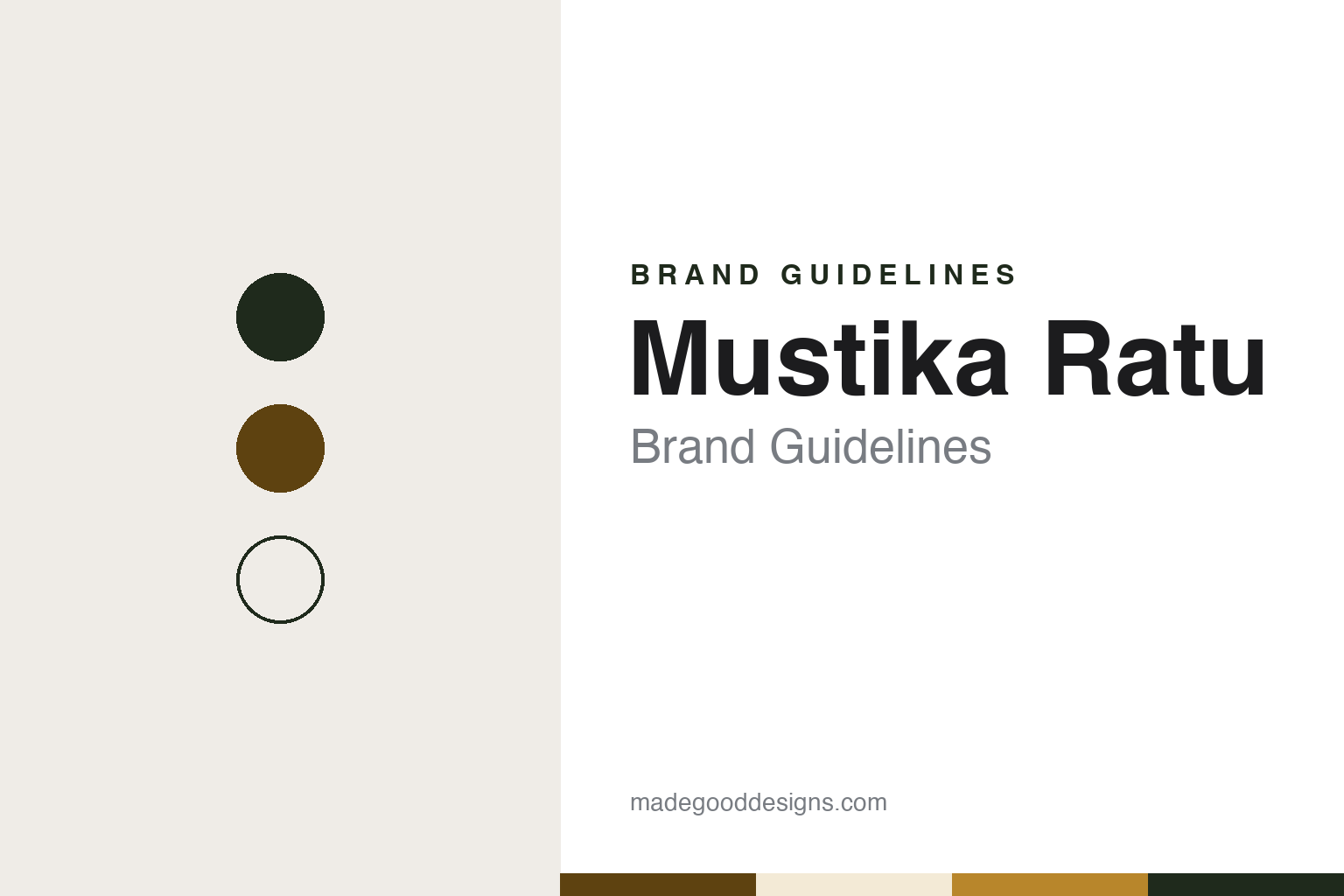
Mustika Ratu Brand Guidelines
A 1975 Jakarta garage jamu business turned listed beauty group.
Aa
Two constants: a Mustika Ratu turmeric gold and dark leaf palette and a Court serif register. Abstract homage — not a Mustika Ratu product or mark; no pack, logo or label is reproduced.
A garage in Jakarta
Jamu and cosmetics from home.
Mustika Ratu began as a home business in Jakarta. English Wikipedia says Mooryati Soedibyo started making cosmetics and jamu, the traditional Indonesian herbal drinks, in her garage in 1975, and that the company was formally established on 14 March 1978. Warta Ekonomi, in a May 2025 profile, described the garage operation as starting with two assistants, and said the founder at first delivered her jamu in person to friends, neighbours and acquaintances who asked for it.
The founder grew up in the palace of the Surakarta court in Central Java, English Wikipedia says, where her education included classical dance, batik and the preparation of traditional herbal mixtures and cosmetics. The same Warta Ekonomi profile traced the company name to a Javanese philosophical verse that contains the phrase “Mustika ning Ratu,” and described the business as growing from small orders into a wider range of beauty products.
Production moved out of the garage within a few years. English Wikipedia says the company began operating a factory at Ciracas, in East Jakarta, on 8 April 1981; Indonesian Wikipedia gives the same date and places the company’s head office in South Jakarta. Both articles describe the business as a maker of cosmetics and jamu rather than a retailer.
Colour
A listed company and a pageant.
PT Mustika Ratu Tbk was listed on the Indonesia Stock Exchange in 1995, and it trades under the code MRAT, English Wikipedia says. Citing the 2021 annual report, it gives the main shareholder as PT Mustika Ratu Investama, with about 71 per cent of the shares; Indonesian Wikipedia puts the public’s holding at about 23 per cent. The company’s own milestones, as summarised by English Wikipedia, add ISO 14001 and ISO 9002 certification in 1996, the spread of its products and spa franchise to South-east Asia and the Middle East in 2000, and further distribution to Canada, the United States, China, Iraq, New Zealand and Bulgaria in 2018. In 2021 it split its business into two divisions, one for beauty and body care and one for jamu and related products.
Its brand list is long. English Wikipedia names labels including Beauty Queen, Moor’s, Mustika Puteri and Bask; Indonesian Wikipedia groups the products into skin care, hair care, men’s care, teen care and make-up lines, with Bask as the men’s range and Mustika Puteri as the teen range, and includes body scrubs, hair tonics and olive and sandalwood oils sold under the Mustika Ratu name. Other names in the English infobox include Ratumas, Biocell, Jejamu and Zaitun, and its subsidiaries include Mustika Ratu (M) Sdn. Bhd. in Malaysia. The group also runs the Taman Sari Royal Heritage Spa and a training institute that carries its founder’s name, English Wikipedia says.
The company is closely tied to a beauty pageant. English Wikipedia says the founder acquired the licence for Puteri Indonesia in 1990, and that Yayasan Puteri Indonesia, the foundation that runs the contest, was formed in Surakarta on 8 March 1992. The contest has been held every year since 1992, Warta Ekonomi reported in 2025. English Wikipedia lists Mustika Ratu among the foundation’s affiliations and says the final is traditionally staged in Jakarta in March, so the pageant gives the brand a yearly public stage.
The link is visible in official records. On 21 April 2025, Indonesia’s food and drug agency, BPOM, received the 45 finalists of Puteri Indonesia 2025, from 34 provinces, at its Jakarta offices, according to the agency’s own news page. The finalists were accompanied by Mustika Ratu’s president director and by Kusuma Ida Anjani, a Mustika Ratu director who chaired that year’s Puteri Indonesia selection committee. BPOM said the finalists were briefed on cosmetics labelling and named as ambassadors for its public-information work, and it quoted the committee chair giving the 2025 theme as “brave and be right.”
Typography
Indonesian beauty and jamu.
Indonesian beauty and modest-fashion brands tend to present themselves through people, packaging and the places they sell, and only occasionally through a published identity manual. Logos and colour codes are rarely documented in the press, so a design reading has to rest on what companies show in public: the pack, the campaign, the ambassador and the corporate page that names founders and owners.
Halal statements are part of that picture, but companies publish them in different ways. Liputan6 reported in 2022 that Wardah received a halal certificate from the Majelis Ulama Indonesia in 1999, while Wardah’s founder told The Jakarta Post in 2019 that the brand did not put its certificates at the centre of its advertising. A marketing analyst quoted by the same paper linked the growth of halal cosmetics to the spread of the hijab as everyday fashion from around 2009, saying that fashion and cosmetics moved together.
Campaigns lean on familiar faces. Singers, racing drivers and other public figures appear as named ambassadors in dated launches, from a 2014 Wardah event in Jakarta reported by Fimela to a 2026 lip campaign shot in Dubai and Abu Dhabi, covered by Marketing-Interactive. Marketplace launches matter as much as shops: Monocle reported in 2025 that Paragon Corp sells through livestreams on TikTok, Shopee, Lazada and Tokopedia, and Sinar Harian reported that Emina’s 2022 Malaysian launch named Shopee, TikTok Shop and Watsons as its outlets.
Group ownership shapes the field. Paragon Corp, founded in 1985 and renamed in 2011, runs a family of brands for different ages and budgets, and older houses with roots in the jamu tradition sit alongside it with their own founders and corporate histories. Each guide in this series describes those owners plainly, dates every ambassador and launch, and treats colour and type as our own unofficial interpretation.
Aa
A court serif — a name taken from a Javanese verse. (Specimen set in Cormorant Garamond, a serif STAND-IN; NOT the Mustika Ratu logo.)
Mustika Ratu
New categories and a Japanese partner.
The company has added new categories in recent years. In April 2026 Warta Ekonomi reported that Mustika Ratu had entered the sunscreen category with a product called Multi Shield Serum Sunscreen, sold first through online and social-commerce channels; the report presented the launch as an extension of the body care and hair care lines the company had already built up.
It has also taken a Japanese partner. At its annual general meeting on 25 June 2026, held at Graha Mustika Ratu in Jakarta, the company described its joint venture with Sugi Holding Co., Ltd. of Japan, called PT Mustika Ratu Sugi, INDUSTRY.co.id reported; the company said its products had reached more than 40 countries. The same meeting confirmed Bingar Egidius Situmorang as president director. English Wikipedia places its factory in Ciracas and its head office in South Jakarta, and the June 2026 report described the company as a business built on Indonesian plant materials and local tradition, a description that comes from the company itself.
For a design guide, Mustika Ratu shows how a company can carry a Javanese court-heritage name and jamu traditions into a listed, multi-brand business with a pageant attached. Compare Sariayu, the Martha Tilaar group’s Jakarta beauty brand, which also began with jamu and herbal treatments, and Wardah, another Indonesian beauty brand. For this guide we use a turmeric gold and a dark leaf green with a serif, an unofficial interpretation; no product or logo is reproduced.
Explore & save
Keep Mustika Ratu’s identity on hand — save it to a board in the Made Good inspiration library.
Mustika Ratu identity set
Pin the Mustika Ratu turmeric gold and dark leaf palette and the Court serif register to your own board.
Source & notes
Frequently Asked Questions
What font can I use to match the Mustika Ratu look?
This guide describes Mustika Ratu’s type as “A court serif — a name taken from a Javanese verse”. Its type specimen is set in Cormorant Garamond from Google Fonts as a stand-in; Cormorant Garamond is not Mustika Ratu’s own lettering.
What colours are in the Mustika Ratu palette?
This guide’s Mustika Ratu palette is Turmeric gold #B8862B, Dark leaf #1F2A1C, Jamu brown #5E4210, Rice cream #F3EAD6 and Paper #FAF7F0. The tones are the guide’s own unofficial interpretation, not official Mustika Ratu hex codes.
When was Mustika Ratu founded?
Mustika Ratu was founded in 1975 (garage business); 1978 (company), in Jakarta, Indonesia.
Who founded Mustika Ratu?
Mustika Ratu was founded by Mooryati Soedibyo in 1975 (garage business); 1978 (company).
Where is Mustika Ratu made?
Mustika Ratu is made in Ciracas, East Jakarta (from 1981).