Bijou Brigitte Brand Guidelines
Hamburg’s fashion-jewellery chain since 1963.
Aa
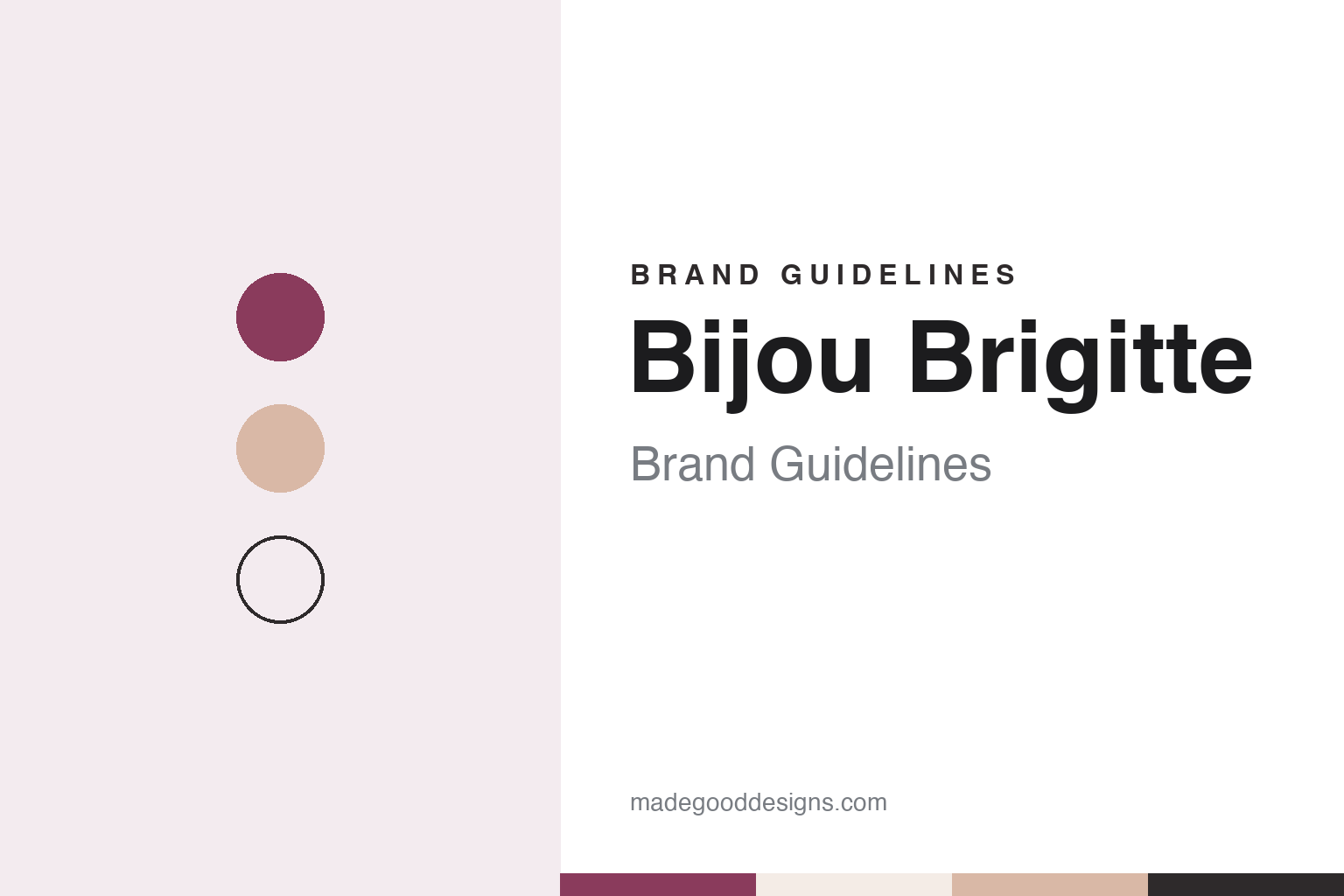
Two constants: a Bijou Brigitte berry, champagne and blush palette and a boutique sans register. Abstract homage — not a Bijou Brigitte product or mark; no jewellery, logo or shop sign is reproduced.
A Hamburg trader
From wholesale to a chain of shops.
Bijou Brigitte is a Hamburg company. Its corporate history says Friedrich-Wilhelm Werner founded the business in Hamburg in 1963 as an import and trading company for fashion jewellery, and that he had the name Bijou Brigitte entered in the commercial register in 1971. TextilWirtschaft, in an article of 16 July 2008, also dates his start in fashion jewellery to 1963, at first as a wholesaler.
The two accounts differ on the first shop. TextilWirtschaft wrote that Werner opened the first shop under the Bijou Brigitte name in Norderstedt, just north of Hamburg, in 1974, and that the chain of branches began in 1977. The company’s own timeline dates the start of its store network to 1977, with a first branch in the Hamburg district of Langenhorn, and says the head office moved to Hamburg-Poppenbüttel in 1979.
Growth then came through shares and borders. The company says it became a stock corporation, Bijou Brigitte modische Accessoires AG, in 1987, building a new production, warehouse and dispatch building the same year, and went public in 1988; its timeline then lists the first shops abroad, in Austria and the Netherlands, and a listing on the Frankfurt stock exchange in 1989, by which time it counted more than 100 shops. TextilWirtschaft likewise dated the move abroad to 1989. In 1997 Bijou Brigitte bought the competitor Rubin GmbH, which the company says had 40 branches in Germany. Spain and Poland followed in 1999, Hungary in 2000, Portugal and Italy in 2003, and France and Greece in 2005, according to the company timeline, which marks the opening of the 300th store in 2000 and the 1,000th in 2007. By the middle of 2008, TextilWirtschaft reported, the count had risen from 1,005 to 1,032 stores, with Sweden, Finland, Bulgaria and Slovakia named as the next planned markets; the company timeline records entry into Slovakia in 2009 and into Bulgaria and Romania in 2010.
Leadership passed to the next generation. TextilWirtschaft reported in July 2008 that the founder would leave the management board at the end of that year and had proposed his son Roland Werner, then seven years with the company and four on the board, as his successor; the company says Roland Werner took over as chief executive in 2009. The company also records that Friedrich-Wilhelm Werner received the Hamburger Gründerpreis for his life’s work in 2005, and it marked its 50th anniversary in 2013 and its 60th in 2023.
Colour
Thousands of pieces, several collections a year.
Bijou Brigitte sells fashion jewellery and accessories in volume. The company says its range runs to more than 9,000 articles and that its buying team develops several collections a year, from statement pieces to classics. German Wikipedia lists necklaces, bracelets, earrings, rings, watches and brooches, pieces in 925 sterling silver and stainless steel, and accessories such as bags, sunglasses, scarves and hair accessories, along with collections for men and children.
Several ideas came early. The company timeline says it introduced automatic replenishment of its stores in 1998 and in the same year presented Senso di Donna, a higher-quality jewellery collection. For its 40th anniversary in 2003 it cast a model as the face of Bijou Brigitte for the first time. A German online shop opened in 2006, the online shops were relaunched in 2016, and online shops for Italy and the Netherlands (2013), Spain (2017), France (2019) and Poland (2024) followed, the company says.
The shop remains the centre of the business, now joined by concessions. The company says it introduced concessions in Germany in 2008, selling its jewellery on partners’ sales floors, and took the format abroad in 2010. It now reports almost 600 concession locations in Germany and abroad and says its jewellery is available at nearly 1,500 points of sale in total. A loyalty programme, BB Club, began in 2019, and a Bijou Brigitte foundation has brought together the company’s social commitments since 2010.
Typography
Shop signs, salons and own labels.
Jewellery and accessories chains sell through the shop itself as much as through any advertising, so the sign over the door, the colour of the shopfront and the way a window is arranged carry most of the identity. Histoire d’Or, the French chain, is one example: its parent company, THOM, says its stores use an open front, a single identity colour, red, and a layout meant to help customers choose a gift.
The formats in this guide run from watch and fine-jewellery boutiques to mall shops and fashion-accessories stores. Bucherer, in Lucerne, sells many watch and jewellery brands alongside its own fine jewellery, which Luxury London reported in December 2025 is designed and made in an atelier at its headquarters. At the other end of the range are chains selling fashion jewellery and accessories from small units and department-store corners, a format that France’s competition authority described in June 2021 when it reviewed the takeover of the Agatha brand’s 32 boutiques and 40 corners.
Ownership varies as widely as format. Some of the chains covered here in Switzerland, France, the Netherlands, England, Spain, Poland, Germany, Australia and the United States are family businesses, some are listed on a stock exchange, and some belong to private-equity funds or to larger groups. Bucherer was family-owned from 1888 until Rolex bought it in a deal announced in August 2023, while Histoire d’Or has passed between investment funds since the merger that created THOM.
Each guide sets out what can be checked: who founded the chain and when, who owns it now, which own-label collections and services the company names, and how it presents its founders and owners on its corporate pages. Where a fact rests only on the company’s own word, the guide says so.
Aa
A boutique sans for a high-street jewellery chain. (Specimen set in Montserrat, a sans STAND-IN; NOT the Bijou Brigitte logo.)
Bijou Brigitte
Listed, family-led and counted in stores.
Bijou Brigitte remains a listed company led by the founder’s son. Its investor-relations pages list the bearer shares on the regulated market in Frankfurt, in the General Standard segment, and on the regulated market in Hamburg, with Roland Werner as chairman of the management board. The trade press follows the store count closely: retail-news.de wrote on 9 January 2026 that the company operated 904 stores at the end of 2025, nine fewer than a year earlier, mainly because a franchise partner consolidated its locations, and FashionUnited reported on 6 October 2026 that the count stood at 904 at the end of September 2026, unchanged since the start of the year, with the company expecting a slightly higher figure by the year’s end. The company’s list of current markets runs from Germany, Austria and the Netherlands to Portugal, Greece, Bulgaria and Romania, and includes Saudi Arabia and Kosovo, which it marks as new in 2025.
For a design guide, Bijou Brigitte shows how a chain selling thousands of small, fast-changing pieces can hold one name steady across six decades of shopfronts, concessions and online shops. Compare Lovisa and Claire’s, two other fashion-jewellery and accessories chains. For this guide we use a berry rose, champagne and blush with a sans, an unofficial interpretation; no product or logo is reproduced.
Explore & save
Keep Bijou Brigitte’s identity on hand — save it to a board in the Made Good inspiration library.
Bijou Brigitte identity set
Pin the Bijou Brigitte berry, champagne and blush palette and the boutique sans register to your own board.
Source & notes
Frequently Asked Questions
What font can I use to match the Bijou Brigitte look?
This guide describes Bijou Brigitte’s type as “A boutique sans for a high-street jewellery chain”. Its type specimen is set in Montserrat from Google Fonts as a stand-in; Montserrat is not Bijou Brigitte’s own lettering.
What colours are in the Bijou Brigitte palette?
This guide’s Bijou Brigitte palette is Berry rose #8A3B5C, Charcoal #2E2A2B, Champagne #D9B8A6, Blush #F4ECE6 and Paper #FBF8F6. The tones are the guide’s own unofficial interpretation, not official Bijou Brigitte hex codes.
When was Bijou Brigitte founded?
Bijou Brigitte was founded in 1963, in Hamburg, Germany. Bijou Brigitte is known for Fashion jewellery and accessories.
Who founded Bijou Brigitte?
Bijou Brigitte was founded by Friedrich-Wilhelm Werner in 1963. Bijou Brigitte is known for Fashion jewellery and accessories.