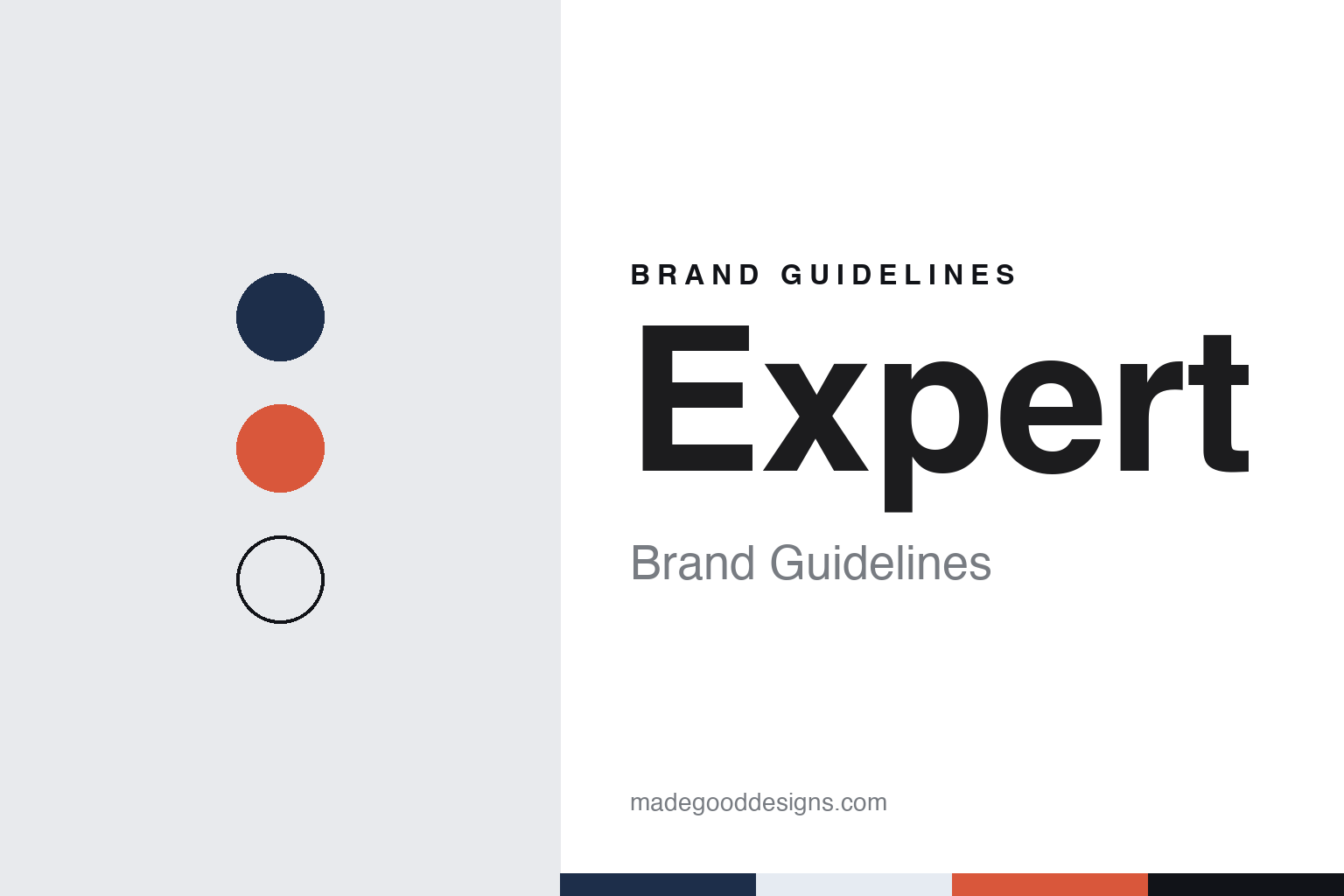
Expert Brand Guidelines
The 1967 alliance of independent electronics retailers.
Aa
Two constants: a navy, mist and coral palette and a shared-sign sans register. Abstract homage — not an Expert sign, product or mark; no logo is reproduced.
Intercop, 1967
Six national buying groups in Zurich.
Expert is not a single retailer but an alliance of independent electronics retailers that share a name. Its central company, Expert International GmbH, was founded in Zurich on 16 October 1967 as Intercop GmbH by six national buying organisations, German Wikipedia says. English Wikipedia names the initiator as Gunnar Nygren, who represented Samex, a Swedish association of radio and television retailers, alongside representatives of five other national retail organisations; the group’s own site also names Nygren as its founder.
The company was renamed Expert International GmbH on 30 March 1971, according to German Wikipedia, and the group dates the Expert brand itself to 1971. As retailers from more countries joined, the Expert trademark was registered internationally, English Wikipedia says. In 1999 the group formed Expert Global after signing a letter of intent with Associated Volume Buyers of the United States and Cantrex of Canada; that collaboration later ended. The head office is now in Zug, and the group says a small international team works from Zug and from Zagreb in Croatia.
Some of the national organisations behind the name have their own long histories. In Austria, German Wikipedia says, electronics retailers formed a purchasing cooperative in 1958 and joined the international Expert group in 1976 as EXPERT Österreich e.Gen.; it counts more than 170 member companies running more than 180 shops there. In Germany the national company is expert SE, based in Langenhagen near Hanover, which marked its 60th anniversary in 2022, the international group’s site notes.
Colour
Owned by its member countries.
Expert International describes itself as a retail alliance that supports retailers of consumer electronics and household appliances, and says it is owned by the countries in the group, whose representatives sit on its supervisory board. The group says it owns the Expert trademark, develops and defends it, and provides retail services to the member countries. Its home page sets out three principles — “Always add value,” “In it together” and “Today towards the future” — and says it helps members deliver electronics, appliances and related services to consumers. In December 2024 it announced that the supervisory board had elected Stefan Müller, chief executive of expert SE in Germany, as its president.
The name on the shop sign varies by country. German Wikipedia notes that the group writes its own name in lower case, as expert. Some members trade as Expert; others keep their own banners. The group’s country finder lists Expert Italy in Milan, a Greek member trading as Expert Hellas, Komputronik in Poland and Digitec Galaxus in Switzerland. In January 2024 the group announced a partnership with Technodom of Kazakhstan, starting on 1 January 2024, and another with Comfy in Ukraine.
In Germany, a July 2024 announcement published on the Hannover city portal described expert SE as a buying group for consumer electronics, IT, telecoms, entertainment and household appliances, with 194 member companies running 399 stores across the country. The same announcement said that expert and Euronics, the two German buying groups, would move their joint trade and order fair, KOOP, to the Hanover exhibition grounds from 2026.
Italy shows how membership can change. The Forlì retailer SGM Distribuzione joined the Expert group in 2000 and from 2001 traded as Marco Polo-Expert, Unieuro’s corporate history says; after buying the Unieuro chain it dropped that banner and left the Expert consortium in 2014. In 2019 Unieuro bought twelve Sicilian stores from Pistone, which Italian Wikipedia describes as one of the main members of the Expert buying group in Italy.
Typography
Design and documentation.
The consumer-electronics chains of France, Poland, the Czech Republic, Romania and Greece sell many of the same televisions, phones, laptops and washing machines, so their identities do much of the work of telling them apart. The shop sign, the logo and the colour scheme are the parts each company controls and publishes itself, on its corporate site, its store fronts and its online shop, and they are the starting point for this series.
Store formats vary from chain to chain. The companies in this series describe formats ranging from large out-of-town stores to smaller shops in city centres and shopping centres, alongside their online shops. Some run every store themselves; others mix directly run stores with affiliated stores owned by independent retailers.
Ownership shapes each brand as well. Some chains are listed companies, some belong to larger retail groups that run several banners, and others are independent retailers joined together in buying associations such as Expert, founded in 1967, whose members trade either under the shared name or under their own banners.
Corporate pages add their own layer: histories of founders and owners, own-label ranges, loyalty schemes and advertising claims, each presented in the company’s own words. In the guides that follow, those claims are attributed to the companies that make them, and the colours and typefaces shown are our own unofficial interpretation rather than any chain’s official specification.
Aa
A plain sans for a name shared by many owners. (Specimen set in Barlow, a sans STAND-IN; NOT the Expert logo.)
Expert
A name shared across more than 20 countries.
The alliance has grown by adding members rather than by opening stores of its own. The Spanish trade journal Alimarket reported on 1 February 2016 that two new licensees had joined in 2015 — the Polish IT retailer Komputronik and the Swiss chain Melectronics, part of the Migros group — and that the Expert brand was then present in 20 countries with more than 3,500 specialist stores. The group’s managing director at the time told the journal that the aim was to move from a buying association to a multichannel retailer built on service and advice, and that organic growth, rather than new countries, was the priority for 2016.
The counts have moved since then, and sources give different figures. English Wikipedia gives more than 5,000 affiliated stores in 20 countries and lists the former Nordic business, now Power International, among past operations. The July 2024 Hannover announcement put the brand at more than 4,000 locations in 22 countries. Expert International’s own site gives 1967 as its year of origin and more than 42,000 people across the group, and its pages give 22 or 23 countries; its country finder includes Austria, Belgium, Croatia, the Czech Republic, Greece, Ireland, Portugal and Spain among others.
For a design guide, Expert shows how one shared name can sit above many independent owners, each with its own shops and sometimes its own banner. Compare Euronics, another European buying group of electronics retailers, and Komputronik, which joined the Expert group in Poland in 2015. For this guide we use a deep navy, ink and a coral with a sans, an unofficial interpretation; no product or logo is reproduced.
Explore & save
Keep Expert’s identity on hand — save it to a board in the Made Good inspiration library.
Expert identity set
Pin the Expert navy, mist and coral palette and the shared-sign sans register to your own board.
Source & notes
Frequently Asked Questions
What font can I use to match the Expert look?
This guide describes Expert’s type as “A plain sans for a name shared by many owners”. Its type specimen is set in Barlow from Google Fonts as a stand-in; Barlow is not Expert’s own lettering.
What colours are in the Expert palette?
This guide’s Expert palette is Alpine navy #1D2E4A, Ink #111318, Mist #E6EBF2, Signal coral #D9573B and Paper #F8F9FB. The tones are the guide’s own unofficial interpretation, not official Expert hex codes.
When was Expert founded?
Expert was founded on 16 October 1967 (as Intercop GmbH), in Zurich, Switzerland.