Flanco Brand Guidelines
Florin Andronescu’s Romanian electronics chain.
Aa
Two constants: a Flanco teal, amber and cream palette and a Rounded sans register. Abstract homage — not a Flanco product or mark; no sign, logo or shopfront is reproduced.
Florin Andronescu Company
A founder’s initials over a shop door.
Flanco is a Romanian chain of electronics and home-appliance shops whose name comes from its founder. Revista Biz reported in September 2012 that Florin Andronescu opened the first Flanco shop for electronics and appliances in Bucharest in the early 1990s, and that the name is an acronym of Florin Andronescu Company. English Wikipedia dates the first store to 1994 and describes Flanco as the first Romanian electronics and home-appliance retail chain.
Investment funds paid for the national roll-out. English Wikipedia says Oresa Ventures and the Danube Fund invested in 1996, that Oresa later bought a majority shareholding, and that the chain had 50 stores by 1999. Revista Biz adds that Oresa, through a company called Flanco Holding, was a shareholder of Flanco International by 2003, and that with these partners the business grew into a national chain before it was sold to the IT retailer Flamingo. Flanco became a subsidiary of Flamingo International, a company listed on the Bucharest Stock Exchange, in 2005 according to Revista Biz, which put the combined network at 97 stores; English Wikipedia dates the takeover to 2006.
By the middle of the decade Flanco was one of the names that defined the market. Ziarul Financiar listed it in July 2004 among the main Romanian competitors of the Altex chain, alongside Cosmo and Domo, with international retailers such as Metro and Carrefour also selling electronics in the country.
Colour
Insolvency, a new owner and two repositionings.
The Flamingo years ended in insolvency. Revista Biz reported that between 2006 and 2008 the Flamingo group expanded its network, and that in December 2009, during the economic crisis, it had to enter reorganisation; Flanco was reorganised entirely separately from Flamingo, under a manager who had joined the company in 2003, and the process was completed within ten months of the insolvency filing. Ziarul Financiar reported on 25 August 2010 that the three banks that had lent to the chain, ING, UniCredit Țiriac and BRD, had approved the reorganisation plan of the insolvent Flanco International, taking bankruptcy off the table for the time being, and that the court-appointed administrator, Casa de Insolvență Transilvania, said the banks were in talks with two possible investors.
The investor was Iulian Stanciu. English Wikipedia says the Asesoft group bought a 60 percent stake in September 2010; Revista Biz says Stanciu’s arrival as a shareholder that month marked the end of the reorganisation, and that he became the sole shareholder in August 2012. At that point the chain had about 31,000 square metres of selling space and 500 staff, the magazine reported; by September 2012 it had 78 stores and 43,000 square metres. In October 2011 Flanco opened a new store concept in Bucharest’s Unirea Shopping Center, in which products on display are kept switched on so that customers can try them, and took it to Sibiu, Cluj and Iași in the first half of 2012. The same article credits Flanco and the online retailer eMAG with launching Black Friday in Romania in November 2011, and lists an all-inclusive warranty and 30-day returns among the policies the company introduced.
The brand has been repositioned twice since. In March 2021, Revista Biz reported, Flanco finished a repositioning built around the idea that customers could afford quality rather than chase the lowest price, with a campaign by the creative agency Friends\TBWA; the company then said it had 156 stores in 116 towns. English Wikipedia says Flanco opened its largest store, in Ploiești, the same year. In April 2024, gadget.ro reported, Flanco announced that it was renaming itself Flanco Smart Discounter, which it called the first electro-IT smart discounter in Romania, starting with a refitted store in Bucharest’s AFI Cotroceni on 12 April, with ten more stores that year, 70 in 2025 and the rest in 2026, along with weekend and one-day discounts and weekly catalogues.
Typography
How the region’s chains present themselves.
The consumer-electronics chains of France, Poland, the Czech Republic, Romania and Greece sell many of the same televisions, phones, laptops and washing machines, so their identities do much of the work of telling them apart. The shop sign, the logo and the colour scheme are the parts each company controls and publishes itself, on its corporate site, its store fronts and its online shop, and they are the starting point for this series.
Store formats vary from chain to chain. The companies in this series describe formats ranging from large out-of-town stores to smaller shops in city centres and shopping centres, alongside their online shops. Some run every store themselves; others mix directly run stores with affiliated stores owned by independent retailers.
Ownership shapes each brand as well. Some chains are listed companies, some belong to larger retail groups that run several banners, and others are independent retailers joined together in buying associations such as Expert, founded in 1967, whose members trade either under the shared name or under their own banners.
Corporate pages add their own layer: histories of founders and owners, own-label ranges, loyalty schemes and advertising claims, each presented in the company’s own words. In the guides that follow, those claims are attributed to the companies that make them, and the colours and typefaces shown are our own unofficial interpretation rather than any chain’s official specification.
Aa
A friendly rounded sans for a chain of shop signs. (Specimen set in Rubik, a sans STAND-IN; NOT the Flanco logo.)
Flanco
An agreed sale to a Greek group.
Flanco is now set for new ownership. On 3 November 2026 the Greek energy group PPC announced that its subsidiary Kotsovolos had signed an agreement to buy all of Flanco Retail S.A. from Iulian Stanciu, who held 98 percent, and the chief executive Dragoș Sîrbu, who held 2 percent, according to the announcement as published by Revista Biz and Financial Intelligence. The deal was agreed in November 2026 and was not completed at the time of writing: completion was expected by the end of 2026, subject to approvals from the regulators, including Romania’s Competition Council.
The announcement described Flanco as having 150 stores in more than 100 Romanian towns, nearly 60,000 square metres of selling space and more than 1,200 staff, and called it the second-largest network of physical stores in the country. PPC said Flanco would keep developing its IT&C and appliance retail business, while its shops and logistics would also serve as a last-mile platform for the group, and that PPC Romania planned to promote residential solar systems, heat pumps and electric-vehicle chargers through Flanco stores, following the model it runs with Kotsovolos in Greece. Stanciu said in the announcement that he had taken over Flanco fifteen years earlier, at a difficult moment for the company and the market.
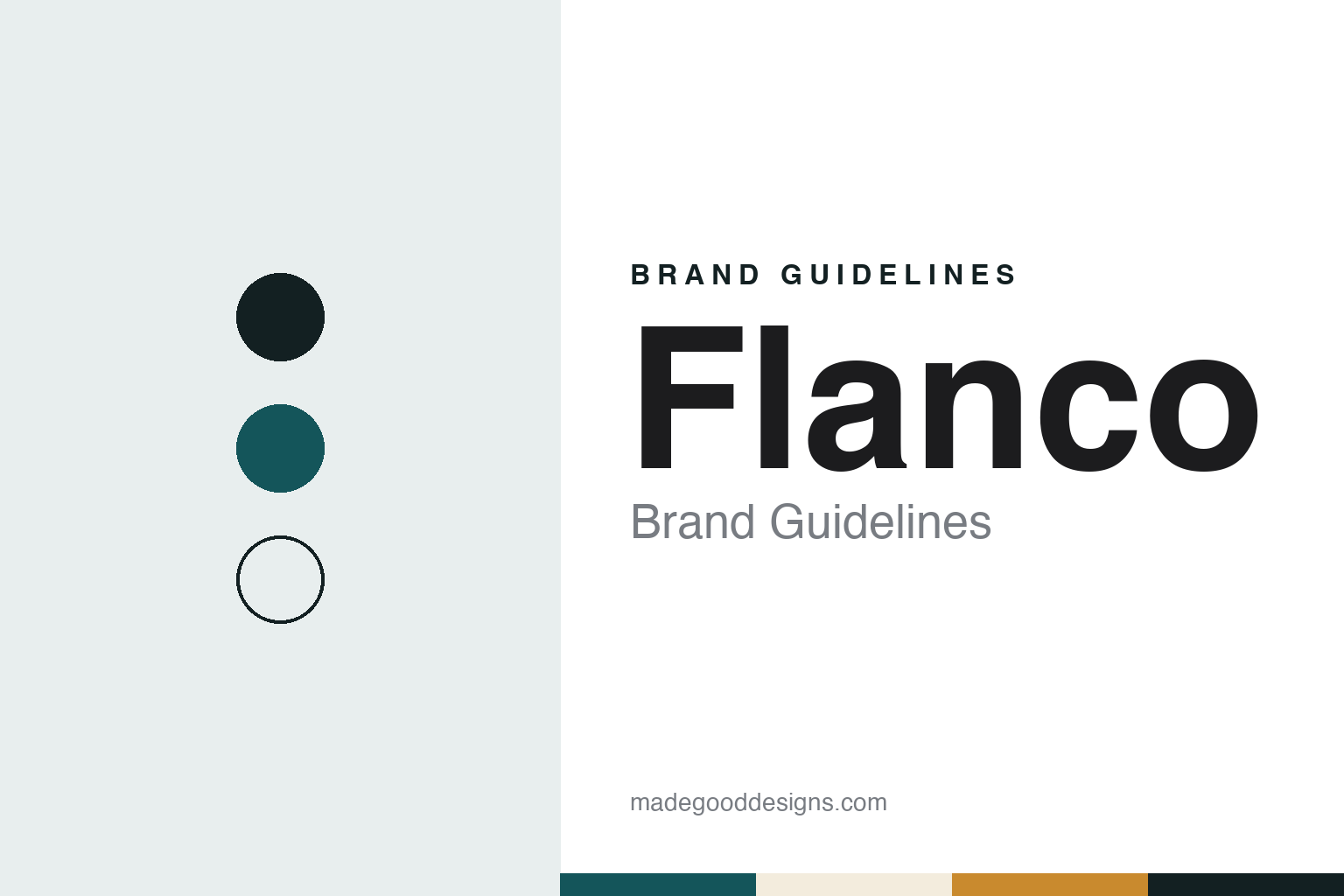
For a design guide, Flanco shows how a name built from its founder’s initials has carried through a change of owners, an insolvency and two repositionings, and is now set to join a Greek group. Compare Kotsovolos, the agreed buyer, and Altex, the Romanian chain Ziarul Financiar listed alongside it in 2004. For this guide we use a deep teal, a warm amber and a soft cream with a sans, an unofficial interpretation; no product or logo is reproduced.
Explore & save
Keep Flanco’s identity on hand — save it to a board in the Made Good inspiration library.
Flanco identity set
Pin the Flanco teal, amber and cream palette and the Rounded sans register to your own board.
Source & notes
Frequently Asked Questions
What font can I use to match the Flanco look?
This guide describes Flanco’s type as “A friendly rounded sans for a chain of shop signs”. Its type specimen is set in Rubik from Google Fonts as a stand-in; Rubik is not Flanco’s own lettering.
What colours are in the Flanco palette?
This guide’s Flanco palette is Deep teal #14555A, Night #132022, Soft cream #F3ECDD, Warm amber #C98A2E and Paper #FBF8F2. The tones are the guide’s own unofficial interpretation, not official Flanco hex codes.
When was Flanco founded?
Flanco was founded in 1994 (first store), in Bucharest, Romania.
Who founded Flanco?
Flanco was founded by Florin Andronescu in 1994 (first store).
What does the name Flanco mean?
According to this guide, the name Flanco comes from Florin Andronescu Company.