Pipoos Brand Guidelines
The Dutch hobby chain inside Sweden’s Panduro group.
Aa
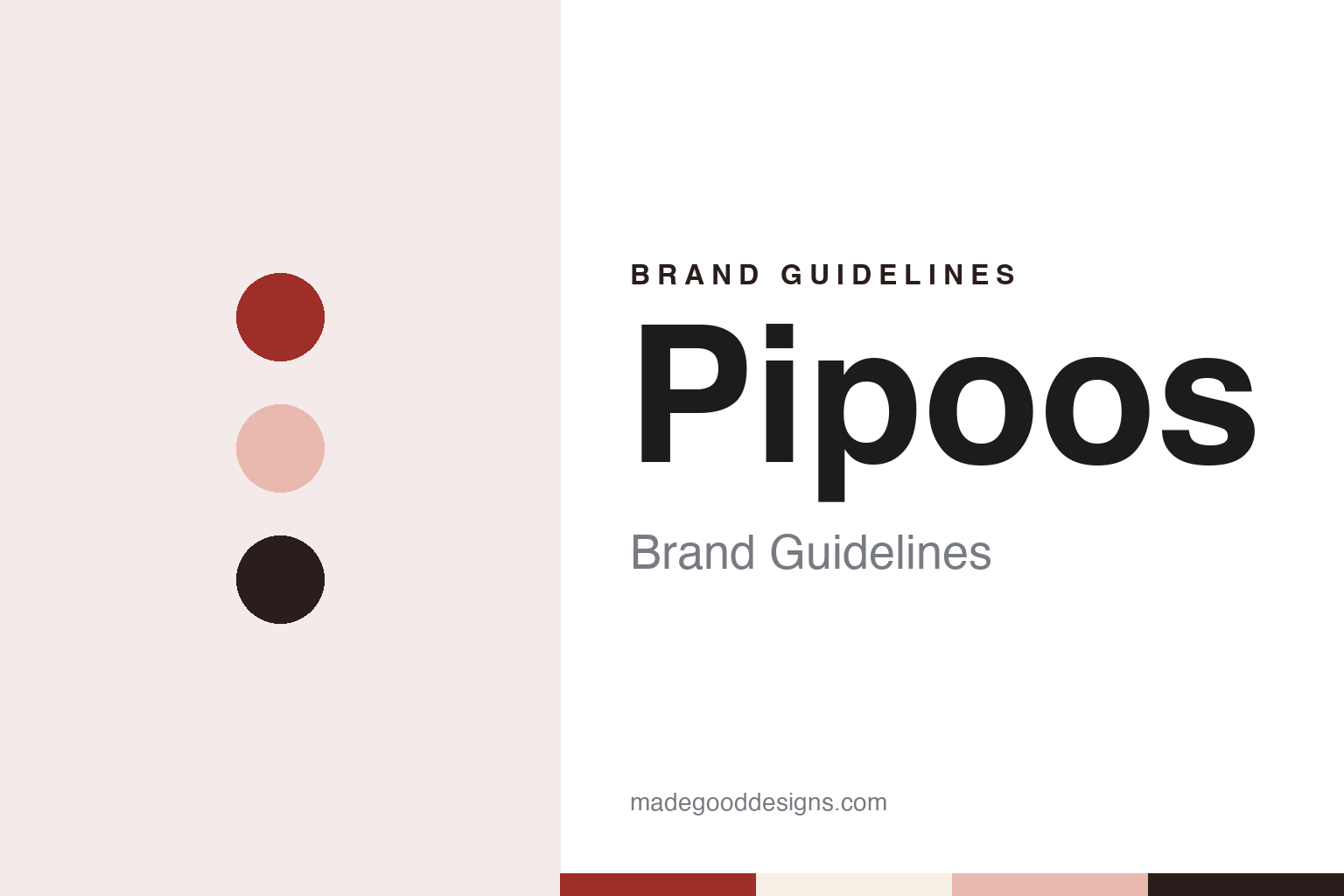
Two constants: a craft red, cream and pink palette and a rounded sans register. Abstract homage — not a Pipoos product or mark; no shop sign, logo or pack is reproduced.
A Dutch hobby chain
Thirty-odd shops and a warehouse in Drunen.
Pipoos is a chain of hobby and craft shops in the Netherlands and Belgium. On its own website the company says it has been active since 1992, and describes itself as having been, for more than 30 years, the largest chain of hobby-supply shops in the two countries. That ranking is the company’s own description. In November 2026 the banner across the Pipoos website counted 36 shops in the Netherlands and Belgium.
The shop list on the same site stretches from Groningen, Leeuwarden and Assen in the north to Maastricht in the south, with branches in city centres such as Utrecht, Rotterdam, Haarlem, Nijmegen and Zwolle. The Belgian shops listed are in Antwerpen, Gent, Sint-Niklaas and Wijnegem. The head office and the warehouse, which is closed to visitors, are listed at Drunen, and the copyright line of the website names the operating company as Popov BV.
Pipoos explains its purpose in plain terms. Making things by hand, the company writes, feels good and stimulates creativity, and it presents its shops as a place for anyone who wants a creative way to spend free time: on their own or with children, as an amateur or as a professional. Its website organises that offer under headings for drawing and painting, needlework, crafting with children, and parties and baking, with a separate section for basic materials such as paper, card, wire, glue and casting materials.
The chain has also been covered by the Dutch retail trade press. In April 2017 RetailTrends, summarising its sister title RetailWatching, reported that the managing director of Pipoos, Wouter de Keizer, saw a strong countertrend to digital pastimes, and that the hobby chain, after some modest years, was putting itself back in the spotlight by expanding and moving shops to prime high-street locations.
Colour
More than 8,000 articles, many from Panduro.
The range is the core of the brand. Pipoos says it stocks more than 8,000 articles and that the selection is renewed continuously to follow new hobby trends. The hobby pages on its website run from jewellery making, clay and candle and soap making to ironing beads, paper crafts, miniatures and model building and the hobby horse.
A large part of that range comes from the parent company. Pipoos says that its Swedish owner, Panduro, develops much of its assortment under its own brand name, and that a broad selection of these products is sold in the Pipoos shops and online. The company presents that Panduro range as what sets Pipoos apart as a hobby shop, giving it a range it calls exclusive. Panduro-branded goods, such as a Panduro sketchbook, sit alongside other makers’ products in the online shop.
The chain also sells themed ranges under names it does not own. One section of the website is given to Het Muizenhuis, with miniature objects and books for knitting, crochet and search-and-find play sold under that name.
Instructions are a large part of how Pipoos presents itself. The company says that almost all the craft projects on its website come with a description of the work and a list of what is needed, and that staff in its shops give advice. The site carries pages of project ideas for seasonal moments such as Sinterklaas and Christmas, and a section for creations shared by customers under the tag #pipooscreatives.
Pipoos also publishes a short sustainability page. It says that Panduro carried out a materiality analysis using the United Nations Sustainable Development Goals to identify its sustainability risks and opportunities, that a sustainability strategy based on that analysis will guide the company over the coming years, and that Panduro’s sustainability report, written in English, covers climate, materials and human rights.
Typography
Signs, stores and catalogues.
Art-supply retail chains sell materials made by other companies, so much of their identity lives in the shop itself: the sign over the door, the name on the carrier bag, the catalogue cover and the colours of a website. The chains in this guide come from Germany, the United Kingdom, France, the United States, Canada and Singapore, and each presents that identity in its own way, often in a name its founders or owners chose decades ago.
Store formats vary widely. Some chains run large stores on the edge of town; German Wikipedia gives the average sales area of a Boesner branch as about 3,000 square metres. Others keep compact shops in city centres or near art schools, and several run both, alongside web shops that now carry most of their range.
Print still matters in this trade. Gerstaecker, which began in Eitorf in 1953, built its business on a mail-order catalogue that the company says took its present form in 1982, and Boesner publishes its own catalogue and customer magazines. Chains also name their own-label ranges and services, such as framing workshops, and many describe courses, demonstrations and workshops held in their stores; where this guide repeats such descriptions, they are given as the companies’ own words.
Corporate pages tell the rest of the story: who founded each chain, who owns it now and how it grew, through new stores, sister chains abroad or changes of owner. This guide sets out what can be checked about each company, separates documented facts from what the company says about itself, and states plainly where a chain has changed hands or closed.
Aa
A rounded sans for a craft-shop register. (Specimen set in Nunito, a rounded sans STAND-IN; NOT the Pipoos logo.)
Pipoos
A Dutch chain inside a Swedish group.
Pipoos is not independent. The company says it is part of the Swedish hobby retailer Panduro, whose shops it describes as found throughout Scandinavia. Panduro itself changed hands in 2022. On 20 October 2022 Sweden’s competition authority, Konkurrensverket, cleared without action the acquisition of sole control of Panduro Förvaltning AB by Lekolar Group AB, a supplier of educational and creative materials to schools and preschools in the Nordic countries. The authority’s decision describes Lekolar as a portfolio company owned by Nalka Invest, part of the Interogo group, and Panduro as a business that sells mainly through its own shops, with some online sales to consumers and some wholesale to companies.
The same decision notes that in Sweden Panduro also runs Kreatima, a subsidiary selling artists’ materials online and through its own shops in Stockholm and Göteborg. In a release dated 1 November 2022, Lekolar said it had completed the acquisition, first announced on 11 August 2022, after the usual review by competition authorities, and that Panduro would continue to be run as an independent business under its chief executive, Rickard Kemfors, with a shop network spanning Sweden, Denmark, Norway, the Netherlands and Belgium.
For a design guide, Pipoos shows how a national hobby chain can sit inside a foreign group while keeping its own name, shop list and voice on the high street. Compare Hobbycraft, a craft chain in the United Kingdom, and Cultura, a French creative-leisure and culture retailer. For this guide we use a craft red with cream, a soft pink and a deep ink with a rounded sans, an unofficial interpretation; no product or logo is reproduced.
Explore & save
Keep Pipoos’s identity on hand — save it to a board in the Made Good inspiration library.
Pipoos identity set
Pin the Pipoos craft red, cream and pink palette and the rounded sans register to your own board.
Source & notes
Frequently Asked Questions
What font can I use to match the Pipoos look?
This guide describes Pipoos’ type as “A rounded sans for a craft-shop register”. Its type specimen is set in Nunito from Google Fonts as a stand-in; Nunito is not Pipoos’ own lettering.
What colours are in the Pipoos palette?
This guide’s Pipoos palette is Craft red #9E2F28, Deep ink #2A1E1C, Paper cream #F6EFE6, Petal pink #E9B9B0 and Thread grey #6E6460. The tones are the guide’s own unofficial interpretation, not official Pipoos hex codes.
Who owns Pipoos?
Pipoos is owned by Panduro, Sweden (part of Lekolar Group since 2022).