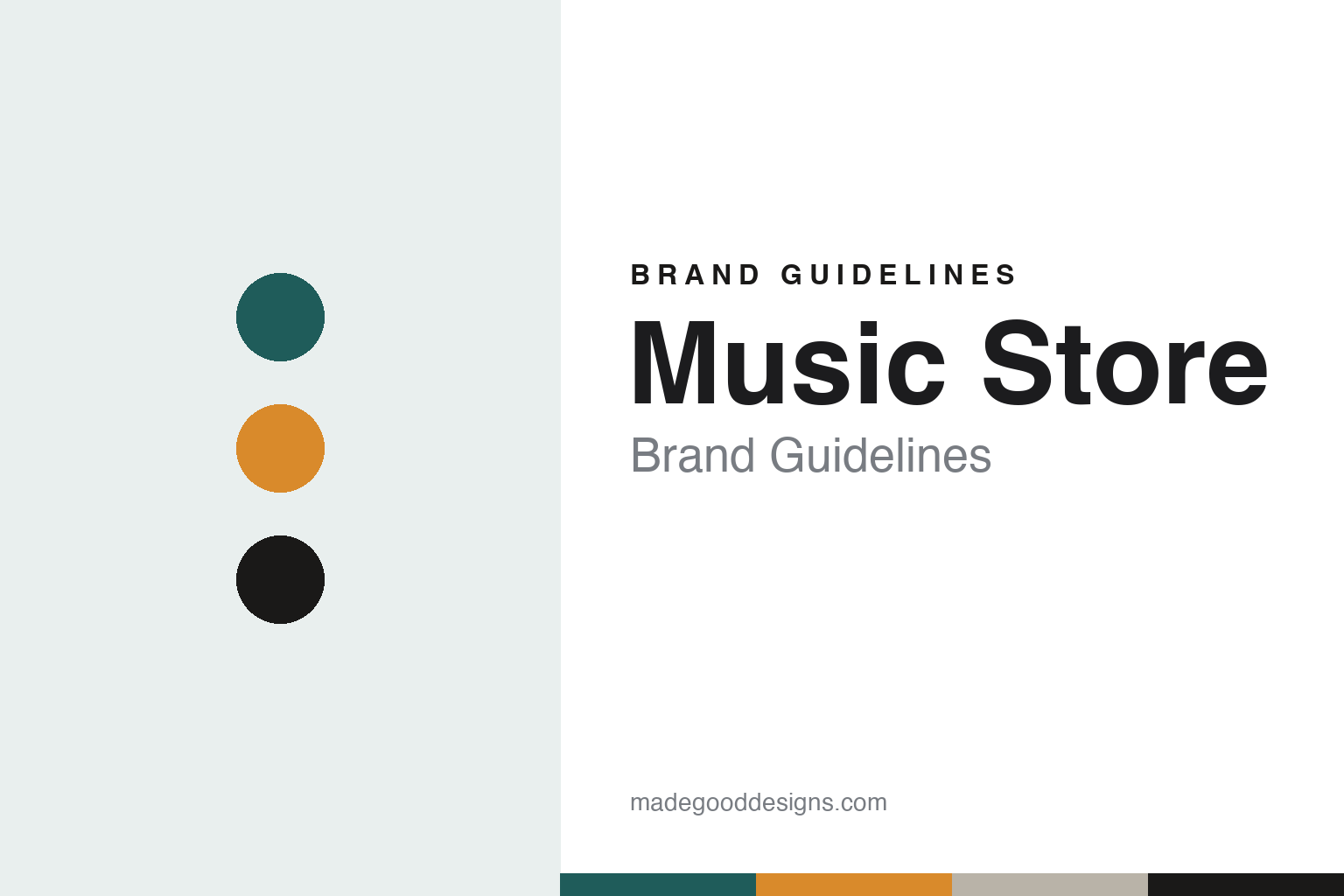
Music Store Brand Guidelines
A Cologne music store that became a campus for instruments, stage and studio.
Aa
Two constants: a Rhine teal, amp amber and warm ink palette and a stage-sign condensed sans register. Abstract homage — not a Music Store product or mark; no sign, logo or instrument is reproduced.
From Farfisa to the city centre
An organ business, a Cologne shop and a family name.
Music Store trades as MUSIC STORE professional GmbH, a specialist retailer of musical instruments and stage, studio and DJ equipment with its head office in Köln-Kalk, on the right bank of the Rhine in Cologne. German Wikipedia dates the business to 1972, the year in which Arthur Sauer became managing director at Farfisa, the electronic-organ brand. The Music Store Köln opened that year, and shops followed in Bensberg, Gummersbach, Neumünster, Heide and Husum; all of those branches except Gummersbach were soon closed again, the encyclopedia says.
In the 1980s the store moved from Bonner Straße to the centre of Cologne. In 1983 Farfisa was sold and Michael Sauer took over the management of Music Store, according to German Wikipedia. From the late 1980s the company took over further shop units and a multi-storey car park on the Große Budengasse to enlarge its sales floor. In 1992 it founded the Music Store Rock School, which, the encyclopedia says, still offers band coaching and tuition on band instruments.
Logistics moved several times as the mail-order side grew. A central warehouse at Cologne’s Rheinauhafen allowed faster dispatch in the 1990s. When the store turned 25 in 1997 it had 4,000 square metres of floor space, and German Wikipedia counts it at that time among the three largest music shops in Germany. The Rheinauhafen buildings were demolished in 2001, and the warehouse moved at short notice into the former Farfisa building in Brombach, part of Overath, east of Cologne. In 2003 it moved again, to the Großmarkt Köln, the city’s wholesale market, from which most goods were then shipped.
Colour
A Kalk campus, a wide range and own brands.
In May 2011 Music Store opened its new head office on Istanbulstraße in Kalk. German Wikipedia gives the site a total area of 40,000 square metres and a floor area of 25,000 square metres, leaving room for future development. The same building is the address given for the company by the German Music Information Centre (MIZ) and in the imprint of the company’s Fame guitar website.
The range is broad. The MIZ, in an entry last updated in May 2023, lists wind instruments, drums, string instruments, guitars and basses and keyboards, along with sheet music and music books, PA and audio equipment, DJ gear, lighting and music software, and names a repair workshop among the company’s services. It classes Music Store as both an online and a bricks-and-mortar specialist music retailer.
Music Store also develops and sells products under its own names. German Wikipedia lists several own brands, among them Fame, for electric guitars and basses, amplifiers, effects, audio equipment, drums and percussion; Jack&Danny, for electric guitars and basses; Almeria, for acoustic guitars; and Lightmaxx, for lighting. The Fame website is published by MUSIC STORE professional GmbH, its imprint shows, with Michael Sauer named as managing director.
One of these names was bought rather than built. After the organ and keyboard maker Wersi went into insolvency, German Wikipedia says, Music Store acquired its trademark and property rights. Development, production and service for Wersi take place in Hohentengen, the encyclopedia says, while Wersi keyboards are made by the Chinese supplier Medeli.
Typography
Signs, stores and services.
Musical-instrument retailers present themselves through a small set of public elements: a shop sign and logo, a colour scheme carried from the storefront to the web shop and the delivery box, and the words they use for their stores and services. This series looks at chains and single large stores in Germany, France, the United Kingdom, Slovakia, Canada, Japan, Hong Kong and Singapore, and describes each identity only as the company publishes it or as a dated source records it. Where a company does not publish its colours or typefaces, the palette in each guide is an unofficial interpretation.
Store formats differ widely. Some retailers run one very large store beside a central warehouse: German sources describe Music Store in Cologne and Musikhaus Kirstein in Schongau this way, each with a single store and a large logistics site. Others run chains of city shops across a country or a region, and the guide for each company sets out its own store count only as a dated source gives it.
Services sit alongside the sales floor. Some of these companies describe music schools, lessons or repair workshops as services they offer; Music Store founded its Rock School in 1992, German Wikipedia says, and lists a repair workshop among its services. Events play a part too: Musikhaus Kirstein has held its own house fair, MusiConnect, since its 30th anniversary in 2017.
Online shops now sit next to physical stores, and corporate pages tell the story of founders and owners, from a musician opening a small shop to a second generation joining the management. Each guide that follows separates what the company says about itself from what independent, dated sources document, and names those sources at the end.
Aa
A tall condensed sans in the manner of stage signs and flight-case stencils. (Specimen set in Barlow Condensed, a sans STAND-IN; NOT the Music Store logo.)
MUSIC STORE professional
A family-led firm and a competition case.
Michael Sauer has led the company since 1983, German Wikipedia says, and he is named as managing director in the MIZ entry of 2023 and in the Fame imprint. The company sells online and from its store in Kalk, with the Rock School and repair workshop as part of the same business.
The company has also faced a competition case. On 5 August 2021 the Bundeskartellamt, Germany’s competition authority, announced that it had fined three manufacturers and two retailers of musical instruments, together with staff responsible. The manufacturers, or their German distributors, were Yamaha Music Europe, Roland Germany and Fender Musical Instruments; the retailers were Thomann and MUSIC STORE professional GmbH. The authority said the companies had agreed to keep to minimum sales prices set by the manufacturers, and that when those prices were undercut, manufacturer staff on several occasions asked the two retailers to adjust their prices, which they did in many cases. It also found that the two retailers had agreed price increases for individual products with each other in thirteen cases between December 2014 and April 2018. The proceedings had begun in April 2018 with a search of business premises after tip-offs from market participants. In setting the fines the authority took into account that the companies had cooperated extensively, Music Store only in the resale-price-maintenance proceeding, and that a settlement was reached; the orders were final.
For a design guide, Music Store shows a retailer whose name works across a large city store, a rock school, a repair workshop and a family of own-label brands such as Fame. Compare Thomann, the Bavarian music retailer, and Musikhaus Kirstein, the music retailer from Schongau. For this guide we use a Rhine teal, an amp amber and a warm ink with a condensed sans, an unofficial interpretation; no product or logo is reproduced.
Explore & save
Keep Music Store’s identity on hand — save it to a board in the Made Good inspiration library.
Music Store identity set
Pin the Music Store Rhine teal, amp amber and warm ink palette and the stage-sign condensed sans register to your own board.
Source & notes
Frequently Asked Questions
What font can I use to match the Music Store look?
This guide describes Music Store’s type as “A tall condensed sans in the manner of stage signs and flight-case stencils”. Its type specimen is set in Barlow Condensed from Google Fonts as a stand-in; Barlow Condensed is not Music Store’s own lettering.
What colours are in the Music Store palette?
This guide’s Music Store palette is Rhine teal #1F5C5A, Warm ink #1A1918, Amp amber #D98A2B, Cable grey #B9B3A8 and Stage paper #F6F4F0. The tones are the guide’s own unofficial interpretation, not official Music Store hex codes.
When was Music Store founded?
Music Store was founded in 1972, in Cologne, Germany. Music Store is known for Rock School, Fame, Wersi, Köln-Kalk head office.