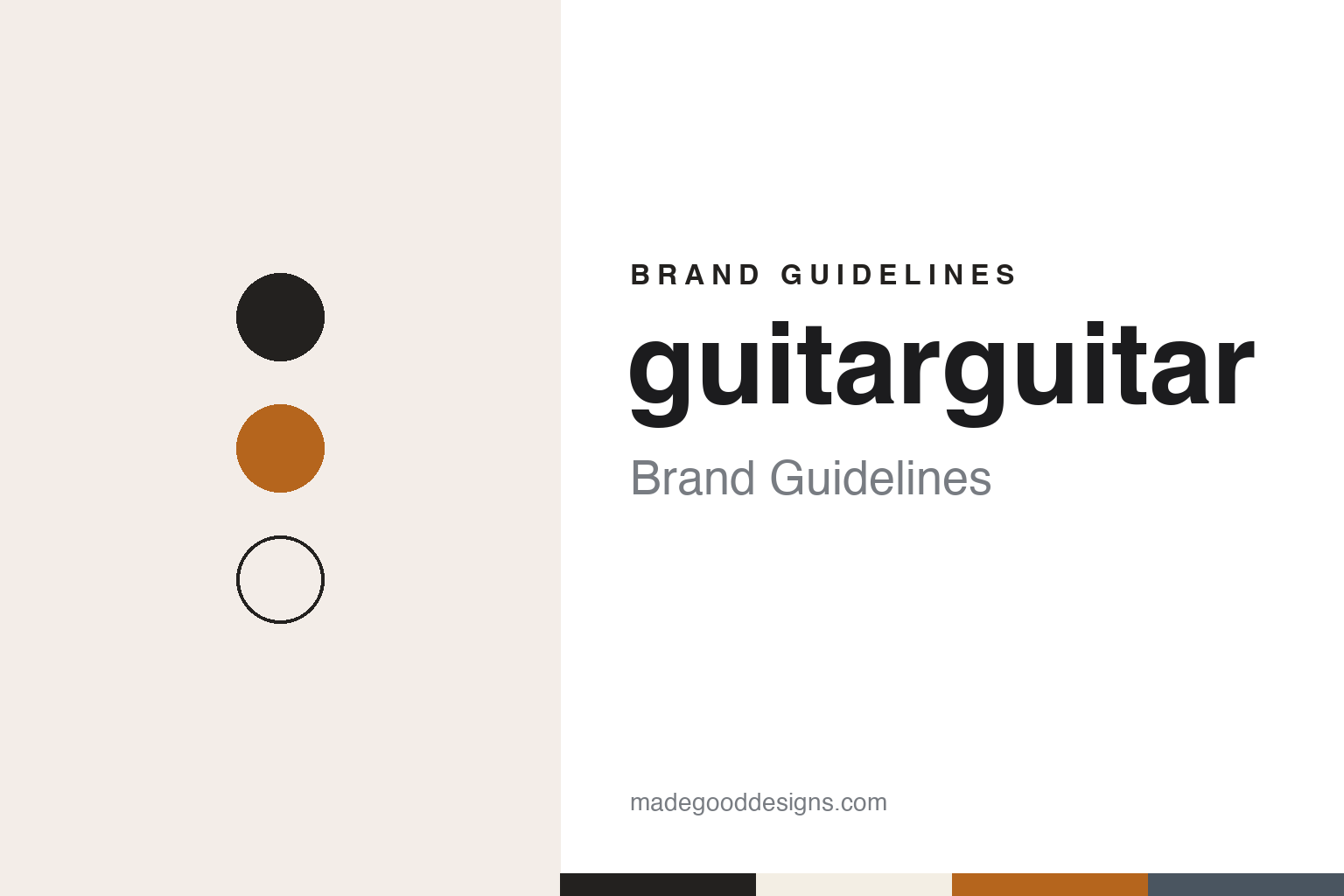
guitarguitar Brand Guidelines
The Edinburgh guitar shop that became employee owned.
Aa
Two constants: a charcoal, amber and slate palette and a plain workshop sans register. Abstract homage — not a guitarguitar product or mark; no instrument, logo or shop sign is reproduced.
Corstorphine, 2004
A neighbourhood shop in the west of Edinburgh.
guitarguitar is a guitar retailer founded in Edinburgh in 2004 by Kip McBay and Graham Bell, as MusicRadar and Scottish Financial News both reported in January 2022. The company writes its name as one lowercase word, and that spelling runs through its website, its shop pages and its own press; trade press sometimes capitalises it as GuitarGuitar. Its first shop opened in Corstorphine, a neighbourhood in the west of the city near the zoo, according to the company’s own twentieth-anniversary history, published in June 2024. That history describes a quiet start, with no online shop at first and a run of print advertisements that the company now reproduces as part of its story.
The Glasgow shop followed a few months later, in the Trongate area, and became the flagship. The company says the Glasgow premises grew several times: in 2010 it took over the unit next door for a keyboards, drums and recording department first called GG-Digital, which is now simply part of the main shop, and in 2013 it added a dedicated acoustic department in a further neighbouring space, so that the shop now spans three units in a row. The Edinburgh shop was also extended with an acoustic room, the company says, and some of the staff who were there at the start still work in it.
Expansion south of the border came next. guitarguitar’s Newcastle branch began in the Newgate Shopping Centre and has been on Grainger Street since 2009; Newcastle is also home to the company’s web support team, which handles after-sales questions from online customers. A Birmingham shop opened in 2010 and an Epsom shop, in Surrey, in 2011, which the company still calls its most southerly branch. In October 2016 it opened in Camden, in north London, a move the company describes as completing its line-up of UK shops.
Colour
Six shops, one warehouse and a trust.
The defining change in guitarguitar’s ownership came in January 2022. Scottish Financial News and MusicRadar, both reporting on 21 January 2022, said that 60 per cent of the company’s shares had been placed in an employee ownership trust, giving its team of about 160 people a majority stake in the business and its profits. Both described guitarguitar as the first musical instrument retailer in the UK to adopt the model; MusicRadar compared it with the structure used by the hi-fi retailer Richer Sounds. The founders made the move, the reports said, so that they could plan their eventual exits without putting the direction of the business at risk. EY advised on the transaction, according to Scottish Financial News.
At the time, both reports gave the company six retail locations across the UK and placed its headquarters on the outskirts of Glasgow. The company’s 2024 history is more specific: since 2021 its head office has been in Linwood, near Paisley, in a building that also houses its main warehouse and distribution centre, its buyers, web developers and marketing staff, and the small studio where it films its videos and shoots its product photographs. The same history, written in mid-2024, described the move to employee ownership as a step that was still in the process of happening.
The brands named in the 2022 coverage were Fender, Gibson, Taylor and Martin, with Scottish Financial News describing a range that runs from entry-level instruments to collectors’ pieces. Beyond guitars, the company’s website lists amplifiers, effects pedals, recording and live-sound equipment, keyboards and electronic drums, alongside a service for trading in or selling used guitars. It sells both online and through its six shops, and its website offers click-and-collect from the shops.
Typography
Shops, schools and online stores.
Musical-instrument retailers present themselves through a small set of public elements: a shop sign and logo, a colour scheme carried from the storefront to the web shop and the delivery box, and the words they use for their stores and services. This series looks at chains and single large stores in Germany, France, the United Kingdom, Slovakia, Canada, Japan, Hong Kong and Singapore, and describes each identity only as the company publishes it or as a dated source records it. Where a company does not publish its colours or typefaces, the palette in each guide is an unofficial interpretation.
Store formats differ widely. Some retailers run one very large store beside a central warehouse: German sources describe Music Store in Cologne and Musikhaus Kirstein in Schongau this way, each with a single store and a large logistics site. Others run chains of city shops across a country or a region, and the guide for each company sets out its own store count only as a dated source gives it.
Services sit alongside the sales floor. Some of these companies describe music schools, lessons or repair workshops as services they offer; Music Store founded its Rock School in 1992, German Wikipedia says, and lists a repair workshop among its services. Events play a part too: Musikhaus Kirstein has held its own house fair, MusiConnect, since its 30th anniversary in 2017.
Online shops now sit next to physical stores, and corporate pages tell the story of founders and owners, from a musician opening a small shop to a second generation joining the management. Each guide that follows separates what the company says about itself from what independent, dated sources document, and names those sources at the end.
Aa
A plain, sturdy sans for a retailer that writes its name in lowercase. (Specimen set in Archivo, a sans STAND-IN; NOT the guitarguitar logo.)
guitarguitar
For players, by players.
guitarguitar’s public voice is informal and aimed at players. Its About Us page, read in November 2026, calls it an “employee owned, award-winning musical instrument retailer for players, by players” and describes it as the UK’s largest guitar retailer, with more than 160 staff and six stores; those are the company’s own descriptions, and MusicRadar used similar wording in 2022 when it called the business the UK’s biggest guitar retailer. A banner across the company’s website reads “Proudly Employee Owned,” so the 2022 change of ownership appears in its everyday marketing copy.
The company also leans on events and editorial. Its blog publishes artist interviews, buying guides and long-form features, and its shops host clinics, signings and restringing days, according to its 2024 history. For its twentieth anniversary in 2024 it worked with a public-relations agency on a survey of the most influential guitarists of the previous two decades; five names from that survey inspired a set of hand-painted Fender Stratocasters that then toured every guitarguitar shop, the company says.
For a design guide, guitarguitar shows how a doubled, lowercase name and a plain statement of ownership can carry a retailer’s identity across shops, warehouse and website. Compare Andertons, another UK guitar retailer, and PMT, a UK music chain. For this guide we use a charcoal, a burnt amber and a slate grey with a sans, an unofficial interpretation; no product or logo is reproduced.
Explore & save
Keep guitarguitar’s identity on hand — save it to a board in the Made Good inspiration library.
guitarguitar identity set
Pin the guitarguitar charcoal, amber and slate palette and the plain workshop sans register to your own board.
Source & notes
Frequently Asked Questions
What font can I use to match the guitarguitar look?
This guide describes guitarguitar’s type as “A plain, sturdy sans for a retailer that writes its name in lowercase”. Its type specimen is set in Archivo from Google Fonts as a stand-in; Archivo is not guitarguitar’s own lettering.
What colours are in the guitarguitar palette?
This guide’s guitarguitar palette is Trongate charcoal #23211F, Burnt amber #B5651D, Linwood slate #4A5560, Fret ivory #F3EEE4 and Paper #F8F7F5. The tones are the guide’s own unofficial interpretation, not official guitarguitar hex codes.
When was guitarguitar founded?
guitarguitar was founded in 2004, in Edinburgh, Scotland. guitarguitar is known for Six UK guitar shops.
Who founded guitarguitar?
guitarguitar was founded by Kip McBay and Graham Bell in 2004.