Eram Brand Guidelines
The 1927 family shoemaker from Saint-Pierre-Montlimart.
Aa
Two constants: an Eram mulberry, linen and ochre palette and a Rounded geometric sans register. Abstract homage — not an Eram product or mark; no shoe, logo or shop sign is reproduced.
Biotteau-Guéry
A workshop in the Mauges and a name built from two first names.
Eram began as a shoe workshop. In 1927 Albert-René Biotteau set up the Établissements Biotteau-Guéry at Saint-Pierre-Montlimart, a small town near Cholet in Maine-et-Loire, according to both Groupe Eram and French Wikipedia. The International Directory of Company Histories, in its entry on the company, says he had started out as a shoemaker’s apprentice at the age of thirteen, and that his workshop was turning out more than 600 pairs of shoes a day by the start of the 1930s, with two more plants added in the surrounding area during that decade.
The brand name followed in 1932. Groupe Eram explains it as the first letters of the couple’s first names, reversed: “Er” from René and “Am” from Marie, his wife. French Wikipedia gives the same account and names her as Marie-Josèphe. The name has stayed in use for more than ninety years, and the company writes it today simply as Eram.
The war years are thinly documented. The International Directory of Company Histories says the development of the new brand was put on hold when the Second World War broke out, that Eram was in production again by 1942, and that in that year it bought a shop in Paris and gave it the Eram name, its first retail store. The sources used for this guide do not say how the company operated during the occupation of 1940–1944 beyond those points.
Manufacturing set the pace in the 1950s. Groupe Eram says that in 1954 it invented a process called “Plastifor” for making plastic soles, and that about ten factories were opened to meet demand for the new products; the Directory dates the company’s patent for injection-moulded plastic soles to 1955. By the start of the 1970s, the Directory says, Eram ran nine production plants, all in communities near its headquarters.
Colour
From factory shops to a national chain and a long-running advertising saga.
Eram looked abroad early. According to the International Directory of Company Histories, it set up sales subsidiaries in Belgium and Germany in 1958 and opened its first foreign shop, in Belgium, in 1961. At home the chain grew through a mix of company-owned branches and franchised shops. In 1969 Gérard Biotteau, the founder’s son, created the Eram franchisees’ club, Groupe Eram says, and French Wikipedia adds that Eram shops then multiplied in northern Europe and in Portugal. The group dates his presidency from 1971 to 1998; the Directory puts the start of his leadership in 1970.
Advertising made the name familiar across France. The Directory says Eram ran its first national advertising campaign in 1970. Groupe Eram calls the 1980s “the great advertising years,” with the adman Philippe Michel and the director Étienne Chatiliez, and says the “saga Eram” ran to about sixty films built around the line “Il faudrait être fou pour dépenser plus !” (“You’d have to be mad to spend more!”). French Wikipedia dates the start of that campaign to 1979.
The company also widened its range of shop formats and brands. The Directory records that Eram acquired the women’s fashion brand Bocage in 1977, launched the out-of-town discount format L’Hyper aux Chaussures in 1987 and bought the France Arno chain in 1989. In 1991 it created Gémo, a shoe and clothing chain that the Directory says followed the same out-of-town location policy; French Wikipedia says that name too was built from first names, those of Gérard and Simone Biotteau. The holding company, Groupe Eram, was formed in 1992, according to French Wikipedia.
The Eram chain itself remained the flagship. The Directory counted more than 650 Eram stores in 2001, mostly in town-centre locations, and described the family as the owner of a private company led by the founder’s grandsons.
Typography
Shoe chains and their signs.
Shoe store chains in Europe present themselves first through the shop sign. The name over the door, its lettering and its colours are what a shopper sees from a car park or a high street, and the same mark is repeated on carrier bags, loyalty apps and websites. When a chain changes hands or merges its banners, the sign can change with it: in 2024 the German group Kienast announced that it would rename around 250 of its shops under the Reno name, replacing the logo lettering inside and outside each store, as the company and the trade title Shoez reported.
The chains in this guide come from Germany, the Netherlands, Switzerland, Poland, France and the United Kingdom, and they trade in different formats. As the companies describe them, these run from large shoe centres on retail parks and the edges of towns to smaller units on high streets and in shopping centres, and most now add an online shop and often an app.
Ownership varies as much as format. Some chains are still run by founding families, some are listed on a stock exchange, and some belong to larger shoe-retail groups that run several banners side by side, each with its own sign and its own own-label ranges. Ownership can also change quickly: Reno was sold by its long-time owner in 2022, entered insolvency proceedings in March 2023 and now continues as a brand of the Kienast group, according to WirtschaftsWoche and the company itself.
Each guide sets out what can be checked about one chain: when and where it was founded, who owns it today, how it describes its shops and its own-label ranges, and what its corporate pages say about founders and owners. Where a fact rests only on a company’s own word, the guide says so. The palettes and type pairings are our own unofficial interpretations; no logo or shop sign is reproduced.
Aa
A rounded geometric sans for a high-street shoe chain. (Specimen set in Outfit, a sans STAND-IN; NOT the Eram logo.)
Groupe Eram
A third-generation family group with a workshop still in Anjou.
The founder’s grandson Xavier Biotteau took charge in 1998, French Wikipedia says, and Groupe Eram names him today as its president. The group describes itself as a French family group based in Maine-et-Loire since 1927 and run by the third generation of the Biotteau family. Its website lists ten brands across shoes, clothing and accessories, including Eram, Bocage, Gémo and Mellow Yellow, and gives 770 points of sale in France and abroad in its 2025 figures. The trade paper FashionUnited reported in September 2026 that the group had begun a new plan for 2026 to 2030 after its “Change for Good” programme.
For the Eram chain itself, the group says it has close to 140 points of sale in shopping centres and town centres, and presents the brand with the line “Here I Am. Eram.” Its head office remains at Saint-Pierre-Montlimart. French Wikipedia records that Eram stopped trading in Belgium in 2017, and that in March 2023 it opened its first Eram & Co store, a multi-brand format for retail parks, at Salaise-sur-Sanne; the same article notes that the current logo has been in use since 3 September 2012.
Where the shoes are made is a question the group answers in part. Groupe Eram says it still runs one shoe workshop in France, La Manufacture at Montjean-sur-Loire, which uses injected and welded construction, makes shoes for the group’s brands and received the “Entreprise du Patrimoine Vivant” label in 2023. The group also says it has offices in Asia for its international teams. The Directory recorded ten factories in 2001, nine of them in France and one in Portugal; current production sites beyond La Manufacture are not set out by the group.
For a design guide, Eram shows how a name made from two first names can carry a family company from a 1920s workshop to a national shoe chain. Compare Torfs, another family-run shoe retailer, and Scapino. For this guide we use mulberry, linen and ochre with a sans, an unofficial interpretation; no product or logo is reproduced.
Explore & save
Keep Eram’s identity on hand — save it to a board in the Made Good inspiration library.
Eram identity set
Pin the Eram mulberry, linen and ochre palette and the Rounded geometric sans register to your own board.
Source & notes
Frequently Asked Questions
What font can I use to match the Eram look?
This guide describes Eram’s type as “A rounded geometric sans for a high-street shoe chain”. Its type specimen is set in Outfit from Google Fonts as a stand-in; Outfit is not Eram’s own lettering.
What colours are in the Eram palette?
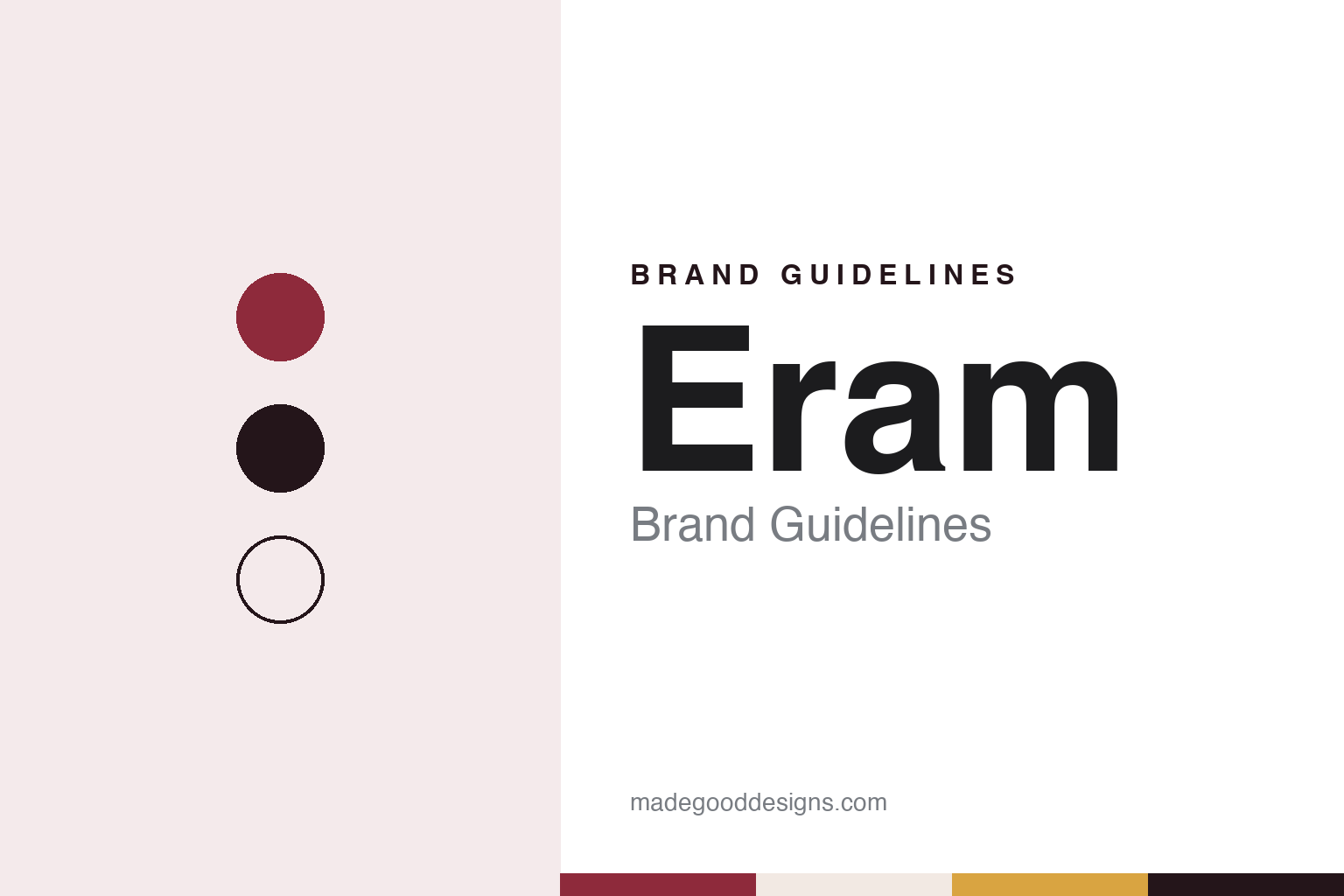
This guide’s Eram palette is Mulberry #8E2A3B, Ink plum #24151A, Linen #F2E9E3, Ochre #D9A441 and Paper #FAF7F4. The tones are the guide’s own unofficial interpretation, not official Eram hex codes.
When was Eram founded?
Eram was founded in 1927 (as Établissements Biotteau-Guéry), in Saint-Pierre-Montlimart, France.
Who founded Eram?
Eram was founded by Albert-René Biotteau in 1927 (as Établissements Biotteau-Guéry).