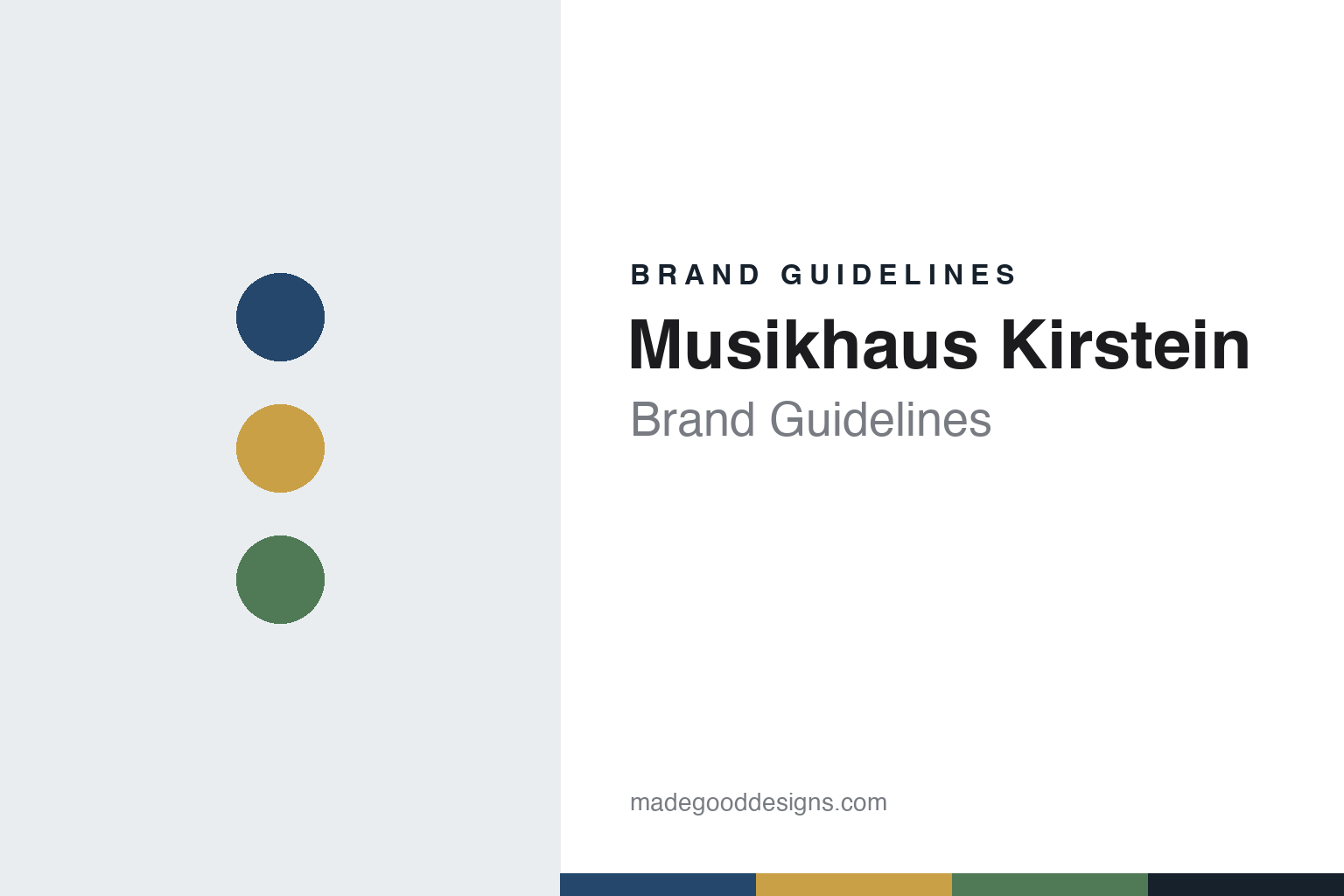
Musikhaus Kirstein Brand Guidelines
A small-town Bavarian music shop that grew into a web shop, a warehouse and a fair.
Aa
Two constants: a Lech blue, brass gold and meadow green palette and a shopfront sans register. Abstract homage — not a Musikhaus Kirstein product or mark; no sign, logo or instrument is reproduced.
From the old town
A professional musician, a small shop and an early web shop.
Musikhaus Kirstein began in September 1987 in Schongau, a small town on the river Lech in Upper Bavaria. The regional weekly Kreisbote reported in September 2017 that the founder, Klaus Kirstein, and his wife Uschi had started the business “from zero,” drawing on the know-how and the contacts he had built up as a professional musician. The first shop was a small one in Schongau’s old town; a photograph printed with that report shows the staff in front of it in 1995.
The music trade was never an easy one, Kirstein told the paper, but the little shop found its feet and grew steadily. The real acceleration came after 2005, when the company opened its first web shop. Kirstein described himself as a technology enthusiast who had built that first shop himself, and said that being early online had later allowed the firm to hire good people and still paid off in know-how and recognition. In 2006 the business moved out of the old town to a larger site elsewhere in Schongau, the Kreisbote reported.
The company’s own brands followed in 2007. According to the same report, the first was a digital piano made in China, which Kirstein described as affordable for customers but of serious quality, and own brands had become an important line of business by 2017. The company’s press releases of 2023 and 2024 say that over the years it has established a considerable number of own brands.
By its 30th anniversary the scale had changed. The Kreisbote reported in 2017 that the company held about 50,000 product records, with around 9,000 items active in the online shop, kept most of its stock in a 17,000-square-metre warehouse in the former Möbel Centrale furniture store in neighbouring Altenstadt, and employed 130 people. Musicians from the region once drove to Munich to buy their equipment, Kirstein told the paper; now, he said, people from Munich came to Schongau.
Colour
One store, one web shop and a house fair.
Kirstein sells through two channels: its online shop and a single large store in Schongau. The company’s press boilerplate, published with its releases in 2023 and 2024, describes a wide range of musical instruments, accessories and stage and studio equipment, sent out every day from Schongau to customers across Europe, “from the recorder to the concert grand.” In December 2020 the Kreisbote called the approach multichannel: the company had gone online in 2005 but kept faith with its shop, and Kirstein said that some customers travelled a long way because they valued the advice. The range had been widened considerably over the years, he added, so that customers could find everything in one place.
The house fair is the most visible part of the brand. For the 30th anniversary, from 29 September to 1 October 2017, the company staged MusiConnect, a mix of trade fair, workshops and festival spread between the Schongau store and the Altenstadt warehouse, with shuttle buses running between the two sites. The Kreisbote reported that 90 exhibitors had signed up, that the exhibition area would cover about 2,000 square metres, and that workshops would run “from brass-band courses to high-tech recording,” with live acts playing throughout. The company’s marketing staff told the paper that manufacturers had responded strongly because the Frankfurt music fair was losing visitors and many small music shops were closing, leaving brands fewer chances to meet buyers face to face; Kirstein himself spoke of a wave of closures among small shops.
MusiConnect has continued. A company release of August 2024 announced the third edition for 21 September 2024 in Schongau, this time as a one-day house fair opening with a morning concert of Alpine folk music. It promised workshops for guitarists, saxophonists, tuba players, singer-songwriters and teachers at music schools and in local music associations, a children’s programme including a drum corner, special exhibitions by instrument brands, and instruments to try across the whole store. The company said that every part of the programme was free.
Typography
Signs, stores and services.
Musical-instrument retailers present themselves through a small set of public elements: a shop sign and logo, a colour scheme carried from the storefront to the web shop and the delivery box, and the words they use for their stores and services. This series looks at chains and single large stores in Germany, France, the United Kingdom, Slovakia, Canada, Japan, Hong Kong and Singapore, and describes each identity only as the company publishes it or as a dated source records it. Where a company does not publish its colours or typefaces, the palette in each guide is an unofficial interpretation.
Store formats differ widely. Some retailers run one very large store beside a central warehouse: German sources describe Music Store in Cologne and Musikhaus Kirstein in Schongau this way, each with a single store and a large logistics site. Others run chains of city shops across a country or a region, and the guide for each company sets out its own store count only as a dated source gives it.
Services sit alongside the sales floor. Some of these companies describe music schools, lessons or repair workshops as services they offer; Music Store founded its Rock School in 1992, German Wikipedia says, and lists a repair workshop among its services. Events play a part too: Musikhaus Kirstein has held its own house fair, MusiConnect, since its 30th anniversary in 2017.
Online shops now sit next to physical stores, and corporate pages tell the story of founders and owners, from a musician opening a small shop to a second generation joining the management. Each guide that follows separates what the company says about itself from what independent, dated sources document, and names those sources at the end.
Aa
A sturdy, open sans for shop signs and warehouse labels. (Specimen set in Work Sans, a sans STAND-IN; NOT the Musikhaus Kirstein logo.)
Musikhaus Kirstein GmbH
An award, a family firm and a third managing director.
The company trades as Musikhaus Kirstein GmbH, based in Schongau. In December 2020 it was among the fifty winners of the Bavarian economics ministry’s annual growth award, which honours fast-growing, owner-managed mid-sized companies in the state; the Kreisbote reported that the 2020 round was the 19th and that an auditing firm acted as the independent judge. At the time Roman Thomas was managing director, with Klaus Kirstein as co-managing director, and the paper wrote that since 1987 the firm had grown into the third-largest retailer in the music trade. It added that the logistics centre in Altenstadt was working at full stretch that winter, as many customers were giving instruments as presents or had time to learn one.
The founder’s son joined the management in 2023. A company release dated 15 February 2023 announced Andreas Kirstein as the third managing director, alongside Roman Thomas and Klaus Kirstein, with lead responsibility for purchasing and sales; Klaus Kirstein said he would step back a little. The company describes itself as one of the largest music shops in Germany and marked its 35th anniversary in 2022.
For a design guide, Musikhaus Kirstein shows how a retailer with one store in a small Bavarian town can build its name through a web shop, own brands and a house fair held on its own premises. Compare Thomann, the music retailer based in Burgebrach, also in Bavaria, and Music Store, the Cologne music retailer. For this guide we use a Lech blue, a brass gold and a meadow green with a sans, an unofficial interpretation; no product or logo is reproduced.
Explore & save
Keep Musikhaus Kirstein’s identity on hand — save it to a board in the Made Good inspiration library.
Musikhaus Kirstein identity set
Pin the Musikhaus Kirstein Lech blue, brass gold and meadow green palette and the shopfront sans register to your own board.
Source & notes
Frequently Asked Questions
What font can I use to match the Musikhaus Kirstein look?
This guide describes Musikhaus Kirstein’s type as “A sturdy, open sans for shop signs and warehouse labels”. Its type specimen is set in Work Sans from Google Fonts as a stand-in; Work Sans is not Musikhaus Kirstein’s own lettering.
What colours are in the Musikhaus Kirstein palette?
This guide’s Musikhaus Kirstein palette is Lech blue #24476B, Night ink #16212C, Brass gold #C9A045, Meadow green #4F7A55 and Alpine paper #F5F3EE. The tones are the guide’s own unofficial interpretation, not official Musikhaus Kirstein hex codes.
When was Musikhaus Kirstein founded?
Musikhaus Kirstein was founded in September 1987, in Schongau, Upper Bavaria.
Who founded Musikhaus Kirstein?
Musikhaus Kirstein was founded by Klaus Kirstein in September 1987.