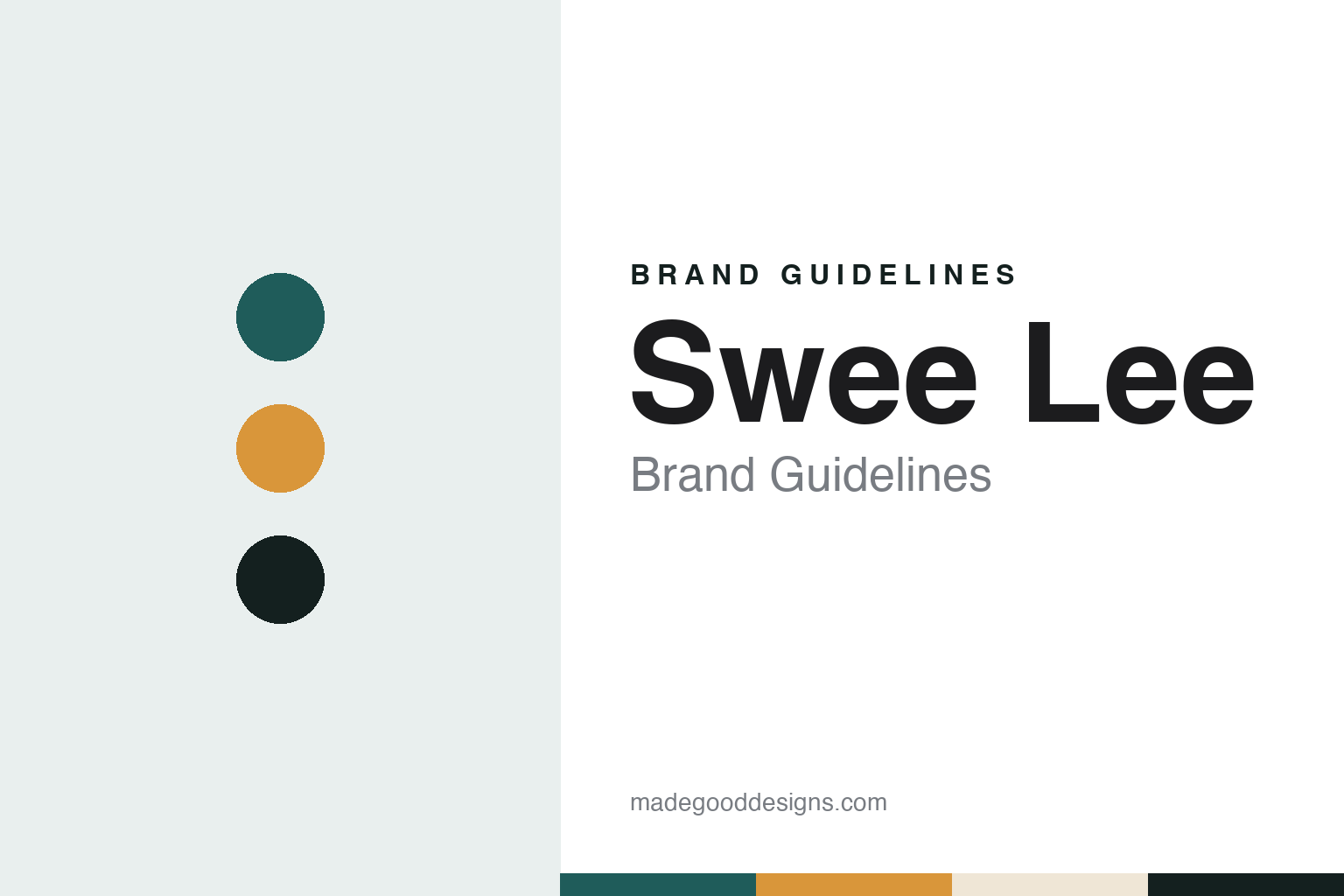
Swee Lee Brand Guidelines
A post-war distributor that became a regional music chain.
Aa
Two constants: a deep teal, amp amber and warm cream palette and a warm sans register. Abstract homage — not a Swee Lee product or mark; no sign, logo or store fascia is reproduced.
Since 1946
A Singapore distributor that learned to sell guitars.
Swee Lee dates itself to 1946. The company says it has been “founded and headquartered in Singapore since 1946,” and independent profiles give the same year. SG Magazine wrote in October 2017 that Swee Lee “first began as a pure distribution business” with only a few showrooms, and a Nikkei Asia report republished by KrASIA in July 2024 said the company had previously focused on wholesaling musical instruments.
The first shop was inside a Singapore theatre. In the 2017 interview, the company’s managing director, Kuok Meng Ru, said Swee Lee started in the Capitol Theatre in 1946, and listed among the company’s recent milestones its win of the audio-visual refitting project for the same building. TheSmartLocal repeated in July 2026 that the first store opened in Capitol Theatre.
The range followed popular music. Asked in 2017 how a supplier of classical instruments came to sell guitars and drums, Kuok said that Swee Lee “went where the consumers were,” as rock ’n’ roll and pop music built around guitars and drums grew from the 1950s onwards; TheSmartLocal also dates the turn to guitars and drums to the 1950s. By the early 2000s the company had a shop at Sims Drive: in a January 2018 interview with Bandwagon, Kuok said that was where he bought his first guitar, a Fender Stratocaster.
The company marked its 75th anniversary in November 2021, Bandwagon reported that December, noting that Swee Lee shares its founding year with Fender.
Colour
Kuok Meng Ru and Caldecott Music Group.
Ownership changed in 2012, when Kuok Meng Ru took over the business; SG Magazine, Bandwagon and Nikkei Asia all date the purchase to that year. In 2017 he told SG Magazine that “retail wasn’t the core priority for Swee Lee at that point,” and that he had worked on the shop floor at first while building supplier relationships and purchasing, product and marketing strategies for the company’s brands.
Swee Lee now sits inside a larger music group. In December 2021 Bandwagon described Kuok as group chief executive and founder of Caldecott Music Group, which then oversaw the publications NME, Guitar.com, MusicTech and Uncut as well as music brands including Harmony, Heritage Guitars and Swee Lee. Nikkei Asia reported in July 2024 that Caldecott owns the Swee Lee chain and the music-making app BandLab, had bought the Michigan guitar maker Harmony and reopened its factory, and in 2023 had acquired the trademark of Dawsons, a British music retailer founded at the end of the nineteenth century that had gone bankrupt.
The new owner set out to sell both online and in shops. In the 2021 interview Kuok said one of the first steps of the new management was an omnichannel approach, and that the online store was localised in three languages with more than 18,000 products listed, from more than 129 brands. Nikkei Asia wrote that he revamped the Swee Lee brand for younger customers and began developing retail stores alongside online sales.
The chain then spread across the region. By July 2024 Swee Lee had expanded into Malaysia, Indonesia and Vietnam and had 11 stores across Southeast Asia, Nikkei Asia reported. The company’s website now offers country stores for Malaysia, Brunei, Vietnam, Indonesia, the Philippines, Thailand and China, and its store finder can filter locations by Singapore, Malaysia, Indonesia, Vietnam and Thailand.
Typography
Signs, shops and owners.
Musical-instrument retailers present themselves through a small set of public elements: a shop sign and logo, a colour scheme carried from the storefront to the web shop and the delivery box, and the words they use for their stores and services. This series looks at chains and single large stores in Germany, France, the United Kingdom, Slovakia, Canada, Japan, Hong Kong and Singapore, and describes each identity only as the company publishes it or as a dated source records it. Where a company does not publish its colours or typefaces, the palette in each guide is an unofficial interpretation.
Store formats differ widely. Some retailers run one very large store beside a central warehouse: German sources describe Music Store in Cologne and Musikhaus Kirstein in Schongau this way, each with a single store and a large logistics site. Others run chains of city shops across a country or a region, and the guide for each company sets out its own store count only as a dated source gives it.
Services sit alongside the sales floor. Some of these companies describe music schools, lessons or repair workshops as services they offer; Music Store founded its Rock School in 1992, German Wikipedia says, and lists a repair workshop among its services. Events play a part too: Musikhaus Kirstein has held its own house fair, MusiConnect, since its 30th anniversary in 2017.
Online shops now sit next to physical stores, and corporate pages tell the story of founders and owners, from a musician opening a small shop to a second generation joining the management. Each guide that follows separates what the company says about itself from what independent, dated sources document, and names those sources at the end.
Aa
A warm, rounded sans for shop signs and café menus. (Specimen set in Manrope, a sans STAND-IN; NOT the Swee Lee logo.)
Swee Lee
A music store with a café and a vinyl library.
Its stores have become social spaces as well as shops. In January 2018 Bandwagon covered the opening of a new flagship at The Star Vista, selling instruments, accessories, clothes and vinyl alongside coffee; Kuok said the change had been “five years in the making.” SG Magazine recorded in 2017 that the company had opened its first lifestyle store at Katong 112, together with the Swee Lee Music Academy, which Kuok said had been set up in 2012 for rock- and pop-oriented teaching, and a specialised drum shop.
In April 2024 Swee Lee opened Swee Lee Clarke Quay, its third store in Singapore, in a former warehouse, Nikkei Asia and TheSmartLocal reported. In July 2026 TheSmartLocal described a bar and café, vinyl-listening stations, a hall that doubles as a dining space and performance venue, a Creator Corner with music-editing set-ups, guitar-testing stations played through headphones, and a guitar “cellar” open by appointment, stocking brands including Fender, Taylor and Heritage Guitars. In the company’s April 2024 release, quoted by Nikkei Asia, Kuok called it a “community-centric retail space.”
Services sit beside the shops. The website lists a Swee Lee Service Centre for guitar set-ups, PLEK fret analysis and levelling and structural repairs, a sell-or-trade service and used instruments sold as Well Played Gear. It describes itself as “South East Asia’s most trusted house of music and expression” and as a multi-brand musical instrument and lifestyle retailer and distributor; those are the company’s own words. The company name in its website footer is Swee Lee Holdings Pte Ltd.
For a design guide, Swee Lee shows how a post-war instrument distributor can rebuild itself as a retail brand around cafés, vinyl and community spaces. Compare Tom Lee Music, the Hong Kong music retailer founded in 1953, and Parsons Music, another music retailer in Asia. For this guide we use a deep teal, an amp amber and a warm cream with a sans, an unofficial interpretation; no product or logo is reproduced.
Explore & save
Keep Swee Lee’s identity on hand — save it to a board in the Made Good inspiration library.
Swee Lee identity set
Pin the Swee Lee deep teal, amp amber and warm cream palette and the warm sans register to your own board.
Source & notes
Frequently Asked Questions
What font can I use to match the Swee Lee look?
This guide describes Swee Lee’s type as “A warm, rounded sans for shop signs and café menus”. Its type specimen is set in Manrope from Google Fonts as a stand-in; Manrope is not Swee Lee’s own lettering.
What colours are in the Swee Lee palette?
This guide’s Swee Lee palette is Deep teal #1F5C5A, Night ink #14201F, Amp amber #D9963A, Warm cream #EFE6D6 and Paper #F8F6F1. The tones are the guide’s own unofficial interpretation, not official Swee Lee hex codes.
When was Swee Lee founded?
Swee Lee was founded in 1946, in Singapore.