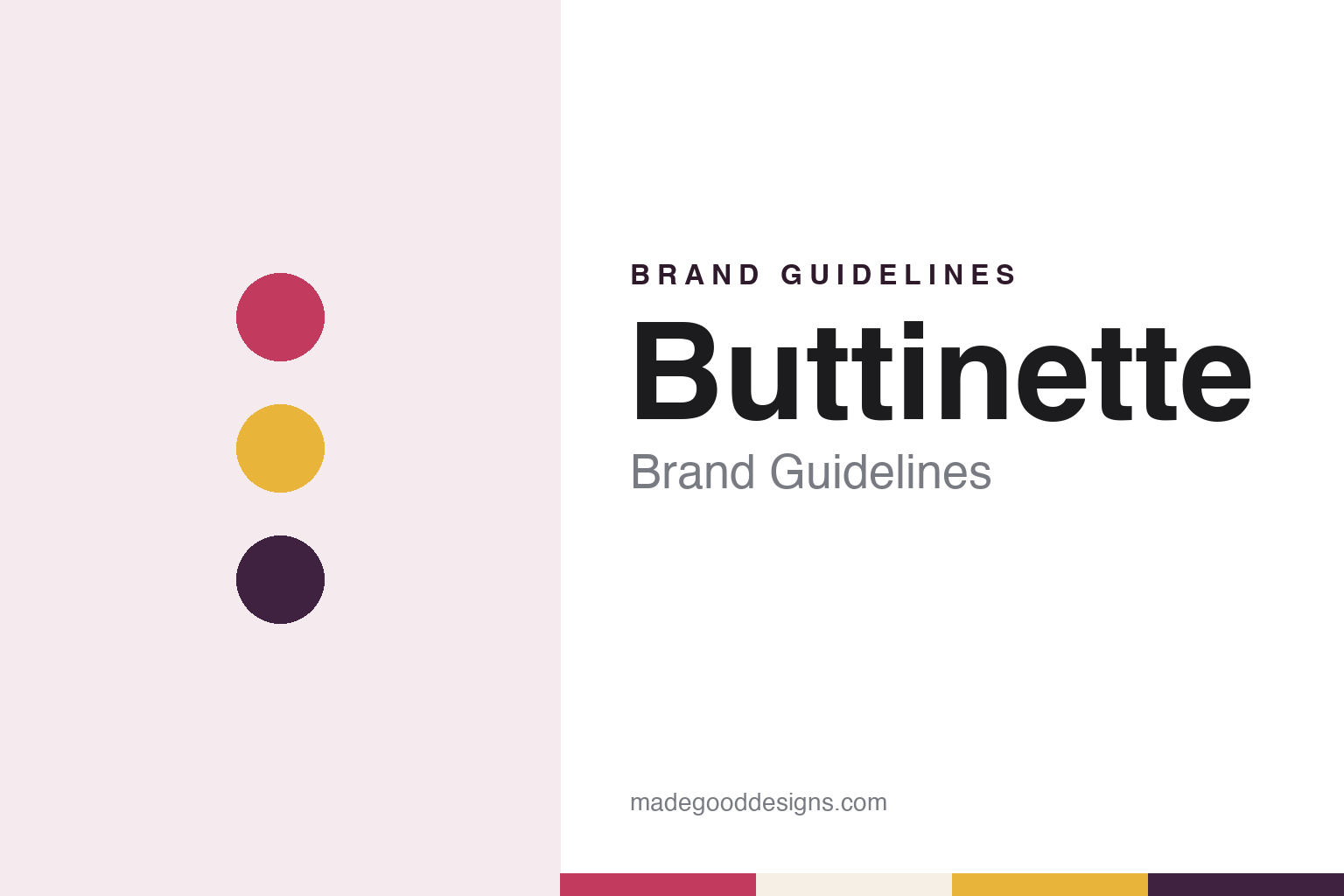
Buttinette Brand Guidelines
The Wertingen mail-order house for crafts, sewing and carnival.
Aa
Two constants: a raspberry, marigold and plum palette and a rounded sans register. Abstract homage — not a Buttinette product or mark; no catalogue, logo or packaging is reproduced.
From Buttenwiesen to Wertingen
A fabric-remnant mail-order house in Bavarian Swabia.
Buttinette is a German mail-order house for craft, sewing and needlework supplies and carnival costumes, based in Wertingen, a small town in Bavarian Swabia. The company writes its name in lower case, as “buttinette,” and trades as buttinette Textil-Versandhaus GmbH; the German company register summary on North Data gives its business as running a textile mail-order house.
Its own company chronicle dates the business to 1979, when, it says, Erwin Müller, Aurelia Müller and Josef Wagner founded buttinette GmbH; the company’s management page names the founders as Erwin Müller and Josef Wagner and calls buttinette “a real family company.” The name, the chronicle says, comes from Buttenwiesen, the village that is home to the Erwin Müller mail-order house. That older firm is a separate business: TextilWirtschaft described it in January 1999 as a Buttenwiesen specialist mail-order house for home textiles, baby goods and needlework, then being restructured as a family-owned GmbH. Buttinette’s web shop still links to Erwin Müller as a partner shop.
Trading began in 1980. The chronicle describes the early company as a mail-order house for fabrics and remnants for home sewing, with 15 employees at the end of that year; a company press release of November 2009 described opening “our mail-order house in Wertingen” in 1980 under the motto “Am liebsten selbstgemacht,” roughly “homemade is nicest.” A 3,600-square-metre dispatch building went up in 1981, and in 1982 the company began posting fashion-fabric catalogues with original fabric swatches glued in. The same year Erwin Müller founded Woll Butt, a further company that the chronicle says was later merged with its sister firm buttinette; the Woll Butt range joined the buttinette catalogue in 2002.
Colour
From sewing remnants to craft and carnival.
The shift from fabric to crafts came in 1993, the chronicle says, with the first catalogue for crafting, sewing and needlework: a small range of fabrics suited to crafts, plus materials such as animal noses and eyes, doll hair, figure wire and stuffing. The slogan changed with it, from “buttinette … damit Selbernähen echten Spaß macht” (so that sewing your own is real fun) to “buttinette – Basteln • Nähen • Handarbeiten,” or crafting, sewing, needlework. Catalogues had already moved from two-colour to four-colour printing in 1989.
In 1996 the company gathered its carnival fabrics and accessories into a first carnival catalogue, creating the division it calls buttinette Fasching. Its website still runs as two shops, one for crafts and one for carnival, with a shared basket. In November 2009 the company announced in a press release that its carnival sale in Wertingen would open on 11 November, the traditional start of the German carnival season, on 600 square metres.
Buttinette went online in 1999, with ordering possible from the start, the chronicle says, and launched a redesigned web shop in 2008. Abroad it opened branches in Altach, in the Austrian state of Vorarlberg, in 2005; in Diepoldsau, in the Swiss canton of St. Gallen, in 2006; and in Alsace, France, in 2009, moving there to Schiltigheim in 2015. Its creative catalogue appeared in French from 2013, and in 2025 it opened an online shop for the Netherlands, which it says puts it directly in five European countries. The shop’s country selector also lists Belgium.
Growth showed in its buildings. The chronicle lists a new warehouse in 2003 that took the site to 12,000 square metres, a dispatch system in 2004 able to send more than 7,000 parcels a day, an administration building in 2010, a logistics building in 2011 and a 20-metre-high picking warehouse that opened in August 2016. Its newest project is a logistics centre in Wertingen-Geratshofen, begun in autumn 2024 and due to be ready at the end of 2026, which the company says is built around an AutoStore system with more than 130,000 storage bins and 300 robots.
Typography
Design and documentation.
Craft, fabric and hobby store chains sell materials rather than finished things, and that shapes how they present themselves. From Scandinavia and Germany to France, the Netherlands, Japan, Australia and North America, these retailers describe their shops, ranges and services on their own websites, and those pages are the main record of how each one wants to be seen: the shop sign over the door, the colours of the website, the names of its catalogues and own ranges.
Store formats vary widely. Some chains run large hobby stores with paper, paint, beads and party goods under one roof; others are fabric halls built around bolts of cloth and haberdashery counters; some began as mail-order catalogues and still publish them. Panduro, for example, says its printed catalogue was its main sales channel until the 1980s, while idee. Creativmarkt says it publishes a free yarn catalogue twice a year with its sister brand Wolle Rödel.
Some of these companies also present themselves as teachers. They publish free instructions, project videos and blogs; TAP Holding, which owns idee. Creativmarkt, says it advises customers in workshops as well as in its shops, and Panduro promotes parties held in its stores. Own-label ranges and kits, often developed by in-house design teams, sit alongside branded materials from outside suppliers, and the companies name those ranges in their own way.
Ownership is part of the story too. Some chains in this guide are family businesses or were until recently, and some now belong to larger groups: Panduro has been part of the Swedish Lekolar group since 2022, and idee. Creativmarkt belongs to the Jacoby family’s TAP Holding. Corporate pages on founders and owners give each company’s own account; this guide sets those beside independent, dated sources wherever they exist.
Aa
A rounded sans for a lower-case name. (Specimen set in Nunito, a sans STAND-IN; NOT the Buttinette logo.)
Buttinette
A catalogue house with two shops in its home town.
Buttinette sells chiefly by catalogue and online. Its catalogue page offers the Kreativkatalog 2026/2027, which the company says runs to 516 pages and appears each year in late summer, and the Faschingskatalog 2027, given as 264 pages on the catalogue page and 248 pages in the chronicle. Printed catalogues are sent only within Germany, while seasonal leaflets such as “Herbst-Trends 2026” can be browsed online. The company says its range covers about 20,000 craft articles and 8,000 carnival articles, and that it has been FSC-certified since April 2022, including for its own sewing books.
In Wertingen the company runs what it calls “buttinette zum Anfassen,” buttinette you can touch: a creative shop opened beside the head office in 1994 as a factory outlet, and a carnival shop opened in 2006 in a former shoe shop next door. Its branch page describes the creative shop as about 700 square metres of fashion fabrics, haberdashery, the current catalogue range and bargains, and lists Wertingen as its one branch.
The town keeps its own record of the company. The Stadt Wertingen newsletter zeitpunkt reported in July 2021 that a heavy-rain event on the evening of 6 June 2021, lasting into the next morning, caused major damage to the Buttinette premises in the town’s industrial area; its April 2021 issue listed Buttinette among local businesses accepting the town’s shopping voucher. Staff figures come from the company: it gives about 450 employees in its chronicle and about 500 on its management page, against about 235 in 2008.
For a design guide, Buttinette shows how a lower-case name and a long-running catalogue can carry a mail-order brand across five countries. Compare Idee Creativmarkt, another German craft retailer, and Wolle Rödel, a German yarn and craft retailer. For this guide we use a raspberry red, a marigold yellow and a deep plum with a rounded sans, an unofficial interpretation; no product or logo is reproduced.
Explore & save
Keep Buttinette’s identity on hand — save it to a board in the Made Good inspiration library.
Buttinette identity set
Pin the Buttinette raspberry, marigold and plum palette and the rounded sans register to your own board.
Source & notes
Frequently Asked Questions
What font can I use to match the Buttinette look?
This guide describes Buttinette’s type as “A rounded sans for a lower-case name”. Its type specimen is set in Nunito from Google Fonts as a stand-in; Nunito is not Buttinette’s own lettering.
What colours are in the Buttinette palette?
This guide’s Buttinette palette is Raspberry #B8325A, Plum #3F2140, Marigold #E2AE38, Linen #F6EFE6 and Paper #FBF8F4. The tones are the guide’s own unofficial interpretation, not official Buttinette hex codes.
When was Buttinette founded?
Buttinette was founded in 1979 (trading from 1980), in Wertingen, Germany.
Who founded Buttinette?
Buttinette was founded by Erwin Müller and Josef Wagner (company account) in 1979 (trading from 1980).