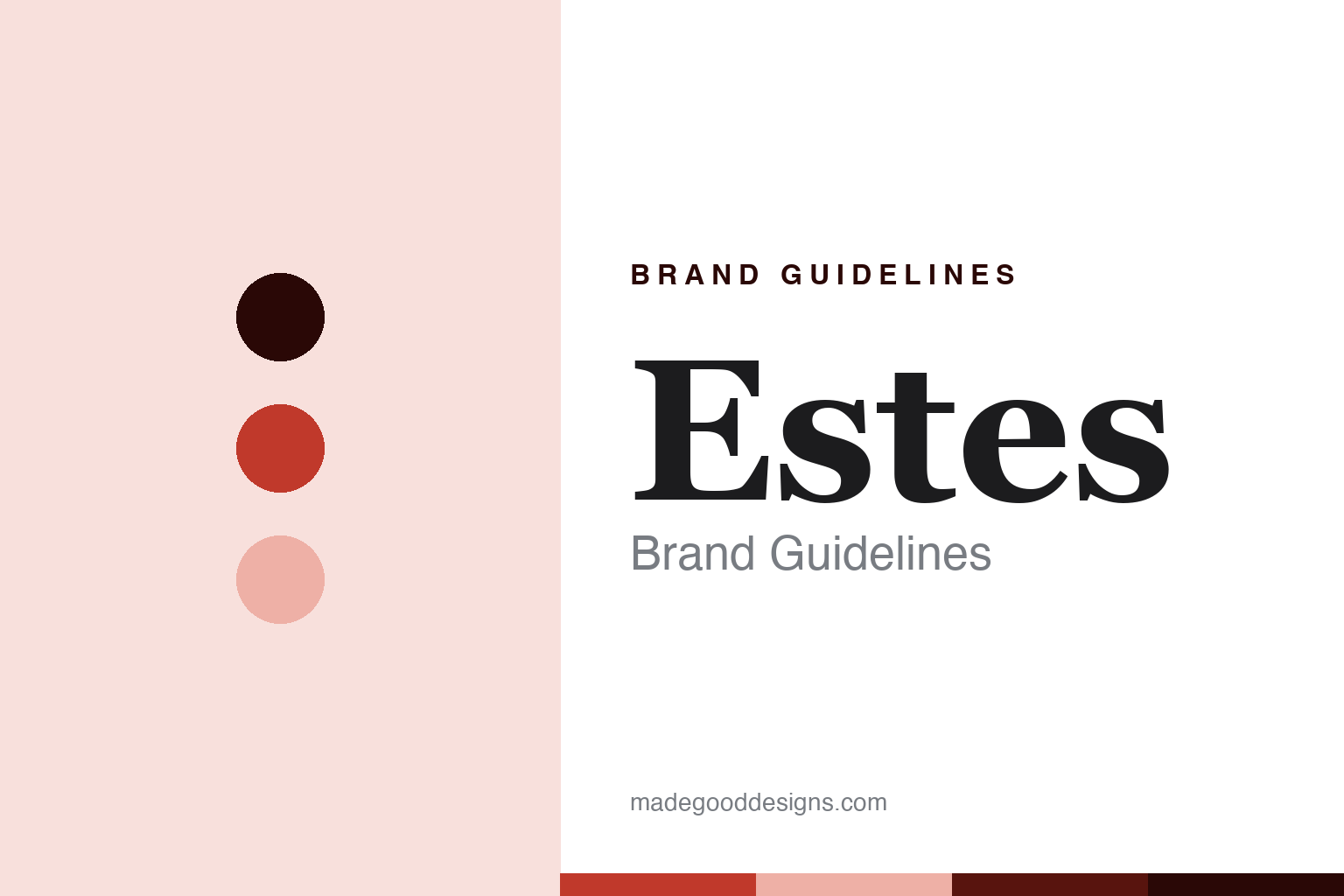
Estes Brand Guidelines
The giant that outlived its owners.
Aa
Two constants: an Estes-red palette and a flagship-serif register. Abstract homage — not an Estes product or mark; no rocket, fin or logo is reproduced.
The giant that outlived its owners
Estes is the 1958 Penrose flagship (the Alpha, the Saturn V) that passed through Damon, Estes-Cox and Hobbico’s bankruptcy to the Langford family in 2018 — its old parent long ago absorbing its rival Centuri.
Estes opens the model-rocket round as its giant-and-survivor node — the dominant hobby brand, and the one whose long ownership history sets up the round’s theme of who owns the launch pad. Its answer to a round about who owns model rocketry is the endurance: the giant that outlived every owner.
Its identity is the giant that outlived its owners. The 1958 origin, the Penrose home and the Langford ownership are the story here. The leader, and the survivor. The giant that outlived its owners.
(Honest notes, so the origin, the ownership, the products and hedges are framed accurately. Estes sells model rockets as its heroes; we report its language as the brand’s own. On origin: Estes was founded in 1958 by Vern Estes, with the official history crediting Vern and Gleda Estes, as a mail-order company that started in Denver and moved in 1961 to Penrose, Colorado, since called the Model Rocket Capital of the World, home of “Mabel,” Vern Estes’s machine for safely mass-producing black-powder motors. On ownership: Estes passed from Vern Estes to the Damon Corporation in 1969, then to Hobby Products after a 1989 takeover of Damon, was renamed Estes-Cox Corp in 2002 after Cox was folded in during 1996, was acquired by Hobbico in 2010, and after Hobbico’s January 2018 bankruptcy was sold on 12 April 2018 to Estes Industries LLC, privately held by the Langford family, with founder Vern Estes still on the board. On the rival: it was the parent Damon, not Estes directly, that absorbed the rival Centuri Engineering, whose line was discontinued in 1983, which we attribute. On the making: Penrose, Colorado, for motors and operations. Its designs and the Estes name are IP we describe but do not reproduce; there is no official brand hex; these tones are an unofficial interpretation.)
Colour
Estes lives in an Estes red. Click a swatch to copy the hex.
Estes’ identity is leading, heritage and enduring — an Estes red, an ink, a pale red, a deep crimson, and a paper. The palette leans Estes red and deep crimson: a classic, heritage register that nods to the familiar rocket brand rather than a loud logo colour. It signals the giant that outlived its owners — leading, heritage and enduring. The honest caveat: with no official brand hex, these values are a heritage, unofficial interpretation, not first-party colours.
The lesson is an Estes red signals a leading, heritage identity. Estes’ world is the launch pad and the beginner’s first flight. For designers, it is a reminder that a classic red and a pale red can carry a leading, heritage brand — a heritage tone held as an accent, not a product shot. Because a strong hue can fail as small text, keep type dark and let the colour live in the accents, palette and band. The takeaways: date the origin to 1958 and the Penrose move to 1961; name the ownership chain into the Langford family in 2018; attribute the Centuri absorption to parent Damon; and keep it distinct from Estes Express Lines.
Typography
The register is a flagship serif — leading, heritage, enduring.
Estes’ identity carries a leading, heritage spirit — the brand that defined the hobby. A flagship serif captures the mood: established, confident and classic, the register of a category leader. Set in an Estes-red palette, the flagship serif feels dependable and earned — exactly the personality Estes carries. It behaves like a made, worn thing rather than a loud logo, mirroring a fin-ring and a motor-band. (Estes’ real products and the name are things we describe but do not reproduce, and the exact typeface is not ours to use.) Because it is not ours to use, the honest description is “a flagship-serif brand,” shown here in a stand-in. The type behaves like the brand: leading, heritage and enduring.
Aa
A flagship-serif brand — dependable and earned. (Specimen set in Fraunces, a flagship-serif STAND-IN; NOT the Estes logo or products.)
The model-rocket node
Estes stands for the giant that outlived its owners.
Estes opens the round as its giant-and-survivor node. An Estes-red palette, a flagship serif and a 1958 origin make one thing — the giant that outlived its owners — the whole identity: leading, heritage and enduring. The 1958 origin is the pitch, the Penrose home is the substance, and the Langford ownership is the frame. The point is the giant that outlived every owner, anchoring the round about who owns model rocketry.
Put to work, the identity is the brand told straight, the chain named and the rival attributed. A brand in this spirit would date the origin to 1958 and the Penrose move to 1961, name the ownership chain into the Langford family in 2018, attribute the Centuri absorption to parent Damon, and keep it distinct from Estes Express Lines. A reader in this spirit would keep the facts right: Estes makes low-power model rockets; it dates to 1958; it is Langford-family-owned since 2018; and its old parent Damon absorbed Centuri. Estes opens the round, before Quest. The honest editorial moves are to date the origin, to name the chain, to attribute the rival, and to keep the name distinct.
For designers and brand-builders, Estes opens the model-rocket node: anchor a round with the survivor — passed hand to hand, still leading. The lessons: a category leader can outlast a long line of owners, here Estes through Damon, Hobby Products, Estes-Cox, Hobbico and finally the Langford family; an origin is dated to 1958 by Vern Estes, with Vern and Gleda Estes credited, a mail-order company from Denver that moved to Penrose, Colorado in 1961, home of the “Mabel” motor machine; an ownership is named, that Estes passed to Damon in 1969, to Hobby Products after a 1989 takeover, was renamed Estes-Cox in 2002 after Cox was folded in during 1996, went to Hobbico in 2010, and after Hobbico’s January 2018 bankruptcy was sold on 12 April 2018 to Estes Industries LLC, held by the Langford family with founder Vern Estes on the board; a rival is attributed, that it was parent Damon, not Estes directly, that absorbed Centuri Engineering, whose line ended in 1983; and a making is placed at Penrose, Colorado. It is also a reminder to stay precise: Estes is the Langford-family giant of the rocket hobby that outlived its owners — with the palette here an unofficial interpretation, and Estes Express Lines kept clear. The hook is that endurance: Estes is the giant that outlived its owners, the 1958 Penrose flagship behind the Alpha and the Saturn V that passed through Damon, Estes-Cox and Hobbico’s bankruptcy to the Langford family in 2018, its old parent long ago absorbing its rival Centuri. Read that way, Estes is less a single rocket than the giant that outlived its owners: leading, heritage, enduring. The lesson for a brand is that anchoring a round with the survivor passed hand to hand reinforces the honesty, and dating the origin keeps it earned. Estes made the-giant-that-outlived-its-owners the identity — proof that a survivor can open a round.
Explore & save
Keep Estes’s identity on hand — save it to a board in the Made Good inspiration library.
Estes identity set
Pin the Estes-red palette and the flagship-serif register to your own board.