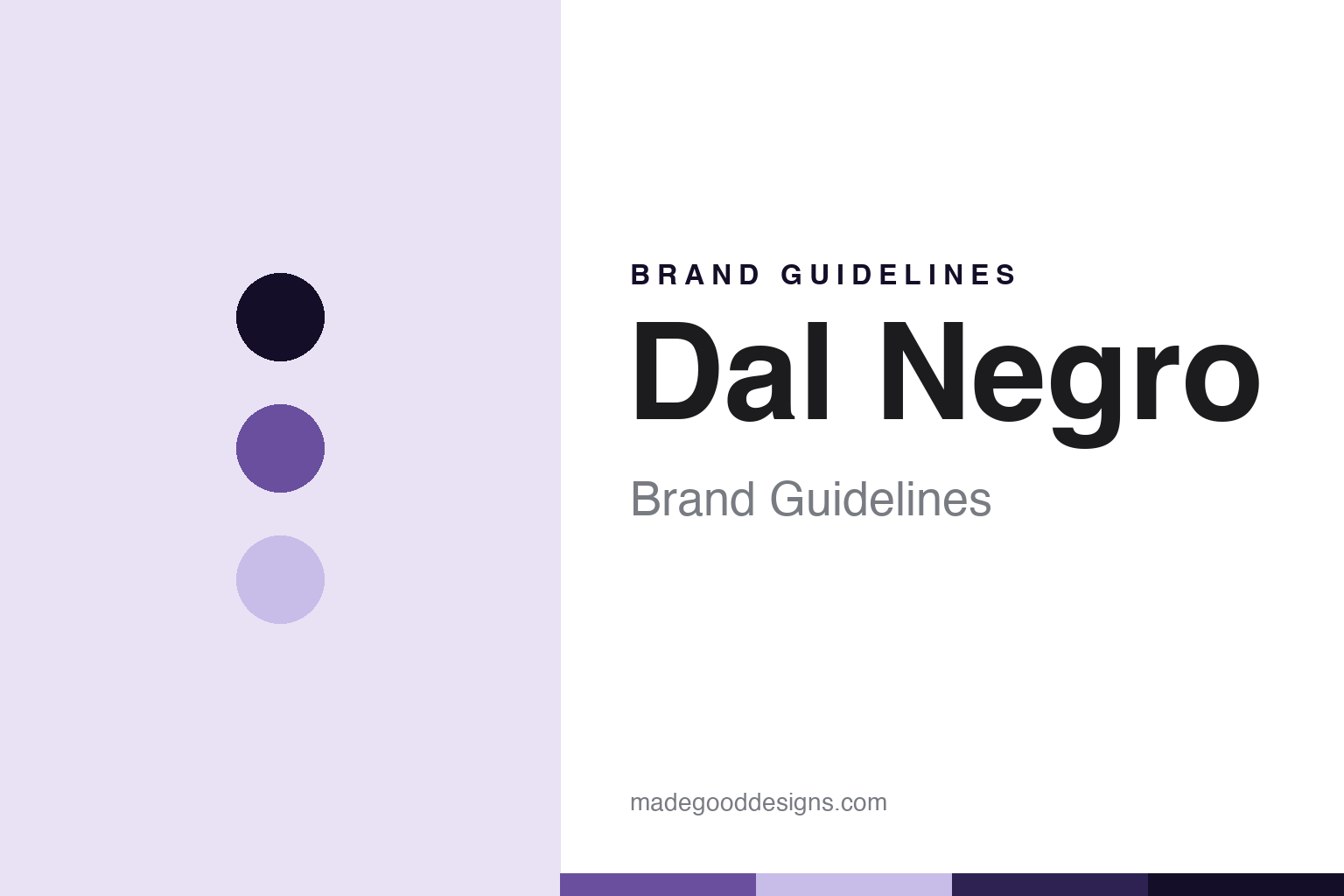
Dal Negro Brand Guidelines
The independent Italian that consolidates too.
Aa
Two constants: a Dal-Negro-violet palette and a maker-sans register. Abstract homage — not a Dal Negro product or mark; no card, tuck or logo is reproduced.
The independent Italian that consolidates too
Dal Negro is the Treviso maker (a card tradition to 1756; the Teodomiro Dal Negro firm) that stands outside the Belgian group and, in its own small way, has rolled up Masenghini and NTP.
Dal Negro closes the playing-card round as its independent-consolidator node — an Italian house outside the Belgian giant that has, on its own scale, done exactly what Cartamundi did: buy up other card names. Its answer to a round about who owns the deck is the mirror: even the independent is a consolidator.
Its identity is the independent Italian that consolidates too. The 1756 tradition, the independent standing and the Masenghini and NTP purchases are the story here. Independent, and a buyer. The independent Italian that consolidates too.
(Honest notes, so the founding, the ownership, the roll-up and hedges are framed accurately. Dal Negro sells playing cards and games as its heroes; we report its language as the brand’s own. On founding: the firm was founded by Teodomiro Dal Negro in the late 1920s to 1930s, with sources conflicting between 1928 and a formal 3 June 1939, on a Treviso card-making tradition dating to 1756, so we frame the dates rather than assert one. On ownership: the legal entity is Teodomiro Dal Negro Fabbrica Carte Da Gioco, with no record of acquisition, so it is a privately held Italian company independent of the Cartamundi group, though we hedge the specific claim of continued family ownership. On the roll-up: it is itself a small consolidator, having acquired Masenghini, a professional-cards maker, in 2003, and NTP of Milan, in plastic and casino cards, in 2004. On the products: regional Italian decks across sixteen patterns, tarot and tarocchi, casino cards, roulette wheels, chess, backgammon and wooden games, plus board games and toys. On the making: Carbonera, in the province of Treviso, its site since 2002. Its designs and the Dal Negro name are IP we describe but do not reproduce; there is no official brand hex; these tones are an unofficial interpretation.)
Colour
Dal Negro lives in a Dal Negro violet. Click a swatch to copy the hex.
Dal Negro’s identity is independent, Italian and a consolidator — a Dal Negro violet, an ink, a pale violet, a deep violet, and a paper. The palette leans Dal Negro violet and deep violet: a distinctive, considered register that stands in for an independent Italian maker rather than a loud logo colour, though its own logo leans red and black. It signals the independent Italian that consolidates too — independent, Italian and a consolidator. The honest caveat: with no official brand hex, these values are a distinctive, unofficial interpretation, not first-party colours.
The lesson is a Dal Negro violet signals an independent, maker identity. Dal Negro’s world is the Italian games table and the workshop. For designers, it is a reminder that a distinctive violet and a pale violet can carry an independent, maker brand — a distinctive tone held as an accent, not a product shot. Because a mid hue can fail as small text, keep type dark and let the colour live in the accents, palette and band. The takeaways: frame the founding between 1928 and 1939 on a 1756 tradition; call it independent of Cartamundi but hedge family ownership; name the Masenghini and NTP purchases; and note Masenghini is a Dal Negro brand, not a rival.
Typography
The register is a maker sans — independent, Italian, a consolidator.
Dal Negro’s identity carries an independent, maker spirit — a games house that buys as well as builds. A maker sans captures the mood: clean, considered and self-reliant, the register of an independent Italian maker. Set in a Dal-Negro-violet palette, the maker sans feels dependable and grounded — exactly the personality Dal Negro carries. It behaves like a made, workshop thing rather than a loud logo, mirroring a tuck-line and an index-line. (Dal Negro’s real products and the name are things we describe but do not reproduce, and the exact typeface is not ours to use.) Because it is not ours to use, the honest description is “a maker-sans brand,” shown here in a stand-in. The type behaves like the brand: independent, Italian and a consolidator.
Aa
A maker-sans brand — dependable and grounded. (Specimen set in Space Grotesk, a maker-sans STAND-IN; NOT the Dal Negro logo or products.)
The playing-card node
Dal Negro stands for the independent Italian that consolidates too.
Dal Negro closes the round as its independent-consolidator node. A Dal-Negro-violet palette, a maker sans and a 1756 tradition make one thing — the independent Italian that consolidates too — the whole identity: independent, Italian and a consolidator. The 1756 tradition is the pitch, the independent standing is the frame, and the Masenghini and NTP purchases are the substance. The point is that even the independent is a buyer, closing the round about who owns the deck.
Put to work, the identity is the brand told straight, the dates framed and the roll-up named. A brand in this spirit would frame the founding between 1928 and 1939 on a 1756 tradition, call it independent of Cartamundi but hedge family ownership, name the Masenghini and NTP purchases, and note that Masenghini is a Dal Negro brand rather than a rival. A reader in this spirit would keep the facts right: Dal Negro makes Italian decks and games; its tradition dates to 1756; it is independent of the Belgian group; and it has bought Masenghini and NTP. Dal Negro closes the round, after Modiano. The honest editorial moves are to frame the dates, to call it independent, to hedge family ownership, and to name the roll-up.
For designers and brand-builders, Dal Negro closes the playing-card node: even an independent can be a consolidator. The lessons: a brand outside the giant can still gather smaller names, here Dal Negro with Masenghini and NTP; a founding is framed, that the Teodomiro Dal Negro firm dates to the late 1920s or 1930s, with sources between 1928 and a formal 3 June 1939, on a Treviso card tradition dating to 1756; an ownership is stated with a hedge, that the legal entity is Teodomiro Dal Negro Fabbrica Carte Da Gioco, with no record of acquisition, so it is a privately held Italian company independent of Cartamundi, though continued family control is not confirmed; a roll-up is named, that it acquired Masenghini, a professional-cards maker, in 2003, and NTP of Milan, in plastic and casino cards, in 2004; and products are described, regional Italian decks across sixteen patterns, tarot and tarocchi, casino cards, roulette wheels, chess, backgammon and wooden games, plus board games and toys, made in Carbonera, in the province of Treviso. It is also a reminder to stay precise: Dal Negro is the independent Italian consolidator of the card aisle, outside the Belgian group — with the palette here an unofficial interpretation, and Masenghini kept clear as a Dal Negro brand rather than a rival. The hook is that standing: Dal Negro is the independent Italian that consolidates too, the Treviso maker on a card tradition to 1756, the Teodomiro Dal Negro firm, that stands outside the Belgian group and, in its own small way, has rolled up Masenghini and NTP. Read that way, Dal Negro is less a single deck than the independent Italian that consolidates too: independent, Italian, a consolidator. The lesson for a brand is that even an independent can be a consolidator reinforces the honesty, and framing the dates keeps it earned. Dal Negro made the-independent-Italian-that-consolidates-too the identity — proof that an independent buyer can close a round.
Explore & save
Keep Dal Negro’s identity on hand — save it to a board in the Made Good inspiration library.
Dal Negro identity set
Pin the Dal-Negro-violet palette and the maker-sans register to your own board.