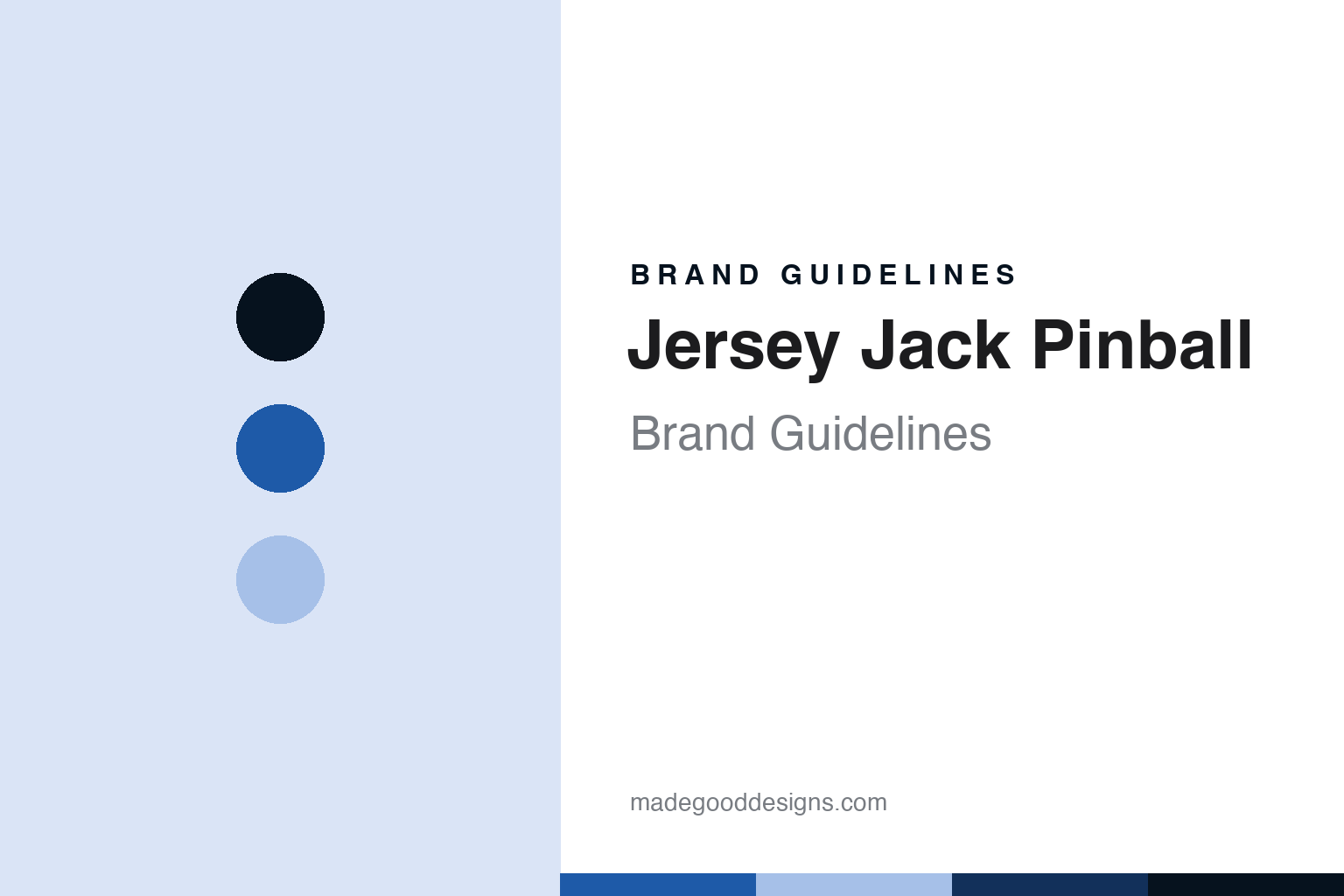
Jersey Jack Pinball Brand Guidelines
The challenger that put a screen in the backbox.
Aa
Two constants: a Jersey-Jack-blue palette and a challenger-sans register. Abstract homage — not a Jersey Jack product or mark; no pinball, screen or logo is reproduced.
The challenger that put a screen in the backbox
Jersey Jack is the 2011 upstart from Jack Guarnieri whose Wizard of Oz brought the first US LCD-backbox pinball — and which now, like Stern, builds in Elk Grove Village, Illinois.
Jersey Jack follows Stern as the round’s challenger node — the first serious modern rival to the survivor, the company that changed what a machine could show. Its answer to a round about who makes the machines is the upstart’s: the one that put a screen in the backbox.
Its identity is the challenger that put a screen in the backbox. The 2011 founding, the Wizard of Oz screen and the Guarnieri ownership are the story here. The modern rival. The challenger that put a screen in the backbox.
(Honest notes, so the founding, the first machine, the ownership and a move are framed accurately. Jersey Jack sells premium pinball machines as its heroes; we report its language as the brand’s own. On founding: Jersey Jack Pinball was founded in January 2011 by Jack Guarnieri, who had serviced electromechanical tables since 1975, in Lakewood, New Jersey. On the first machine: its debut, The Wizard of Oz in 2013, carried a 26-inch LCD in the backbox and was the first United States pinball with an LCD backbox and the first with a colour monitor since Pinball 2000, though not the first worldwide, since Spain’s MarsaPlay had one in 2010, so we say first in the United States. On the ownership: it is still owned by Jack Guarnieri, with minority investors from 2014 and 2015 and no change of control. On the move: it was made in Lakewood, New Jersey from about 2013 to 2019, then relocated to Elk Grove Village, Illinois in 2020, the same town as Stern, so we do not call it a present-day New Jersey maker. Its designs and the Jersey Jack name are IP we describe but do not reproduce; there is no official brand hex; these tones are an unofficial interpretation.)
Colour
Jersey Jack lives in a Jersey Jack blue. Click a swatch to copy the hex.
Jersey Jack’s identity is challenging, premium and independent — a Jersey Jack blue, an ink, a pale blue, a deep navy, and a paper. The palette leans Jersey Jack blue and deep navy: a clean, premium register that stands in for the LCD-era challenger rather than a loud logo colour. It signals the challenger that put a screen in the backbox — challenging, premium and independent. The honest caveat: with no official brand hex, these values are a premium, unofficial interpretation, not first-party colours.
The lesson is a Jersey Jack blue signals a challenging, premium identity. Jersey Jack’s world is the big backbox screen and the elaborate table. For designers, it is a reminder that a clean blue and a pale blue can carry a challenging, premium brand — a premium tone held as an accent, not a product shot. Because a mid hue can fail as small text, keep type dark and let the colour live in the accents, palette and band. The takeaways: date the founding to 2011 and name Jack Guarnieri; call the Wizard of Oz the first US LCD-backbox, not the first ever; keep it Guarnieri-owned; and note the 2020 move to Illinois.
Typography
The register is a challenger sans — challenging, premium, independent.
Jersey Jack’s identity carries a challenging, premium spirit — the upstart that raised the bar. A challenger sans captures the mood: clean, modern and confident, the register of a premium rival. Set in a Jersey-Jack-blue palette, the challenger sans feels current and considered — exactly the personality Jersey Jack carries. It behaves like a made, engineered thing rather than a loud logo, mirroring a playfield-line and a flipper-dot. (Jersey Jack’s real products and the name are things we describe but do not reproduce, and the exact typeface is not ours to use.) Because it is not ours to use, the honest description is “a challenger-sans brand,” shown here in a stand-in. The type behaves like the brand: challenging, premium and independent.
Aa
A challenger-sans brand — current and considered. (Specimen set in Manrope, a challenger-sans STAND-IN; NOT the Jersey Jack logo or products.)
The pinball node
Jersey Jack stands for the challenger that put a screen in the backbox.
Jersey Jack sits second in the round as its challenger node. A Jersey-Jack-blue palette, a challenger sans and a 2011 founding make one thing — the challenger that put a screen in the backbox — the whole identity: challenging, premium and independent. The 2011 founding is the pitch, the Wizard of Oz screen is the substance, and the Guarnieri ownership is the frame. The point is the modern rival that raised the bar, in a round about who makes the machines.
Put to work, the identity is the brand told straight, the superlative bounded and the move noted. A brand in this spirit would date the founding to 2011 and name Jack Guarnieri, call the Wizard of Oz the first US LCD-backbox not the first ever, keep it Guarnieri-owned, and note the 2020 move to Illinois. A reader in this spirit would keep the facts right: Jersey Jack makes premium all-LCD machines; it was founded in 2011 by Guarnieri; its Wizard of Oz was the first US LCD-backbox; and it moved to Illinois in 2020. Jersey Jack sits after Stern and before Chicago Gaming. The honest editorial moves are to date the founding, to bound the superlative, to keep it Guarnieri-owned, and to note the move.
For designers and brand-builders, Jersey Jack carries the pinball node: a challenger can define an era with one feature — bounded honestly. The lessons: a modern rival can change the medium, here Jersey Jack with the LCD backbox; a founding is dated to January 2011 by Jack Guarnieri, an electromechanical-table servicer since 1975, in Lakewood, New Jersey; a first is bounded, that The Wizard of Oz in 2013 was the first United States pinball with an LCD backbox and the first colour monitor since Pinball 2000, though Spain’s MarsaPlay had one in 2010, so first in the United States, not the first ever; an ownership is kept, still owned by Jack Guarnieri with minority investors from 2014 and 2015 and no change of control; and a move is noted, made in Lakewood, New Jersey from about 2013 to 2019, then Elk Grove Village, Illinois from 2020, the same town as Stern. It is also a reminder to stay precise: Jersey Jack is the Guarnieri-owned premium challenger of pinball — with the palette here an unofficial interpretation, and the “first ever” claim bounded to the United States. The hook is that leap: Jersey Jack is the challenger that put a screen in the backbox, the 2011 upstart from Jack Guarnieri whose Wizard of Oz brought the first US LCD-backbox pinball, and which now, like Stern, builds in Elk Grove Village, Illinois. Read that way, Jersey Jack is less a single machine than the challenger that put a screen in the backbox: challenging, premium, independent. The lesson for a brand is that a challenger can define an era with one feature, bounded honestly, and dating the founding keeps it earned. Jersey Jack made the-challenger-that-put-a-screen-in-the-backbox the identity — proof that a challenger can anchor a node.
Explore & save
Keep Jersey Jack Pinball’s identity on hand — save it to a board in the Made Good inspiration library.
Jersey Jack identity set
Pin the Jersey-Jack-blue palette and the challenger-sans register to your own board.