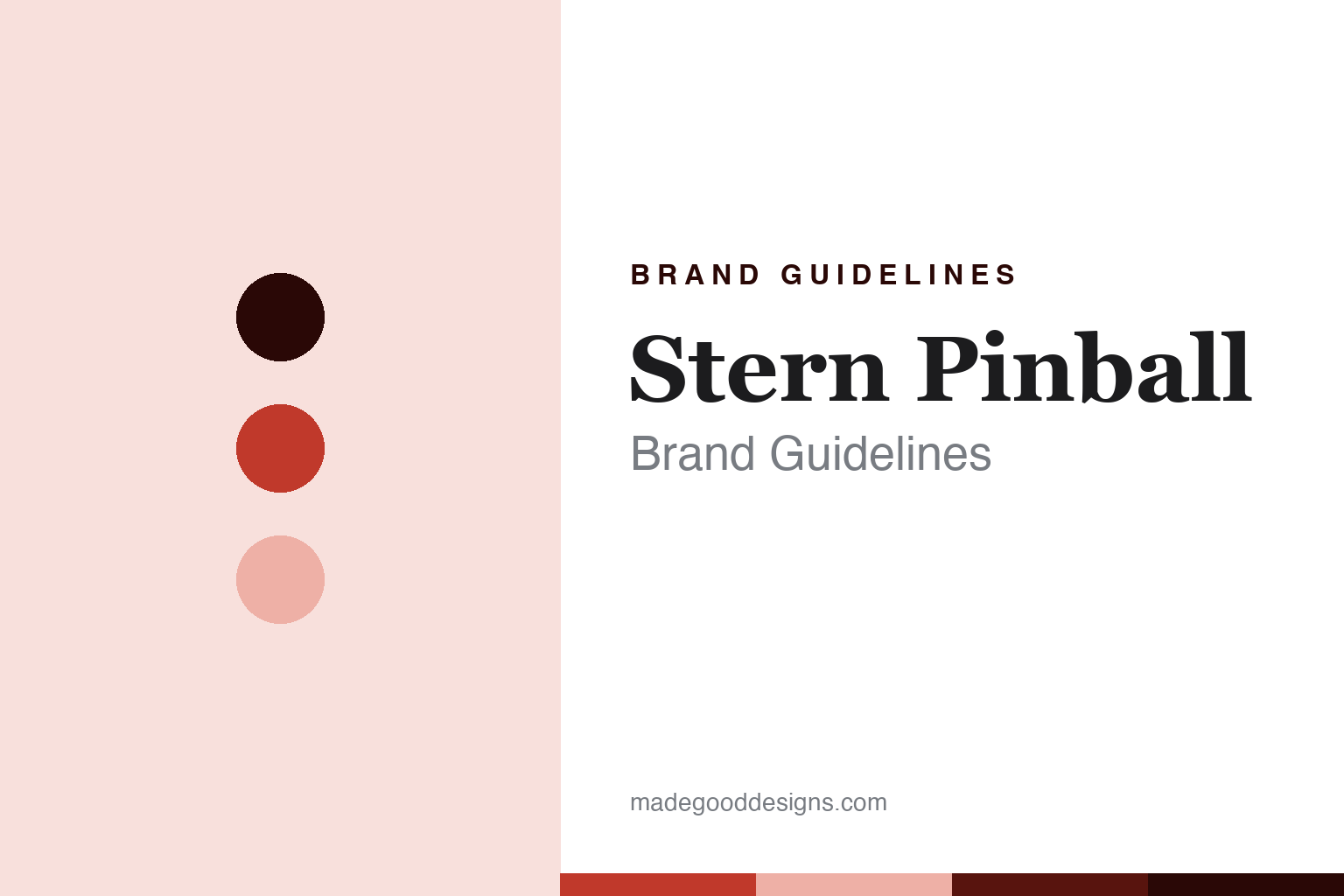
Stern Pinball Brand Guidelines
The last one standing.
Aa
Two constants: a Stern-red palette and a survivor-serif register. Abstract homage — not a Stern product or mark; no pinball, flipper or logo is reproduced.
The last one standing
Stern Pinball is the lone continuous survivor of pinball, formed in 1999 by Gary Stern out of Sega’s pinball division — its family line running back through Data East and Stern Electronics to the Williams era.
Stern opens the pinball round as its survivor node — the one maker that never stopped, the through-line from the classic era to the modern boom, and so the natural start for a round about who owns pinball. Its answer to a round about who makes the machines is endurance: the last one standing.
Its identity is the last one standing. The 1999 founding, the family lineage and the survivor role are the story here. The one that never stopped. The last one standing.
(Honest notes, so the founding, the lineage, the ownership and hedges are framed accurately. Stern sells pinball machines as its heroes; we report its language as the brand’s own. On founding: the modern company, Stern Pinball, Inc., was formed in 1999 when Gary Stern bought Sega’s pinball division, based in Elk Grove Village, Illinois, with Gary Stern as founder, chairman and chief executive. On the lineage: Gary’s father Sam Stern part-owned Williams Manufacturing from the late 1940s, and the line runs through Chicago Coin’s assets into Stern Electronics from 1976, which closed in 1985, then Data East Pinball from 1986, then Sega Pinball from 1994, then Stern Pinball from 1999, so we treat the 1999 entity as the survivor and the Williams era as a family and personnel link rather than a corporate merger. On the ownership: Gary Stern remains chairman and chief executive, with private-equity backing since a 2009 partnership with Hagerty Peterson, and a later reported majority investment we hedge rather than assert, the company being privately held with its split not disclosed. On the products: the leading maker, with Pro, Premium and Limited Edition tiers, the Insider Connected platform and licensed themes. Its designs and the Stern name are IP we describe but do not reproduce; there is no official brand hex; these tones are an unofficial interpretation.)
Colour
Stern lives in a Stern red. Click a swatch to copy the hex.
Stern’s identity is surviving, leading and heritage — a Stern red, an ink, a pale red, a deep crimson, and a paper. The palette leans Stern red and deep crimson: a bold, heritage register that nods to the last continuous maker rather than a loud logo colour, though its own look leans black, white and red. It signals the last one standing — surviving, leading and heritage. The honest caveat: with no official brand hex, these values are a heritage, unofficial interpretation, not first-party colours.
The lesson is a Stern red signals a surviving, leading identity. Stern’s world is the arcade line and the licensed table. For designers, it is a reminder that a bold red and a pale red can carry a surviving, leading brand — a heritage tone held as an accent, not a product shot. Because a strong hue can fail as small text, keep type dark and let the colour live in the accents, palette and band. The takeaways: date the modern company to 1999 and trace the lineage carefully; frame Williams as a family link, not a merger; hedge the current ownership split; and keep it distinct from Stern Electronics.
Typography
The register is a survivor serif — surviving, leading, heritage.
Stern’s identity carries a surviving, leading spirit — the maker that outlasted the crash. A survivor serif captures the mood: established, confident and classic, the register of a name that endured. Set in a Stern-red palette, the survivor serif feels dependable and earned — exactly the personality Stern carries. It behaves like a made, worn thing rather than a loud logo, mirroring a flipper-dot and a bumper-ring. (Stern’s real products and the name are things we describe but do not reproduce, and the exact typeface is not ours to use.) Because it is not ours to use, the honest description is “a survivor-serif brand,” shown here in a stand-in. The type behaves like the brand: surviving, leading and heritage.
Aa
A survivor-serif brand — dependable and earned. (Specimen set in Fraunces, a survivor-serif STAND-IN; NOT the Stern logo or products.)
The pinball node
Stern stands for the last one standing.
Stern opens the round as its survivor node. A Stern-red palette, a survivor serif and a 1999 founding make one thing — the last one standing — the whole identity: surviving, leading and heritage. The 1999 founding is the pitch, the family lineage is the substance, and the survivor role is the frame. The point is the one that never stopped, anchoring a round about who owns pinball.
Put to work, the identity is the brand told straight, the lineage traced and the ownership hedged. A brand in this spirit would date the modern company to 1999 and trace the lineage carefully, frame Williams as a family link not a merger, hedge the current ownership split, and keep it distinct from Stern Electronics. A reader in this spirit would keep the facts right: Stern makes pinball machines; the modern company dates to 1999; it is the lone survivor; and Gary Stern is chairman and chief executive. Stern opens the round, before Jersey Jack. The honest editorial moves are to date the company, to trace the lineage, to hedge the ownership, and to keep the name distinct.
For designers and brand-builders, Stern opens the pinball node: anchor a round with the survivor that carried the whole craft through. The lessons: an industry that nearly died can have one continuous survivor, here Stern; a founding is dated to 1999, when Gary Stern bought Sega’s pinball division, in Elk Grove Village, Illinois, with Gary Stern as founder, chairman and chief executive; a lineage is traced, from Sam Stern’s part-ownership of Williams through Chicago Coin into Stern Electronics from 1976, closed 1985, then Data East from 1986, Sega from 1994 and Stern from 1999, with the 1999 entity the survivor and Williams a family link not a merger; an ownership is hedged, that Gary Stern remains chairman and chief executive with private-equity backing since a 2009 Hagerty Peterson partnership and a later reported majority investment left unasserted; and products are named, the Pro, Premium and Limited Edition tiers, Insider Connected and licensed themes. It is also a reminder to stay precise: Stern is the lone-survivor leader of pinball — with the palette here an unofficial interpretation, and Stern Electronics kept clear. The hook is that endurance: Stern Pinball is the last one standing, the lone continuous survivor of pinball, formed in 1999 by Gary Stern out of Sega’s pinball division, its family line running back through Data East and Stern Electronics to the Williams era. Read that way, Stern is less a single machine than the last one standing: surviving, leading, heritage. The lesson for a brand is that anchoring a round with the survivor that carried the craft through reinforces the honesty, and dating the company keeps it earned. Stern made the-last-one-standing the identity — proof that a survivor can open a round.
Explore & save
Keep Stern Pinball’s identity on hand — save it to a board in the Made Good inspiration library.
Stern identity set
Pin the Stern-red palette and the survivor-serif register to your own board.