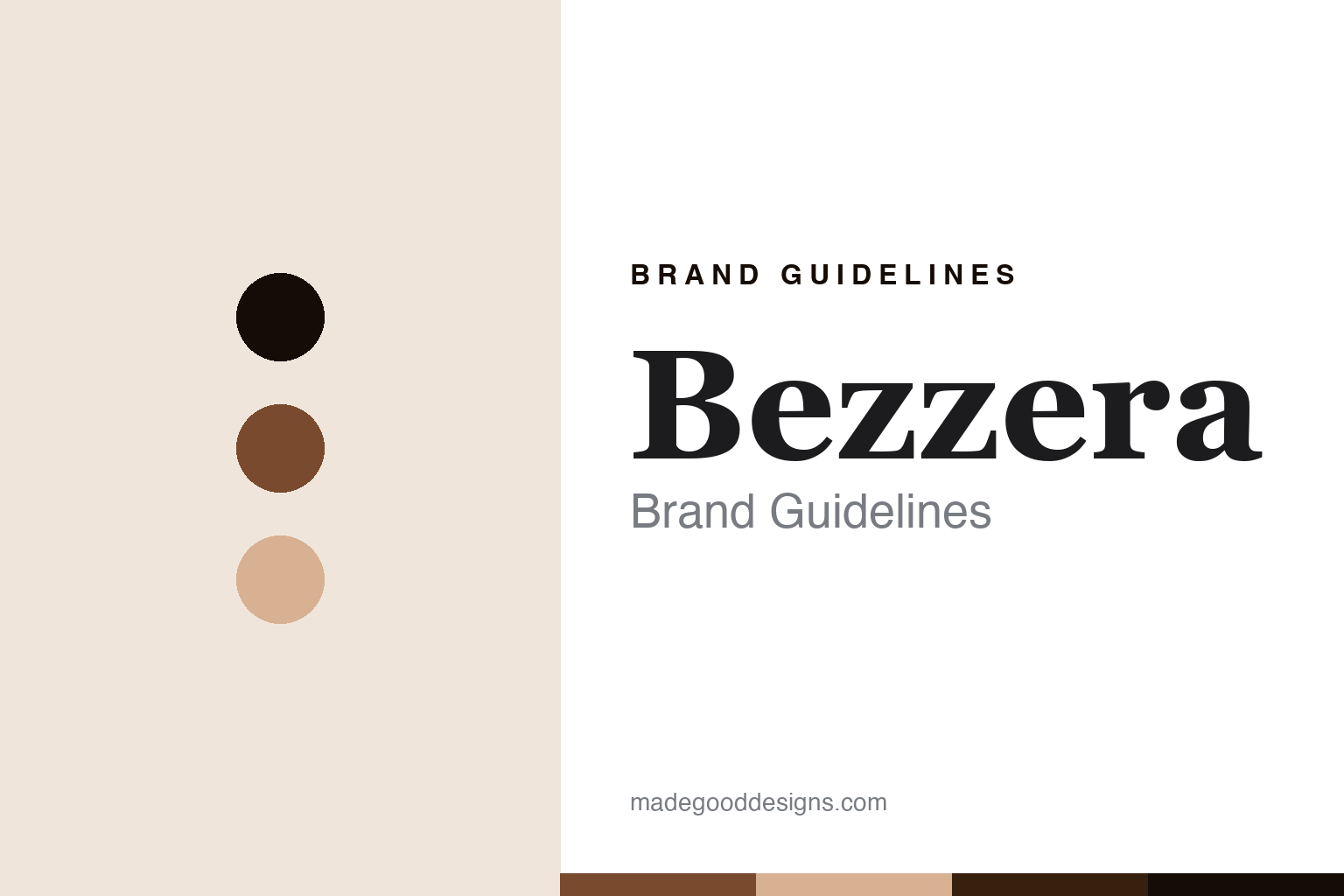
Bezzera Brand Guidelines
Where espresso began.
Aa
Two constants: a chestnut palette and a heritage-serif register. Abstract homage — not a Bezzera product or mark.
Where espresso began
Bezzera is the Milanese house of Luigi Bezzera’s 1901 espresso patent, still family-run and 100% made in Italy.
Bezzera opens the round at the beginning — the Milanese name on the 1901 patent that helped invent espresso itself. Bezzera makes espresso machines for the home and the café, and grinders, on a lineage that reaches back to the machine that started it all. Its answer to how a maker becomes a name is simply to have been first, and to still be here: hold the oldest name in espresso, and keep making in Italy, in the same family. A machine, from where espresso began.
Its identity is where espresso began. Bezzera’s 1901 patent heritage, its family ownership and its Italian making are the work it is known for. A machine, made in Italy. Where espresso began.
(Honest notes, so the story stays precise, because the heritage needs care. Bezzera — at bezzera.it, as Bezzera S.r.l. — makes home and commercial espresso machines and grinders. Its origin is Luigi Bezzera’s patent, filed in December 1901, for a steam-pressure machine with a filter-holder — the group-head idea still used today. A crucial nuance: Luigi Bezzera sold that patent to Desiderio Pavoni, who founded La Pavoni in 1905 and commercialised espresso, so the patent’s fame ran through Pavoni; but the Bezzera company itself continued independently, so this is a genuine, continuous house, not a revived name — and we do not imply Bezzera built its business on a single patent monopoly. On where it is made — a theme of this round — Bezzera states it is one hundred per cent made in Italy, in the Milan area. On ownership, it is family-owned across four generations, now led by Luca Bezzera; it is independent, not part of a group. Some legacy names (the Strega lever among them) now appear as grinders on its site, so we keep the machine-versus-grinder labels careful. Its name and marks are IP, described but never reproduced, and there is no official brand hex; these tones are an unofficial interpretation. This is design commentary and does not promote any product.)
Colour
Bezzera lives in a chestnut palette. Click a swatch to copy the hex.
Bezzera’s identity is historic, made and warm — a chestnut, an ink, a crema, a deep brown, and a paper. The palette leans chestnut and crema: the warm register of an old Milanese workshop and a fresh shot’s crema. It signals the oldest name in espresso. The honest caveat: with no published brand hex, these values are an original, unofficial interpretation, not first-party colours.
The lesson is a chestnut palette signals a historic, made-in-Italy identity. Bezzera’s world is a warm, historic object. For designers, it is a reminder that a deep chestnut and a soft crema can carry an espresso house — the warmth of heritage and the colour of the drink itself. Because these tones can fail as small text, keep type dark and let the colour live in the accents, palette and band. The takeaways: hold a genuine heritage; keep the family and the making; tell the patent story honestly; and treat any single hex as unofficial.
Typography
The register is a heritage serif — classical, historic, made.
Bezzera’s identity carries a classical, historic, made spirit — the oldest name in espresso, not a newcomer. A heritage serif captures the mood: traditional, warm and Milanese, the register of a house that reaches back to 1901. Set in a chestnut palette, the heritage serif feels classical and historic — exactly the personality Bezzera carries. It is a genuine heritage rather than a logo, mirroring the first espresso machine. (Bezzera’s real wordmark, and any machine shape, are things we describe but do not reproduce, and the exact typeface is not ours to use.) Because it is not ours to use, the honest description is “a heritage-serif spirit,” shown here in a stand-in. The type behaves like the machine: classical, historic and made.
Aa
A heritage-serif spirit — classical and historic. (Specimen set in Cormorant Garamond, a heritage-serif STAND-IN; NOT the Bezzera logo.)
The espresso machine makers
Bezzera stands for where espresso began, made in Italy.
Bezzera opens the round at the source, with its heritage told honestly. A chestnut palette, a heritage serif and the 1901 patent make one thing — where espresso began — the whole identity: historic, made and warm. The genuine 1901 heritage is the differentiator, and the continuous Italian family making is the meaning. The point is the oldest name in espresso, still family-run and made in Italy, whose founder’s patent helped invent the drink.
Put to work, the identity is a genuine heritage, told straight, as design. A maker in this spirit would hold a real origin and keep making at home — espresso machines, in Italy, in the family. A reader in this spirit would keep the patent story right: Luigi Bezzera’s 1901 patent helped birth espresso, but he sold it to Desiderio Pavoni, so the fame ran through La Pavoni — while the Bezzera company continued on its own. Bezzera opens the round’s Italian-heartland thread, and it opens the round’s shared-patent lineage with La Pavoni, the two ends of the same 1901 patent sitting side by side in this round. It holds the independent, family pole against the group-owned makers to come. The honest editorial moves are to tell the patent-to-Pavoni story rather than imply a monopoly, to state the Italian making plainly, and to keep the legacy model names careful. The lesson Bezzera teaches is that a genuine heritage can hold an identity: the 1901 origin gives it substance, and the continuous family making keeps it credible. Where espresso began is the personality, and the 1901 patent is the proof.
For designers and brand-builders, Bezzera opens the espresso machine makers, from Italy: hold a genuine heritage — and tell it honestly. The lessons: own a real origin; keep the family and the making; frame a founding patent without overclaiming; keep model labels precise; and never reproduce a logo. It is also a reminder to stay precise: Bezzera is the Milanese house of Luigi Bezzera’s 1901 espresso patent, still family-run and 100% made in Italy — with the palette here an unofficial interpretation. Bezzera made where-espresso-began the identity — proof that a machine, honestly told, can be the difference.
Explore & save
Keep Bezzera’s identity on hand — save it to a board in the Made Good inspiration library.
Bezzera identity set
Pin the chestnut palette and the heritage-serif register to your own board.