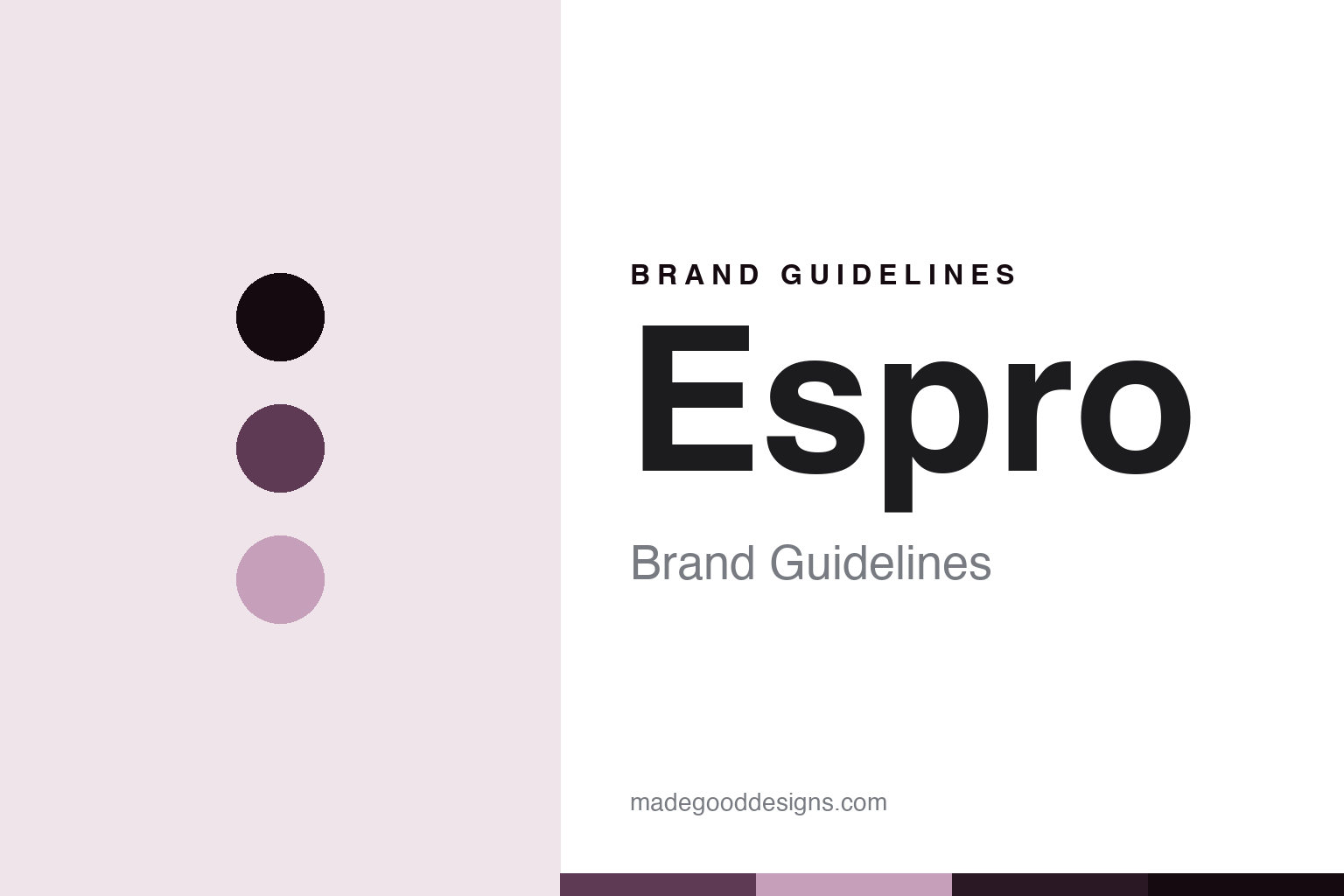
Espro Brand Guidelines
The clean press.
Aa
Two constants: a plum palette and a press-sans register. Abstract homage — not an Espro product or mark.
The clean press
Espro is the Vancouver-designed coffee press with a double micro-filter for clean, sediment-free coffee, made overseas.
Espro is the round’s press-maker — a Vancouver-designed brand that made the French press clean. Espro makes coffee and tea presses, and it is known for its double micro-filter. Its answer to how a maker becomes a name is one fix to an old method: put two fine filters in a press so the coffee comes out clean, without the grit. A press, that filters twice.
Its identity is the clean press. Espro’s double micro-filter, its press range and its Vancouver design are the work it is known for. A press, made overseas. The clean press.
(Honest notes, so the story stays precise. Espro — at espro.com — makes coffee and tea presses; its signature is the Espro Press, a French press whose patented double micro-filter is far finer than a standard press screen, giving clean, sediment-free coffee, across the P3, P5, P6 and P7 and the travel P0 and P1, with tea micro-filters too. It was founded, as reported, around 2007 in Vancouver, Canada, by Chris McLean and Bruce Constantine, whose first names the site gives. On where it is made — a theme of this round — Espro does not state a country of manufacture; it is a Canadian design brand, with manufacture overseas, reported to be in Asia, so we do not claim it is made in Canada. On ownership, it is an independent, founder-run company, which we present as reported. An earlier Bloom pour-over is no longer in its range, so we describe Espro by its presses. Its name and marks, and the press’s form, are IP, described but never reproduced, and there is no official brand hex; these tones are an unofficial interpretation. This is design commentary and does not promote any product.)
Colour
Espro lives in a plum palette. Click a swatch to copy the hex.
Espro’s identity is clean, made and refined — a plum, an ink, a lilac, a deep plum, and a paper. The palette leans plum and lilac: a refined register for a press that made coffee clean. It signals a double-filtered press. The honest caveat: with no published brand hex, these values are an original, unofficial interpretation, not first-party colours.
The lesson is a plum palette signals a clean, refined identity. Espro’s world is a clean, refined object. For designers, it is a reminder that a deep plum and a soft lilac can carry a coffee house — the refinement of a clean cup. Because these tones can fail as small text, keep type dark and let the colour live in the accents, palette and band. The takeaways: fix an old method; make it clean; be honest about the make; and treat any single hex as unofficial.
Typography
The register is a press sans — clean, precise, modern.
Espro’s identity carries a clean, precise, modern spirit — a refined press-maker, not a basic one. A press sans captures the mood: tidy, exact and contemporary, the register of a press engineered for clean coffee. Set in a plum palette, the press sans feels clean and precise — exactly the personality Espro carries. It is a double filter rather than a logo, mirroring a sediment-free cup. (Espro’s real wordmark, and the press’s form, are things we describe but do not reproduce, and the exact typeface is not ours to use.) Because it is not ours to use, the honest description is “a press-sans spirit,” shown here in a stand-in. The type behaves like the press: clean, precise and modern.
Aa
A press-sans spirit — clean and precise. (Specimen set in Manrope, a press-sans STAND-IN; NOT the Espro logo.)
The brewing makers
Espro stands for the clean press, made overseas.
Espro is a lesson in how one fix can be an identity. A plum palette, a press sans and a double filter make one thing — the clean press — the whole identity: clean, made and refined. The double micro-filter is the differentiator, and the clean cup is the meaning. The point is a Vancouver-designed brand that fixed the French press’s grit with two fine filters, and is honest that the make is overseas.
Put to work, the identity is one fix, told straight, as design. A maker in this spirit would solve one flaw in an old method — grit in a press — and design the fix in Vancouver. A reader in this spirit would keep the make honest: Espro is a Canadian design brand, but it does not state a country of manufacture, so the making is overseas and a reader should not assume Canadian production. Espro holds the round’s designed-here-made-overseas thread with Ratio, Orea, Goat Story and Cafelat, against the made-at-home Melitta and Origami, and it carries the round’s brewing-method thread as the press. The honest editorial moves are to present the founding and founders as reported, to state the overseas make plainly, and to describe Espro by its current presses rather than a discontinued pour-over. The lesson Espro teaches is that one fix can hold an identity: the double filter gives it substance, and the clean cup keeps it credible. The clean press is the personality, and the double micro-filter is the proof.
For designers and brand-builders, Espro holds a designed-here pole in the brewing makers: fix one flaw — and be honest about the make. The lessons: solve a real problem in an old method; engineer the fix; don’t claim a country you don’t state; describe the current range, not the discontinued; and never reproduce a logo. It is also a reminder to stay precise: Espro is the Vancouver-designed coffee press with a double micro-filter for clean, sediment-free coffee, made overseas — with the palette here an unofficial interpretation. The double micro-filter carries the substance, and the clean cup carries the reputation; together they show that a single, well-engineered fix to a centuries-old brewing method can define a brand, and that describing the current range rather than a discontinued one keeps the story honest. Espro made the clean press the identity — proof that a press, honestly told, can be the difference.
Explore & save
Keep Espro’s identity on hand — save it to a board in the Made Good inspiration library.
Espro identity set
Pin the plum palette and the press-sans register to your own board.