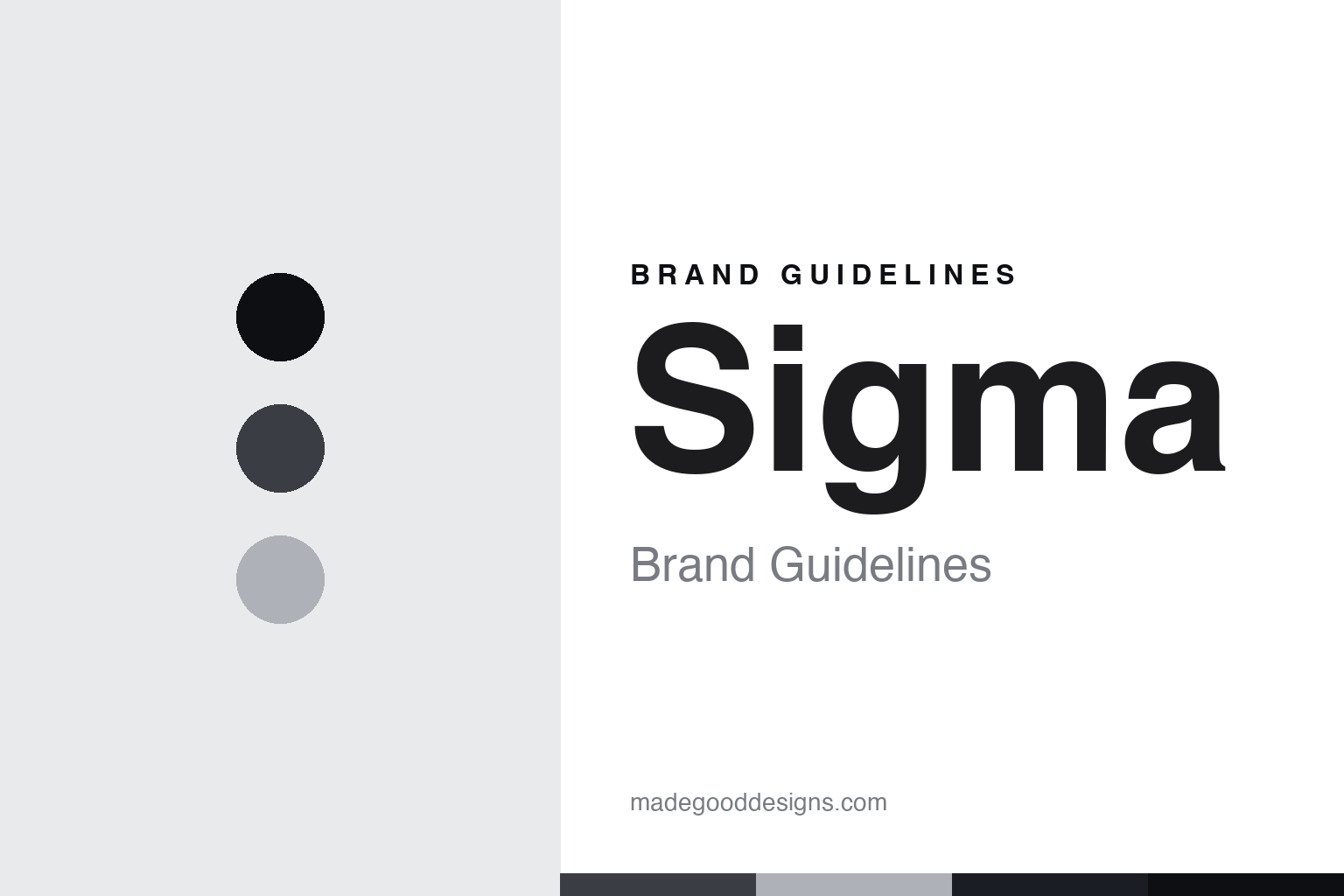
Sigma Brand Guidelines
All made in one place.
Aa
Two constants: a charcoal palette and a precision-sans register. Abstract homage — not a Sigma product or mark.
All made in one place
Sigma is the independent, family-owned Japanese lens and camera maker that builds every product at a single factory in Aizu, Japan.
Sigma opens the vein with the cleanest maker story in optics — everything, made in one place. From Japan, Sigma makes interchangeable photographic lenses — its Art, Contemporary and Sports lines — along with the fp full-frame camera and cine lenses, and it makes them all at a single factory. Its answer to how a maker becomes a name is total, in-house Japanese making: design, engineer and build every product itself, in one plant. A lens, made entirely in one Japanese factory.
Its identity is all made in one place. Sigma’s single Aizu factory, its Art-line lenses and its independent family ownership are the work it is known for. A lens, made in Japan. One maker, one factory.
(Honest notes, so the story stays precise. Sigma — at sigma-global.com — makes interchangeable lenses in its Art, Contemporary and Sports lines, the fp and fp L full-frame cameras, cine lenses, and, historically, the Foveon-sensor DP and Merrill compacts. On where it is made — a key thread of this vein — Sigma states that all its products are produced at its own Aizu factory in Bandai, Fukushima, Japan, with its work based entirely in Japan from concept to assembly, so we state the single-factory, made-in-Japan story plainly. On ownership, Sigma describes itself as the world’s largest independent lens manufacturer and a family-owned business; it was founded in 1961 by Michihiro Yamaki, and is reported to be led today by his son, Kazuto Yamaki, which we attribute. It joined the L-Mount Alliance with Leica and Panasonic in 2018. A long-promised full-frame Foveon camera has been repeatedly delayed; we treat it as still in development rather than a shipping product. Its name and marks are IP, described but never reproduced, and there is no official brand hex; these tones are an unofficial interpretation. This is design commentary and does not promote any product.)
Colour
Sigma lives in a charcoal palette. Click a swatch to copy the hex.
Sigma’s identity is precise, made and understated — a charcoal, an ink, a silver, a deep charcoal, and a paper. The palette leans charcoal and silver: the register of anodised metal and coated glass. It signals precision optics. The honest caveat: with no published brand hex, these values are an original, unofficial interpretation, not first-party colours.
The lesson is a charcoal palette signals a precise, made-in-house identity. Sigma’s world is a precise, metal-and-glass object. For designers, it is a reminder that a deep charcoal and a cool silver can carry an optics maker — the tone of anodised metal and the neutral of a lens barrel. Because these tones can fail as small text, keep type dark and let the colour live in the accents, palette and band. The takeaways: make it all yourself; keep it in one place; let the precision speak; and treat any single hex as unofficial.
Typography
The register is a precision sans — clean, exact, made.
Sigma’s identity carries a clean, exact, made spirit — a precision optics maker, not a marketing-led brand. A precision sans captures the mood: even, engineered and quiet, the register of a single Japanese factory. Set in a charcoal palette, the precision sans feels exact and made — exactly the personality Sigma carries. It is in-house precision rather than a logo, mirroring a machined lens barrel. (Sigma’s real wordmark is a thing we describe but do not reproduce, and the exact typeface is not ours to use.) Because it is not ours to use, the honest description is “a precision-sans spirit,” shown here in a stand-in. The type behaves like the lens: clean, exact and made.
Aa
A precision-sans spirit — exact and made. (Specimen set in Work Sans, a precision-sans STAND-IN; NOT the Sigma logo.)
The optics houses
Sigma stands for the maker that builds everything in one place.
Sigma opens the vein with its clearest question answered: who makes the glass, and where? A charcoal palette, a precision sans and an Art-line lens make one thing — all made in one place — the whole identity: precise, made and understated. The single Aizu factory is the differentiator, and the independent family ownership is the meaning. The point is a maker that designs and builds every product itself, in one Japanese plant, and answers for it.
Put to work, the identity is in-house making, told straight, as design. A maker in this spirit would keep everything under one roof and let precision be the pitch — lenses and cameras, all made in Aizu. A brand learning from it would see that single-site making can be an identity — that “everything made in one Japanese factory” is a proof a marketing claim cannot fake — and that being precise, founded 1961 by Michihiro Yamaki, family-owned still, keeps it honest. Sigma sets the vein’s two threads at their simplest: ownership, family and independent; and where-made, one factory, one country. It is the clean baseline against which the vein’s more tangled cases — a foundation, a licensed name, a private-equity owner, a name that outran its origin — will be read. The honest editorial moves are to state the single-factory making plainly, to attribute the father-to-son succession, and to treat the Foveon revival as unshipped. The lesson Sigma teaches is that making everything in one place can hold an identity: the factory gives it substance, and the independence keeps it credible. The one factory is the personality, and the Art-line lens is the proof.
For designers and brand-builders, Sigma opens the optics houses, from Japan: make it yourself — and keep it in one place. The lessons: control the whole build; concentrate the making; let precision be the story; stay honest about what has not shipped; and never reproduce a logo. It is also a reminder to stay precise: Sigma is the independent, family-owned Japanese lens and camera maker that builds every product at a single factory in Aizu, Japan — with the palette here an unofficial interpretation. Sigma made single-site making the identity — proof that a lens, honestly made, can be the difference.
Explore & save
Keep Sigma’s identity on hand — save it to a board in the Made Good inspiration library.
Sigma identity set
Pin the charcoal palette and the precision-sans register to your own board.