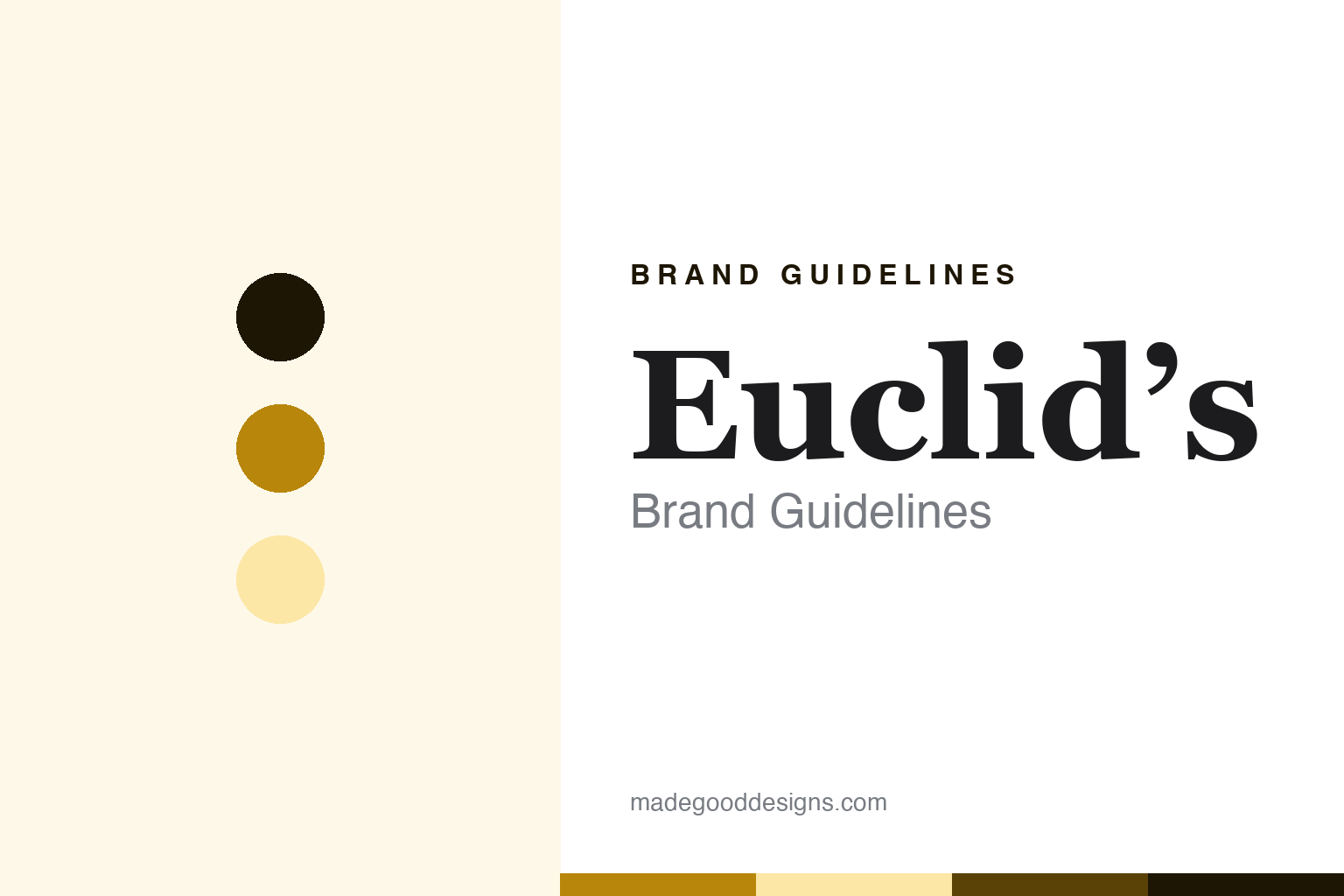
Euclid’s Brand Guidelines
“He wrote the book on elements.”
Aa
Two constants: an element-gold palette and a classical-serif register. Abstract homage — not a Euclid’s or PSH product or mark; no kiln or logo is reproduced.
A pottery supplier on Sixteen Mile Creek
Euclid’s is a brand inside a Canadian family supply house.
Euclid’s belongs to The Pottery Supply House, or PSH, of Oakville, Ontario, on the shore of Lake Ontario west of Toronto. “Euclids is a division of The Pottery Supply House,” the brand says, and “PSH manufactures ‘Euclid Kilns’ and ‘Euclid’s Elements’.” Its history is that of two men: “The Pottery Supply House, in Oakville, Ontario was founded in 1958 by Jorgen Poschmann (1927-2018). His partner, Graham Willis, joined the company in 1961 and the company was incorporated in 1964.”
The division of labour, as the company tells it, explains the brand: “Jorgen’s expertise in ceramic materials… combined with Graham’s talent for designing and building kilns.” The business began in a converted granary on Sixteen Mile Creek in the 1960s, moved to a purpose-built building “complete with Tim Rainey sculpture,” where it spent twenty years, and is now at Speers Road in Oakville.
Both founding families still own it. The company names its owners as Eric Poschmann, who also runs a sister business in São Paulo, PSH Brasil; Gunnar Poschmann; and Jeremy Willis, its managing director and a custom-kiln engineer. On a page about American tariffs it calls itself “A small Canadian-owned business.” Its kilns are built in-house; the company names kiln builders on its staff, and says one of them “now builds our pottery kilns.”
Colour
“Euclid, he wrote the book on elements!”
The name is a joke that works on two levels. Euclid, the Greek mathematician, wrote the Elements, the most famous textbook in history; a kiln’s heating coils are also called elements. Euclid’s makes the point itself: “Euclid, he wrote the book on elements!” Its element business is the brand’s backbone. It custom-winds replacement elements, it says, for “Skutt, Paragon, L&L, Olympic, Evenheat, Cone Art… including ones that are no longer in business” — the competitors’ names listed on its own page, because their kilns all wear out the same part.
Its kilns range from the R-Series top-loaders — R-10 to R-450L — to front-loading “CF” models and glass annealers. A mid-sized R-153 is rated to 2380°F, Cone 10, with 5.7 cubic feet of space, at CA$5,280; the company highlights its “Euclid’s exclusive Halo Lid” and hinges of “1/8” solid steel,” and fits Bartlett’s V6-CF digital controller, with a Genesis upgrade for “+$300.” Beyond pottery and glass kilns, PSH also builds industrial kilns and furnaces under its own name, as “PSH Kilns & Furnaces” — the industrial sibling of the potter’s brand, under the parent company’s name rather than the Greek one. And the Canadian business is exposed to trade policy like any other: on one page the company notes that some clay and glazes are “temporarily unavailable for shipment to the United States.”
It is also unusually candid in its marketing, and it offers a two-year warranty on its kilns. One page opens: “32% Energy Savings! Sounds good but is it true? It’s not that simple…” — a kiln maker questioning a headline number, even one it could have used. That tone suits a company whose brand is a footnote joke about geometry.
Typography
The listing mark.
In Canada the listing mark is a condition of sale. Ontario’s Electrical Safety Authority puts it bluntly: “Before an electrical product or piece of electrical equipment is used, sold, displayed or advertised for sale in Ontario, it must be approved by an accredited certification or evaluation agency,” and it must “carry the official mark or label of the agency.” It adds that “Installation and connection of unapproved electrical equipment is against the law, puts people at risk and can lead to prosecution.” The recognised marks include CSA, Intertek and both the Canadian and American Underwriters Laboratories.
That makes the mark especially important for an Oakville kiln builder. The same logic applies south of the border, where the Occupational Safety and Health Administration says workplace electrical equipment is “acceptable only if approved,” usually by being listed or labelled by a recognised testing laboratory — a list that includes CSA’s testing arm in Etobicoke, Ontario, alongside UL and Intertek. The standard American kiln makers cite is UL 499, for appliances that generate heat “to perform its intended function.”
We searched every product listing on Euclid’s website and found no mention of a CSA, UL or other listing mark for its own kilns; on a resold kiln from another maker, the company’s text did state certification. That is a statement about the website, not about the kilns, which may carry marks on their nameplates that we have not seen, and we do not say whether Euclid’s kilns are certified. Buyers in Ontario, where the rule is explicit, should look for the agency mark on the kiln before it is installed. Ontario is, by coincidence, home to two of this round’s kiln makers: Euclid’s in Oakville and Cone Art in Richmond Hill, whose product pages state “CSA approved.” Both build for a province whose electrical-safety regulator treats the mark as the price of entry to the market.
Ω
A classical serif — the type of a Greek textbook. (Specimen set in Fraunces, a serif STAND-IN; NOT the Euclid’s logo.)
A sun, or an ohm
A yellow glyph and a script name.
Euclid’s logo is a yellow, sun-like glyph shaped like the Greek letter omega, Ω, beside a yellow script “Euclid’s.” Omega is also the symbol for the ohm, the unit of electrical resistance — and resistance is exactly what a kiln element provides, turning current into heat. We cannot confirm that the double meaning is intended; it is our reading, and an apt one for a brand whose name is already a pun.
For a design guide, Euclid’s shows how far a small company can travel on wit. A pottery supply house in Oakville has given its kilns the name of the most famous mathematician of antiquity, and the joke does real work: it tells buyers, in one line, that this is the company to ask about elements. It also flatters them a little. A potter who gets the pun is, by implication, the kind of customer who reads the manual — which, for a kiln, is exactly the customer a maker wants.
For this guide we use an element gold and a pale sun with a classical serif. These are an unofficial interpretation, not Euclid’s colour values, and nothing of its logo is reproduced.
Explore & save
Keep Euclid’s’s identity on hand — save it to a board in the Made Good inspiration library.
Euclid’s identity set
Pin the element-gold palette and the classical-serif register to your own board.