Cone Art Kilns Brand Guidelines
“CSA approved,” in plain sight.
Aa
Two constants: a cone-navy palette and a condensed-sans register. Abstract homage — not a Cone Art product or mark; no kiln or logo is reproduced.
A supplier that had to build its own
Cone Art exists because a kiln maker closed.
Cone Art’s founder tells its story on the company’s about page, under his own name. “When Tucker’s Pottery Supplies, Cone Art’s parent company, opened in 1975 we purchased kilns from companies based in the U.S. Around 1980 we started also working with a small kiln company based in Ontario, Canada. That company suddenly closed and we began a mission to do this ourselves.” The signature reads “Frank Tucker, President & Founder.” The company says it has been making kilns “since 1982.”
It inherited a craftsman as well as a gap in the market. The closed firm’s builder, Kent Van Deventer, Tucker writes, “designed and built all of our machines for building kilns…..several of which, we still use to this day” — groove cutters for firebrick, element winders, slab cutters. “I often think that there would be no Cone Art Kilns without Kent.” And it set itself a competitive brief: “We decided that we would not be able to compete with the U.S. based companies unless we built a better product.” The result, Tucker says, was a kiln seen as “a more European / industrial style.”
Cone Art is family-owned, and its general manager is Michael Leonard. It sells abroad as well as at home, through distributors, it says, in “Australia, India, China, South Korea, Sweden, as well as all over North America.”
Colour
Owned by Shimpo, then bought back — by one account.
Cone Art’s own pages tell a continuous family story. A retailer tells a fuller one. The American pottery-supply store The Ceramic Shop says Cone Art was “sold to Shimpo America Corporation in 1998, Frank Tucker once again re-acquired the business in 2006.” Cone Art’s about page does not mention Shimpo, the Japanese wheel maker, and we report the dates as the retailer’s. Its competitors know the name well: the Oakville maker Euclid’s lists Cone Art among the brands whose kilns it winds replacement elements for. There is a trace of the relationship online: Nidec-Shimpo’s own site still hosts a page for a “Cone Art Round Kiln Series.” We do not say what, if anything, connects the two companies today.
If the account is right, it is a rare story in this series: a founder who sold his brand to a larger group and then bought it back. Most of the names in these guides have moved the other way, from families to groups and investors, and stayed there.
Its kilns are built around a few claims. The 2327D, a round pottery kiln, has a double wall — 2.5 inches of firebrick and an inch of block insulation — which, the company says, gives “approximately 30 % savings in electricity costs”; it has an element in the floor, a Bartlett controller and a counterweighted lid-lifter. Cone Art says the kilns are “proudly designed and built in Toronto, Canada to the highest of standards.” Its legal address is in Richmond Hill, in the Toronto area’s York Region.
Typography
“CSA approved.”
Cone Art’s product page for the 2327D says, in two words next to its warranty: “CSA approved.” Nidec-Shimpo’s page goes further: “Cone Art Kilns are electrically approved by CUL/CSA.” Among the kiln makers in this round, it is the only one whose web pages we read that state a listing mark outright. The others may carry marks on their nameplates; Cone Art puts its mark where a buyer looks before purchase.
That matters more in Ontario than almost anywhere. The province’s Electrical Safety Authority says “Before an electrical product or piece of electrical equipment is used, sold, displayed or advertised for sale in Ontario, it must be approved by an accredited certification or evaluation agency,” and must “carry the official mark or label of the agency.” It adds that “Installation and connection of unapproved electrical equipment is against the law, puts people at risk and can lead to prosecution.” CSA is among the recognised marks.
The same mark can work across the border. In the United States, the Occupational Safety and Health Administration says workplace electrical equipment is “acceptable only if approved,” usually by being listed or labelled by a Nationally Recognized Testing Laboratory — and OSHA’s list of such laboratories includes CSA’s testing arm in Etobicoke, Ontario, alongside UL and Intertek. OSHA also requires that listed equipment “shall be installed and used in accordance with any instructions included in the listing or labeling.” A kiln’s certificate, in other words, is only as good as its installation. OSHA also allows other routes to approval, including inspection by a local authority, so a listing mark is the usual way to satisfy the rule rather than the only one.
The standard that American kiln makers cite is UL 499, for electric heating appliances — any product, in its definition, that “directly or indirectly generates heat to perform its intended function.” The standard does not name kilns, but a kiln is the clearest example of the definition one could find.
Aa
A condensed sans — three stacked words, set tight. (Specimen set in Archivo Narrow, a sans STAND-IN; NOT the Cone Art logo.)
Go make pots
A stacked wordmark and a founder’s name.
Cone Art’s logo stacks three words — “CONE / ART / KILNS” — in a condensed charcoal sans, with “ART” picked out in navy, beside a curved navy-and-charcoal mark shaped like a sail or a pyrometric cone. A vertical rule separates a rotated “TUCKER’S,” keeping the founding family’s shop name on the badge. The taglines are short and confident: “Go make pots. Leave the firing to us,” and, in the footer, “Beyond Compare.” Its web address, countonconeart.com, is a tagline too, and the company uses the same phrase as a hashtag.
For a design guide, Cone Art shows that a safety mark can be a brand asset. Several of the kiln makers whose pages we read said nothing about certification at all; Cone Art puts “CSA approved” beside the warranty, where it reassures a buyer at the moment of decision. For a product that will be wired into a school or a home studio, two words of assurance are worth more than a paragraph of specifications.
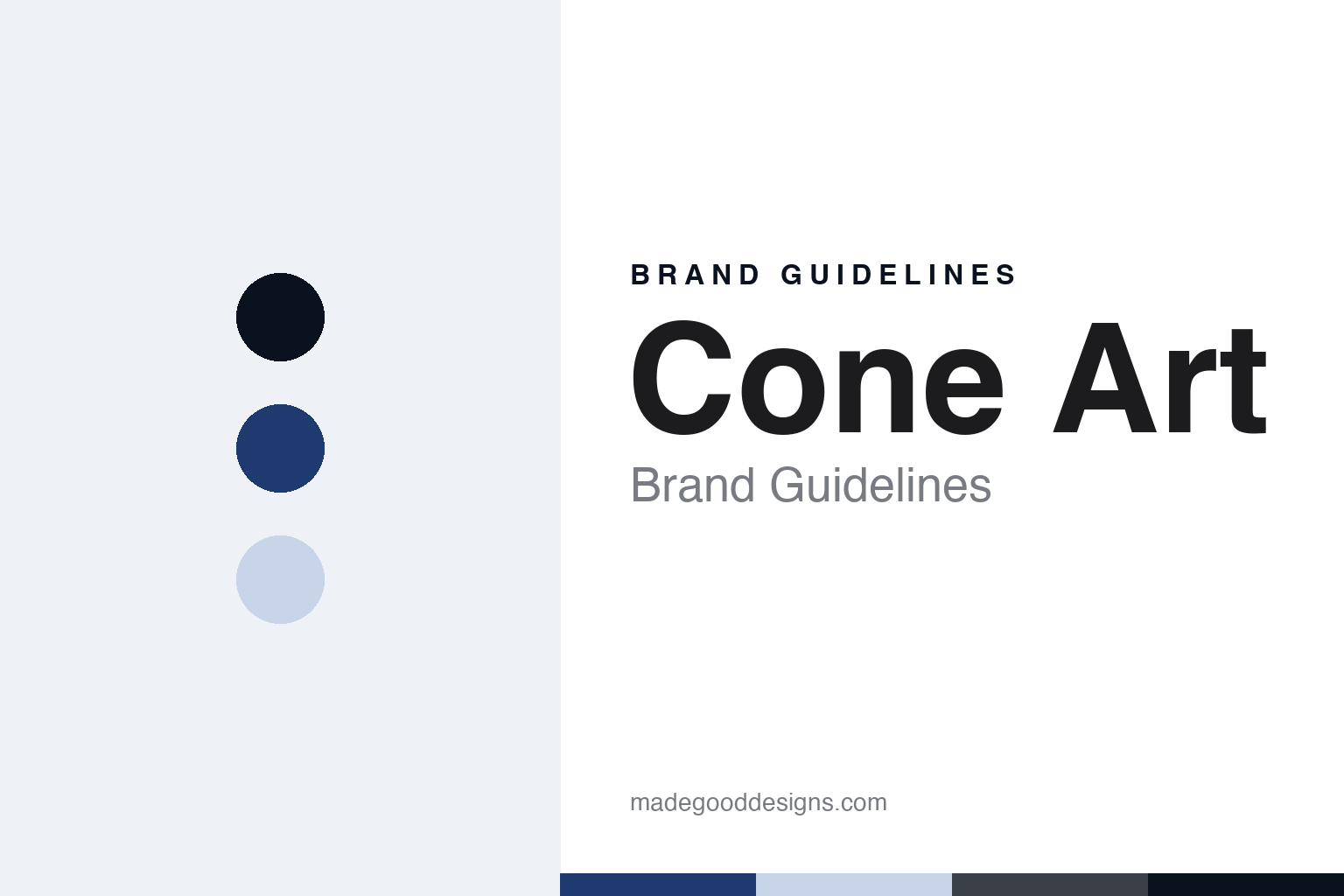
For this guide we use a navy and a pale steel with a condensed sans. These are an unofficial interpretation, not Cone Art’s colour values, and nothing of its logo is reproduced.
Explore & save
Keep Cone Art Kilns’s identity on hand — save it to a board in the Made Good inspiration library.
Cone Art identity set
Pin the cone-navy palette and the condensed-sans register to your own board.