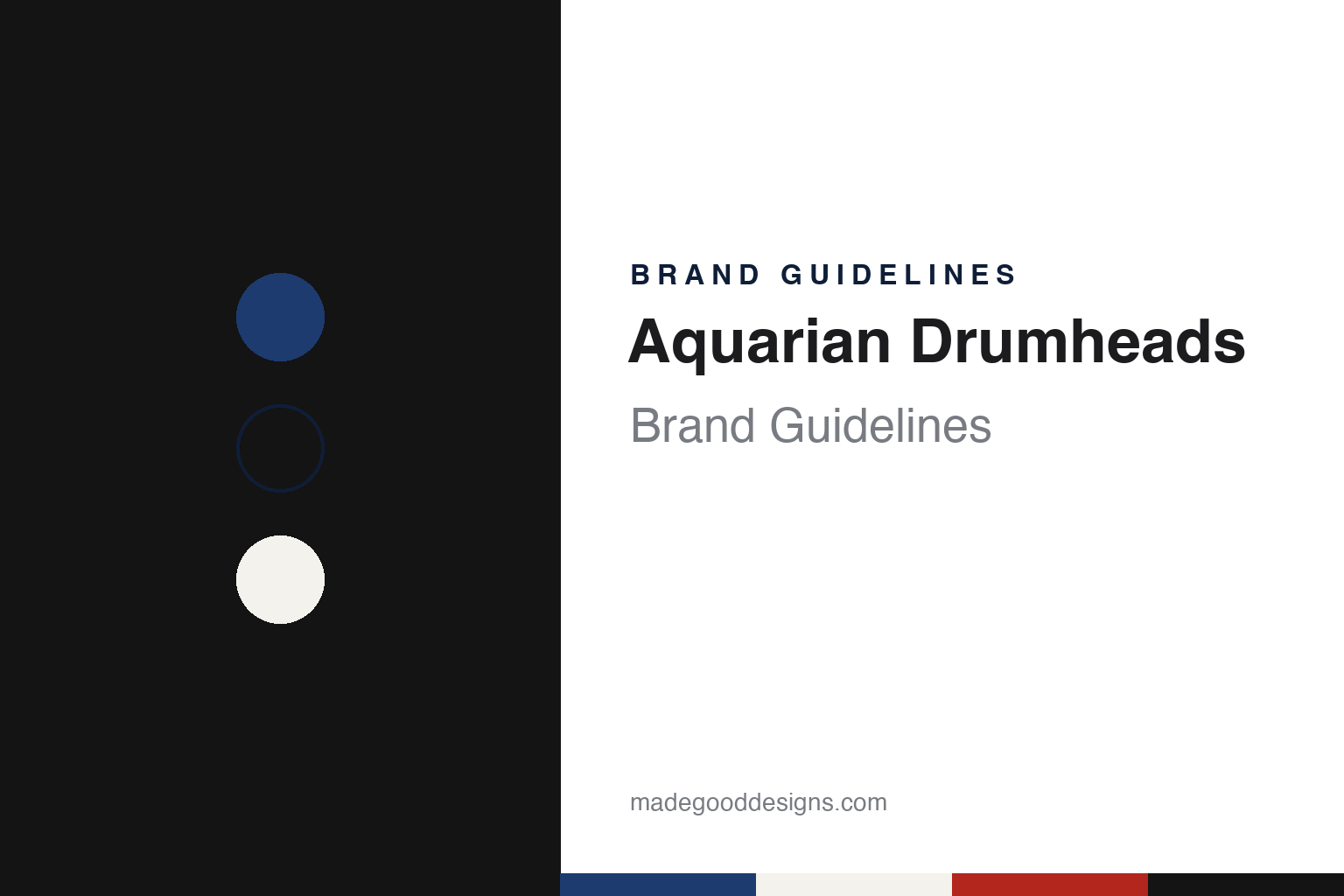
Aquarian Drumheads Brand Guidelines
The drummer’s drumhead maker from Anaheim.
Aa
Two constants: an Aquarian blue, black and white palette and a workshop sans register. Abstract homage — not an Aquarian product or mark; no drumhead, logo or artwork is reproduced.
Aquarian Accessories
A big-band drummer and a powder-coating engineer.
Aquarian began in 1980 in Orange County, California, as Aquarian Accessories. Its founders were the jazz drummer Roy Burns and Ron Marquez, an engineer who had started his own powder-coating business in 1974. The NAMM Oral History archive, which recorded interviews with both men, lists each of them as a co-founder, and says Burns had been looking for manufacturing help with a new line of drumheads when the two met.
Burns brought the name. Born in Emporia, Kansas, he played with Woody Herman and Benny Goodman in the 1950s, worked as a studio drummer in New York on shows including The Tonight Show, and from 1968 to 1980 toured as a clinician for Rogers drums, English Wikipedia says. The Percussive Arts Society, which named him to its Hall of Fame, quotes him explaining that he left Rogers after CBS bought it, because “if you don’t have a musician in a position of power in a musical-instrument company, the product is going to suffer.” He had appeared on the cover of the second issue of Modern Drummer in 1977, and from 1980 to 1992 he wrote its “Concepts” column. He also kept teaching; the Society quotes him naming Josh Freese and Nick D’Virgilio among his students. He died in 2018.
Marquez brought the factory knowledge. According to the company’s own history, he had been a systems analyst and plant manager for the telephone company in southern California, helped pioneer electrostatic powder coating in the United States — the company names Fender and Rogers among his customers — and later made brightly coloured bicycle handlebars. We give that as the company’s account.
Colour
From cymbal springs to the Super-Kick.
Aquarian did not start with drumheads. Its first product was the Cymbal Spring, a shock-absorbing cymbal mount. “Drummers were cracking cymbals,” Burns told the Percussive Arts Society, and he credited Jack DeJohnette, one of Aquarian’s first endorsers, with asking for a heavier spring so he could hang China cymbals upside down. Next came the X-10 graphite drumsticks, which the Society says were popular in the 1980s. In the same years Burns gave clinics for Sabian, then newly founded by Bob Zildjian, sharing the expenses, which he said helped get Aquarian’s products out there.
According to the company, Aquarian began making drumheads in 1987. Burns said they started by copying the shape and dimensions of calfskin heads in modern materials, and that the Super-Kick bass drum head, pre-muffled with a felt strip inside, was “our first big success with drumheads,” followed by the Hi-Energy snare head for heavy hitters. The company also lists as its own firsts a patented Safe-T-Loc hoop meant to stop heads slipping and detuning, a “Sound Curve” collar meant to seat the head automatically, and Burns’s Tap Test for checking a head before it goes on the drum; those are the company’s claims.
The catalogue has grown since. By 2011 it ran from the Hi-Frequency, Response 2 and Super-2 tom heads to the Focus-X, the Studio-X and a Jack DeJohnette signature head, with marching heads and the Regulator ported bass heads alongside. By the mid-2010s it also sold electro-acoustic products, among them the inHEAD and the onHEAD, which it called a portable electronic drum head, and later added the Reflector series. In October 2026 its website listed 116 products and named the Superkick II, Texture Coated, Focus-X and Modern Vintage — a head it describes as “calfskin-inspired” — as what it is known for. Its Regulator bass front head, which it calls “patented,” pairs a small floating muffling ring with an offset port for a microphone.
Typography
Hand percussion and drum accessories.
The seven brands in this group make the instruments that sit around the drum kit: hand drums, cajóns, frame drums, tambourines, concert percussion and drumheads.
Two are hand-drum makers. LP, or Latin Percussion, was founded in New York in 1964 by Martin Cohen; Drum Workshop bought it from Fender’s Kaman Music business in 2014–15, and Roland bought Drum Workshop in 2022. Tycoon Percussion says it was founded in Bangkok in 1983 by Stephen Yu, a musician from Hong Kong, and that it is family-owned and makes its instruments in its own Thai factory.
Two work mainly in wood. Schlagwerk says it began in 1982, when two carpentry apprentices, Gerhard Priel and Bengt Schumacher, copied a Brazilian slit drum, and that it makes its cajóns at Gingen an der Fils, Germany, though its cajón cymbals are hammered in Turkey. Cooperman says Patrick Cooperman began making drumsticks and fifes in Mount Vernon, New York, in the 1950s, and that it has worked from a former sawmill in Bellows Falls, Vermont, since 2006.
Three make tambourines, concert percussion and drumheads. Rhythm Tech grew from the crescent tambourine of the session drummer Richard Taninbaum, which it says it introduced in 1980; its website calls it a division of JAM USA. Black Swamp Percussion was founded by Eric Sooy in Bowling Green, Ohio, dates itself to 1995 and now works from Zeeland, Michigan, calling its instruments “USA made.” Aquarian, founded in 1980 by Roy Burns and Ron Marquez, has made drumheads since 1987 and is based in Anaheim, California.
This guide sets out what can be checked about each brand — who founded it, who owns it, and what it says about where its products are made — and marks clearly what rests only on the company’s own word.
Aa
A plain workshop sans for a company that sells on sound. (Specimen set in Archivo, a sans STAND-IN; NOT the Aquarian logo.)
Aquarian Drumheads
For a better drum sound.
Aquarian has long given its home as Anaheim, California: its contact page did so in 2010, and its homepage still named an Anaheim headquarters in 2023. In 2010 its website also carried a “factory tour” of short videos showing die-cutting, insertion-press, silkscreen, slitting, film-forming and liquid-bonding steps, and current product copy describes some heads as using “USA” film. The current website does not say where every head is made, so we leave that open. Nor does it say who owns the company today. NAMM’s archive, recording Marquez in 2007, said both founders could still be found at the company’s booth at each NAMM show.
The brand’s voice is plain. Its slogan is “For a Better Drum Sound,” and it calls its endorsers “the Aquarian Family.” Burns’s own line, quoted on the company’s website for years, was “In everything we do, we keep the drummer in mind.” Aquarian says NAMM gave Burns a lifetime “Believe in Music” award in 2014, and the Percussive Arts Society remembered that if you phoned the company, “as often as not, Roy answered the phone himself.” The current roster runs from DeJohnette and Joe LaBarbera to Dale Crover of the Melvins and Chad Butler of Switchfoot.
For a design guide, Aquarian shows how a small accessory maker can build a brand on a working drummer’s name and a handful of practical inventions. Compare Remo and Evans, the two older American drumhead makers. For this guide we use a deep studio blue, black and a coated-head white with a sans, an unofficial interpretation; no product or logo is reproduced.
Explore & save
Keep Aquarian Drumheads’s identity on hand — save it to a board in the Made Good inspiration library.
Aquarian Drumheads identity set
Pin the Aquarian blue, black and white palette and the workshop sans register to your own board.


