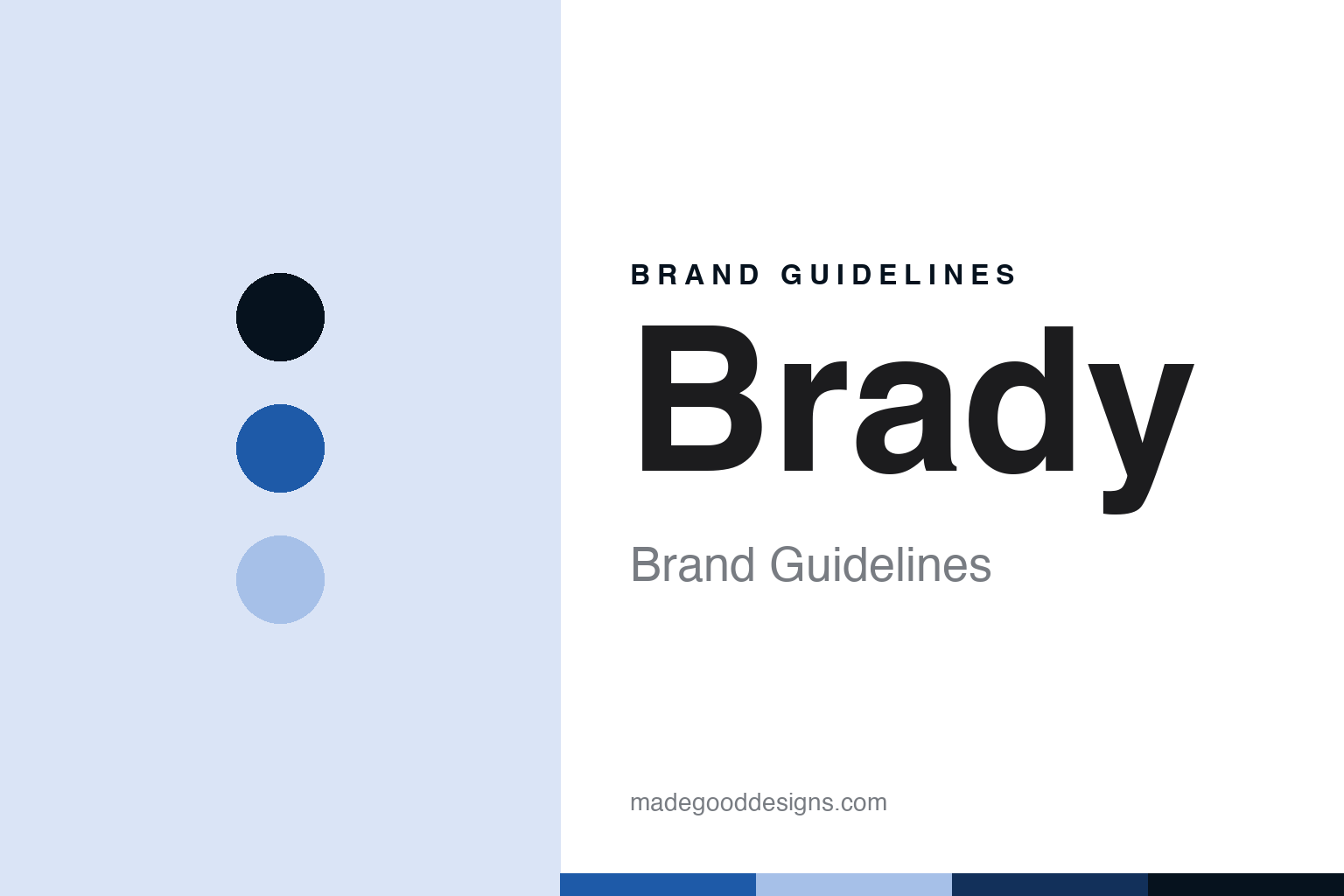
Brady Brand Guidelines
The industrial safety-ID maker.
Aa
Two constants: a Brady-blue palette and an industrial-sans register. Abstract homage — not a Brady product or mark; no label, sign or logo is reproduced.
The industrial safety-ID maker
Brady is a 1914 Wisconsin company (W.H. Brady, now NYSE-listed in Milwaukee) — whose printers, signs, wire markers and lockout/tagout tags label the industrial world.
Brady follows Dymo as the round’s industrial node — an independent, publicly listed American company that makes the durable labels, signs and safety identification the industrial world runs on. Its answer to a round about who owns the labeling tools is the independent one: a heritage maker that stayed its own public company.
Its identity is the industrial safety-ID maker. The 1914 founding, the independent NYSE listing and the label printers, signage and lockout/tagout lines are the story here. Built for the plant. The industrial safety-ID maker.
(Honest notes, so the founding, the ownership, the making and one governance detail are framed accurately. Brady sells industrial identification and safety products as its heroes — the BMP-series label printers, safety signage, wire and cable markers, lockout/tagout tags and the Brady Workstation software; we report its language as the brand’s own. On founding: the company was founded as W.H. Brady Co. in 1914 in Eau Claire, Wisconsin, by William Henry Brady, moved its headquarters to Milwaukee in 1952, and was renamed Brady Corporation in 1998. On ownership, verified: Brady is an independent, standalone public company listed on the New York Stock Exchange as BRC, headquartered in Milwaukee, with no parent. On a governance detail: Brady uses a dual-class share structure that keeps voting control founder-family-linked, which we describe rather than assert in detail. On the making: a global multinational with manufacturing at multiple facilities worldwide, so we do not pin a single country. Its designs and the Brady name are IP we describe but do not reproduce; there is no official brand hex; these tones are an unofficial interpretation.)
Colour
Brady lives in a Brady blue. Click a swatch to copy the hex.
Brady’s identity is industrial, independent and blue — a Brady blue, an ink, a pale blue, a deep navy, and a paper. The palette leans Brady blue and deep navy: a solid, workplace register that nods to industrial safety rather than a loud logo colour. It signals the industrial safety-ID maker — industrial, independent and blue. The honest caveat: with no official brand hex, and only a red-and-black identity documented, these values are a workplace, unofficial interpretation, not first-party colours.
The lesson is a Brady blue signals an industrial, safety identity. Brady’s world is the factory floor and the wire cabinet. For designers, it is a reminder that a solid blue and a deep navy can carry an industrial, safety brand — a workplace tone held as an accent, not a product shot. Because a mid hue can fail as small text, keep type dark and let the colour live in the accents, palette and band. The takeaways: date the founding to 1914 and Eau Claire, with the Milwaukee move; name the independent NYSE listing as BRC; note the founder-family voting control; and keep the making global.
Typography
The register is an industrial sans — industrial, independent, blue.
Brady’s identity carries an industrial, independent spirit — a heritage maker that stayed its own company. An industrial sans captures the mood: clean, sturdy and plain, the register of a workplace tool. Set in a Brady-blue palette, the industrial sans feels solid and dependable — exactly the personality Brady carries. It behaves like a made, working thing rather than a loud logo, mirroring a safety-band and a label-line. (Brady’s real products and the name are things we describe but do not reproduce, and the exact typeface is not ours to use.) Because it is not ours to use, the honest description is “an industrial-sans brand,” shown here in a stand-in. The type behaves like the brand: industrial, independent and blue.
Aa
An industrial-sans brand — solid and dependable. (Specimen set in Manrope, an industrial-sans STAND-IN; NOT the Brady logo or products.)
The labeling node
Brady stands for the industrial safety-ID maker.
Brady sits second in the round as its industrial node. A Brady-blue palette, an industrial sans and a 1914 founding make one thing — the industrial safety-ID maker — the whole identity: industrial, independent and blue. The 1914 founding is the pitch, the independent NYSE listing is the frame, and the label printers, signage and lockout/tagout lines are the substance. The point is a heritage maker that stayed its own public company, in a round about who owns the labeling tools.
Put to work, the identity is the brand told straight, the founding dated and the ownership kept independent. A brand in this spirit would date the founding to 1914 and Eau Claire with the Milwaukee move, name the independent NYSE listing as BRC, note the founder-family voting control, and keep the making global. A reader in this spirit would keep the facts right: Brady sells the BMP-series printers, safety signage and lockout/tagout tags; it was founded in 1914 as W.H. Brady Co. in Eau Claire; it is independent and listed on the NYSE as BRC; and it manufactures worldwide. Brady sits after Dymo and before Zebra. The honest editorial moves are to date the founding, to keep the listing independent, to note the governance, and to keep the making global.
For designers and brand-builders, Brady carries the labeling node: keep a heritage maker independent — and place it in the industrial tier. The lessons: a brand can serve the industrial and safety market rather than the consumer one, here Brady; a founding is dated to 1914 as W.H. Brady Co. in Eau Claire, Wisconsin, by William Henry Brady, with the headquarters moving to Milwaukee in 1952 and the Brady Corporation name adopted in 1998; an ownership is kept accurate as an independent, standalone public company on the New York Stock Exchange as BRC, with no parent; a governance detail is described, a dual-class share structure that keeps voting control founder-family-linked; and a making is kept global and multi-site rather than pinned to one country. It is also a reminder to stay precise: Brady is the independent, NYSE-listed industrial safety-ID maker of the labeling aisle — with the palette here an unofficial interpretation. The hook is that focus: Brady is the industrial safety-ID maker, a 1914 Wisconsin company, W.H. Brady, now NYSE-listed in Milwaukee, whose printers, signs, wire markers and lockout/tagout tags label the industrial world. Read that way, Brady is less a single printer than the industrial safety-ID maker: industrial, independent, blue. The lesson for a brand is that keeping a heritage maker independent and placing it in the industrial tier reinforce the honesty, and dating the founding keeps it earned. Brady made the-industrial-safety-ID-maker the identity — proof that an honestly-placed independent can anchor a node.
Explore & save
Keep Brady’s identity on hand — save it to a board in the Made Good inspiration library.
Brady identity set
Pin the Brady-blue palette and the industrial-sans register to your own board.


