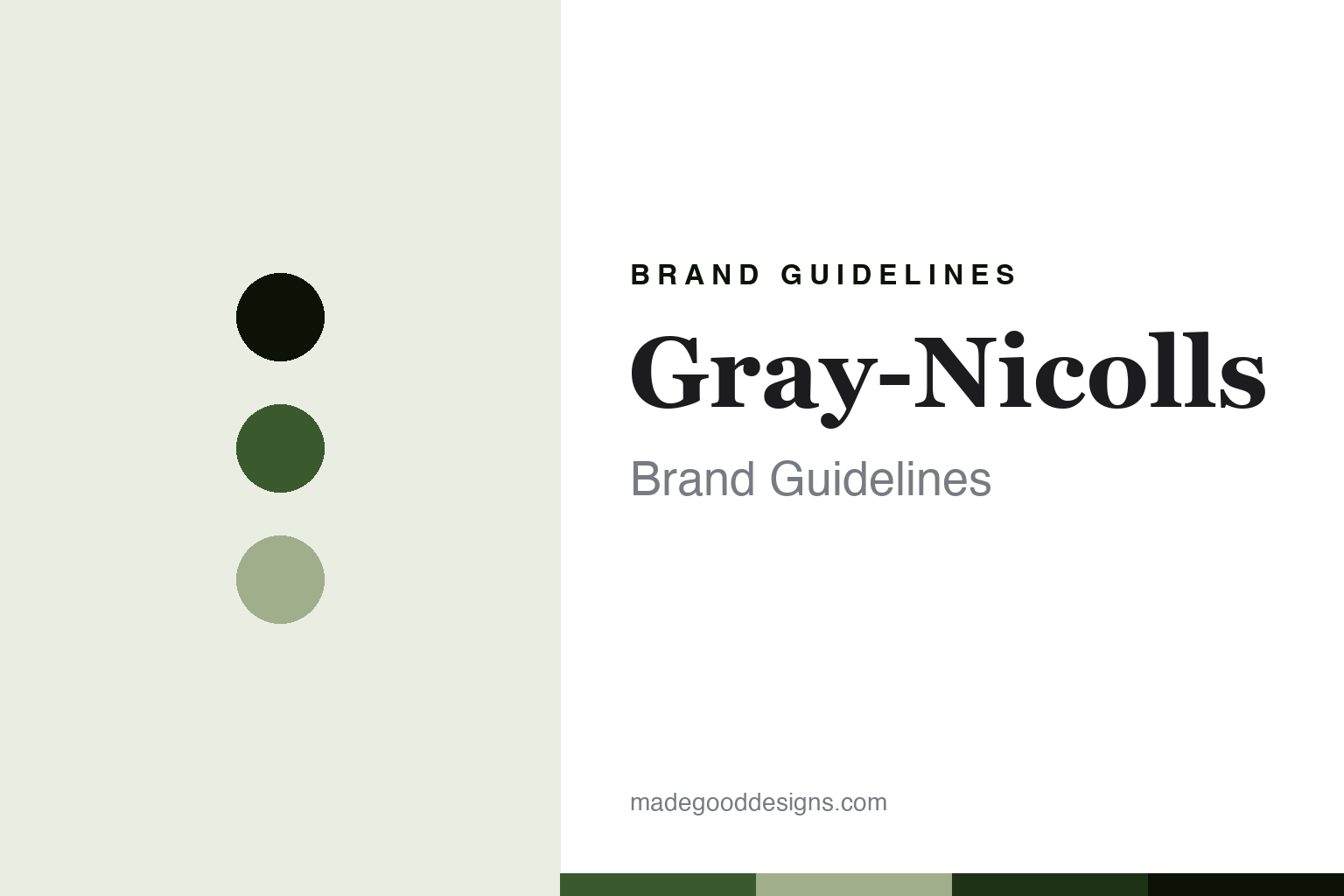
Gray-Nicolls Brand Guidelines
The cricket glove.
Aa
Two constants: a willow-green palette and a willow-serif register. Abstract homage — not a Gray-Nicolls glove, bat, logo or club mark.
The cricket outfitter
Gray-Nicolls is the English cricket outfitter formed by the 1940s merger of Nicolls and Gray, whose bats are made in Robertsbridge and whose gloves are a core line.
Gray-Nicolls is a lesson in how a heritage outfitter equips a sport. From Robertsbridge, in East Sussex, Gray-Nicolls makes cricket equipment — bats above all, plus batting and wicketkeeping gloves, pads and protection. Its answer to how a glove is made is a game’s kit: outfit the cricketer from bat to gloves, in the English cricket tradition. The English cricket house.
Its identity is the cricket outfitter. Gray-Nicolls’ bats, its batting and wicketkeeping gloves, and its English cricket heritage are the work it is known for. A glove, for the crease. A house that equips the game.
(Honest notes, so the story stays precise. Gray-Nicolls was formed by the merger, in the early 1940s, of two English firms: L. J. Nicolls, a Robertsbridge bat maker from 1876, and H. J. Gray & Sons, of Cambridge, from the mid-1850s. Its batting and wicketkeeping gloves are a genuine core line, across pro, club, school and women’s ranges. On where it is made, an honest point: its bats are made in Robertsbridge, in East Sussex, from English willow — a real heritage craft — but the manufacturing location of its gloves and soft goods is not publicly disclosed, and, as is standard for cricket soft goods, is not confirmed to be English, so we say the bats are made in Robertsbridge and the gloves’ origin is undisclosed. On ownership, an honest correction: it is an English, Gray-family-owned brand of Grays International (of Cambridge), not an Australian company (an Australian entity of the same name is a distributor). Its famous “Scoop” bat dates to 1974. Its name, its marks and any club or player marks are IP, described but never reproduced, and there is no official brand hex; these tones are an unofficial interpretation. This is design commentary and does not promote any product.)
Colour
Gray-Nicolls lives in a willow-green palette. Click a swatch to copy the hex.
Gray-Nicolls’ identity is heritage, English and sporting — a willow green, an ink, a sage, a pitch, and a paper. The palette leans willow green and sage: the register of a cricket field and an English willow bat. It signals the game over fashion. The honest caveat: with no published brand hex, these values are an original, unofficial interpretation, not first-party colours.
The lesson is a willow-green palette signals a heritage, English-cricket identity. Gray-Nicolls’ world is a heritage, sporting, English object. For designers, it is a reminder that a willow green and a soft sage can carry a house built on a game and a cloth — the green of a cricket ground and the pale of willow. Because these tones can fail as small text, keep type dark and let the colour live in the accents, palette and band. The takeaways: equip the game; make the bats at home; be honest about the gloves’ origin; and treat any single hex as unofficial.
Typography
The register is a willow serif — heritage, refined, English.
Gray-Nicolls’ identity carries a heritage, refined, English spirit — a cricket outfitter, not a fashion label. A willow serif captures the mood: traditional, established and sporting, the register of an English cricket house. Set in a willow-green palette, the willow serif feels heritage and refined — exactly the personality Gray-Nicolls carries. It is cricket rather than dressy, mirroring a willow bat and a leather glove. (Gray-Nicolls’ real logo, its Scoop bat and any club marks are things we describe but do not reproduce, and the exact typeface is not ours to use.) Because it is not ours to use, the honest description is “a willow-serif spirit,” shown here in a stand-in. The type behaves like the house: heritage, refined and English.
Aa
A willow-serif spirit — heritage and refined. (Specimen set in Playfair Display, a willow-serif STAND-IN; NOT the Gray-Nicolls wordmark or Scoop bat.)
The sport glove
Gray-Nicolls stands for the glove that equips the crease.
Gray-Nicolls is a lesson in how a heritage outfitter equips a whole game. A willow-green palette, a willow serif and a batting glove make one thing — the English cricket house — the whole identity: heritage, English and sporting. The Robertsbridge bat-making is the differentiator, and the full cricket kit is the meaning. The point is a house, formed from two Victorian firms, that outfits the cricketer from a Sussex-made willow bat to the gloves at the crease.
Put to work, the identity is a heritage outfitter, honestly told, as design. A maker in this spirit would carry its merged heritage, keep its bat-making at home, and be candid about the rest — bats made in Robertsbridge, gloves of undisclosed origin, an English family owner. A brand learning from it would see that a heritage outfitter is a durable identity — that a house that has equipped cricketers for generations carries a depth a new brand cannot — and that being precise, formed by a 1940s merger, bats made in Robertsbridge, gloves’ origin undisclosed, English family-owned not Australian, keeps the story honest. A brand learning from it would also separate what it can claim: a Sussex-made willow bat is a real made-here fact, while the gloves’ origin is not disclosed, and saying so plainly is what keeps the heritage credible. The lesson Gray-Nicolls teaches is that a heritage outfitter can hold an identity: the bat-making gives it authenticity, and the honest disclosure keeps it credible. The heritage is the personality, and the cricket glove is the proof.
For designers and brand-builders, Gray-Nicolls closes this round of the sport glove, from England: equip the game, and disclose the origin honestly. The lessons: carry the merged heritage; make the bats at home; disclose the gloves’ undisclosed origin; correct the ownership honestly; and never reproduce a logo or bat. It is also a reminder to stay precise: Gray-Nicolls is the English cricket outfitter formed by the 1940s merger of Nicolls and Gray, whose bats are made in Robertsbridge and whose gloves are a core line — with the palette here an unofficial interpretation. Gray-Nicolls made the cricket kit the identity — proof that a heritage outfitter, honestly told, can be the difference.
Explore & save
Keep Gray-Nicolls’s identity on hand — save it to a board in the Made Good inspiration library.
Gray-Nicolls identity set
Pin the willow-green palette and the willow-serif register to your own board.