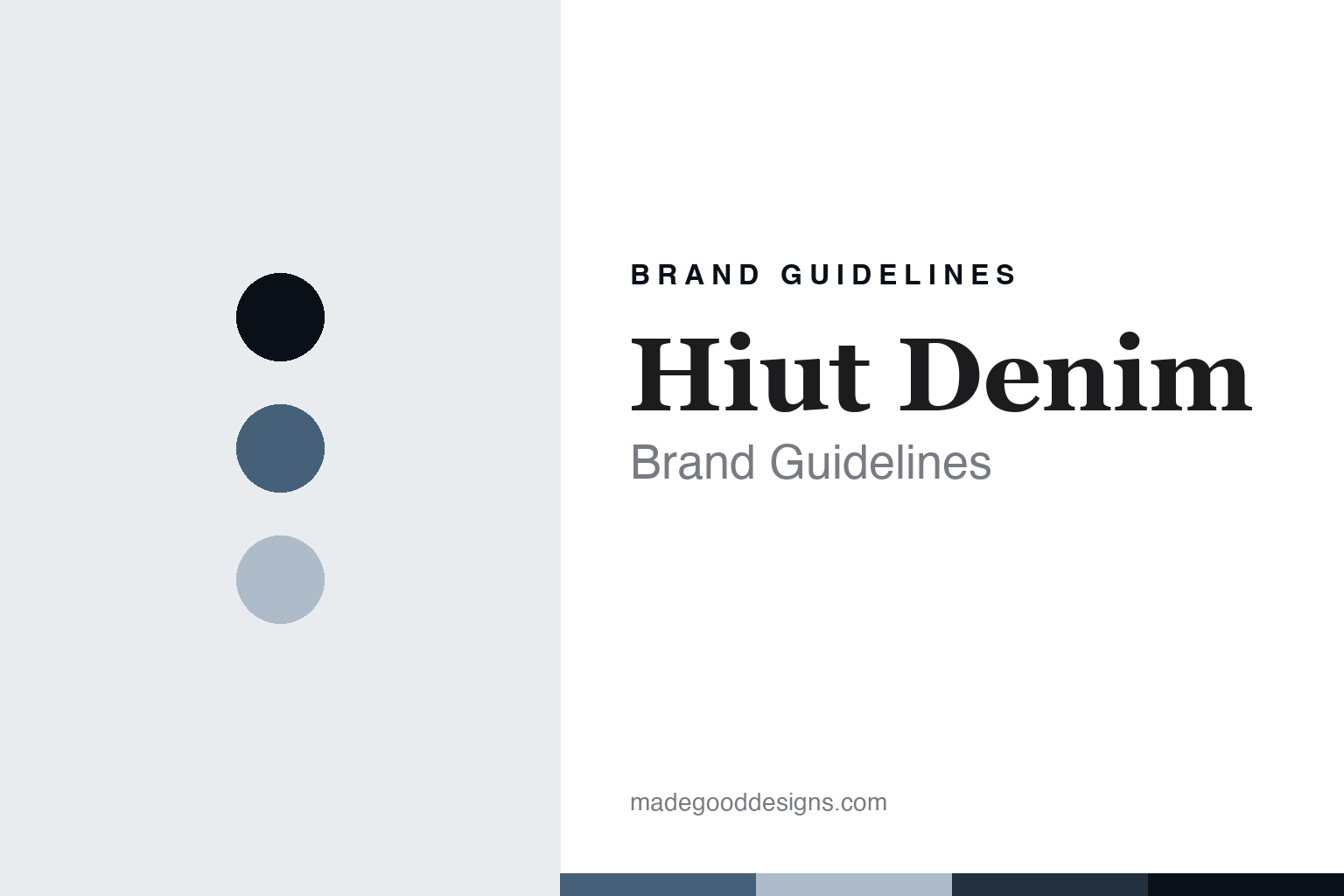
Hiut Denim Brand Guidelines
The Welsh jean revival.
Aa
Two constants: a slate-indigo palette and a revival-serif register. Abstract homage — not a Hiut jean, stitch or maker’s signature.
The Welsh jean revival
Hiut Denim Co. is the Welsh maker founded in 2011 to revive Cardigan’s jean-making trade, sewing raw denim by hand in Wales from Japanese and Italian selvedge.
Hiut is the round’s revival story. From Cardigan — Aberteifi — in Wales, Hiut Denim makes raw selvedge jeans by hand, in a town that used to make them by the thousand. Its answer to how a jean becomes a name is a place and its people: bring back the skilled makers a closed factory left idle, and do one thing well. A raw jean, sewn by hand in Wales.
Its identity is the Welsh jean revival. Hiut’s hand-sewn jeans, its “Grand Master” makers and its free-repairs ethos are the work it is known for. A jean, made where the craft was. A town’s trade, brought back.
(Honest notes, so the story stays precise. Hiut Denim Co. was founded in 2011 (its own date; some press says 2012) by David and Clare Hiut, in Cardigan, Wales, where a jeans factory that once employed the town’s makers saw its production leave in 2002 — Hiut set out to put that idle skill back to work, calling its senior makers “Grand Masters,” signing each pair with its maker’s name, and living by the motto “Do One Thing Well.” On where it is made — the two-part question of this round — its jeans are cut and sewn by hand in Wales, but the denim is woven abroad, which Hiut names openly: Japanese selvedge from the Kuroki mill and Italian denim from Candiani, because Britain no longer weaves selvedge at scale. It offers free repairs for life. The widely-reported details — the town once turning out around 35,000 pairs a week, and a 2017 moment when a public figure was photographed in its jeans — we attribute as reported. Its name and marks are IP, described but never reproduced, and there is no official brand hex; these tones are an unofficial interpretation. This is design commentary and does not promote any product.)
Colour
Hiut lives in a slate-indigo palette. Click a swatch to copy the hex.
Hiut’s identity is heritage, Welsh and human — a slate indigo, an ink, a chambray, a navy, and a paper. The palette leans slate indigo and chambray: the register of a hand-sewn jean and a Welsh workshop. It signals craft and community over fashion. The honest caveat: with no published brand hex, these values are an original, unofficial interpretation, not first-party colours.
The lesson is a slate-indigo palette signals a revival, made-by-hand identity. Hiut’s world is a heritage, denim, Welsh object. For designers, it is a reminder that a slate indigo and a soft chambray can carry a brand built on a town’s craft — the blue of raw denim and the neutral of a maker’s bench. Because these tones can fail as small text, keep type dark and let the colour live in the accents, palette and band. The takeaways: revive the skill; sew at home; name where the cloth is woven; and treat any single hex as unofficial.
Typography
The register is a revival serif — heritage, warm, story-led.
Hiut’s identity carries a heritage, warm, story-led spirit — a maker with a mission, not a fashion label. A revival serif captures the mood: classic, human and narrative, the register of a town’s craft brought back. Set in a slate-indigo palette, the revival serif feels heritage and warm — exactly the personality Hiut carries. It is a workshop with a story rather than a marketing wall, mirroring a hand-sewn jean. (Hiut’s real logo and its maker’s-signature motif are things we describe but do not reproduce, and the exact typeface is not ours to use.) Because it is not ours to use, the honest description is “a revival-serif spirit,” shown here in a stand-in. The type behaves like the house: heritage, warm and story-led.
Aa
A revival-serif spirit — heritage and warm. (Specimen set in Playfair Display, a revival-serif STAND-IN; NOT the Hiut logo or maker’s signature.)
The raw denim makers
Hiut stands for the jean that brought a town’s trade back.
Hiut is a lesson in how a revival can be an identity. A slate-indigo palette, a revival serif and a hand-sewn jean make one thing — the Welsh jean revival — the whole identity: heritage, Welsh and human. The town’s brought-back craft is the differentiator, and the makers are the meaning. The point is a house that did not start a trade from scratch but restarted one, putting a closed factory’s skilled hands back to work sewing jeans in Cardigan.
Put to work, the identity is a revival, honestly told, as design. A maker in this spirit would restore the skill, sew at home, and be candid about the rest — a founding to revive a town, jeans made by hand in Wales, denim woven in Japan and Italy. A brand learning from it would see that a revival is a powerful identity — that a jean sewn by named makers in a town that lost its trade carries a meaning a new label cannot — and that being precise, founded 2011, sewn in Cardigan, denim from Kuroki and Candiani because Britain no longer weaves selvedge, keeps the story honest. Hiut sharpens the round’s two-homes idea into a moral: the sewing can come home even when the weaving cannot, and naming Kuroki (Japan) and Candiani (Italy) openly — rather than implying a Welsh cloth that does not exist — is exactly what lets the made-in-Wales sewing stand as a true claim. There is a lesson in the repair promise, too: a maker that fixes its jeans for life has built the “do one thing well” ethos into the product’s whole lifetime, which is the most convincing proof of intent it could offer. The lesson Hiut teaches is that a revival can hold an identity: the restored craft gives it meaning, and the honesty about the imported cloth keeps it credible. The revival is the personality, and the hand-sewn jean is the proof.
For designers and brand-builders, Hiut holds the Wales pole in the raw denim makers: revive the skill, and name where the cloth is woven. The lessons: restart a lost trade; sew at home; name your mills; build in lifetime repair; and never reproduce a logo or a maker’s signature. It is also a reminder to stay precise: Hiut Denim Co. is the Welsh maker founded in 2011 to revive Cardigan’s jean-making trade, sewing raw denim by hand in Wales from Japanese and Italian selvedge — with the palette here an unofficial interpretation. Hiut made the revival the identity — proof that bringing a town’s trade back, honestly told, can be the difference.
Explore & save
Keep Hiut Denim’s identity on hand — save it to a board in the Made Good inspiration library.
Hiut Denim identity set
Pin the slate-indigo palette and the revival-serif register to your own board.