Old Blood Noise Endeavors Brand Guidelines
The Oklahoma pedal maker started in a shed in Norman.
Aa
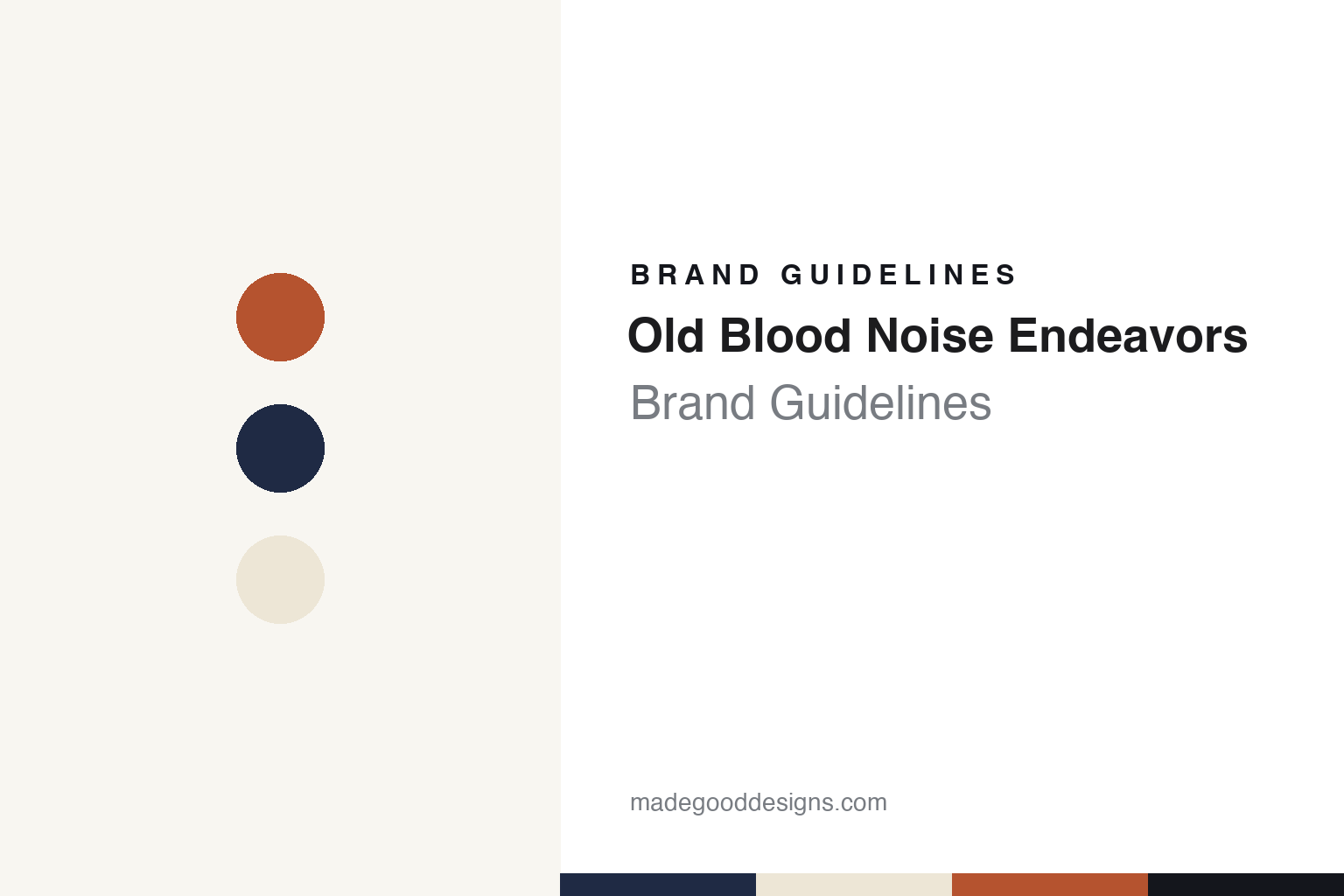
Two constants: an Old Blood night blue, rust and bone palette and a Workshop sans register. Abstract homage — not an Old Blood Noise Endeavors product or mark; no pedal, artwork, logo or nameplate is reproduced.
The return to the garage
Two musicians who had worked for other pedal makers.
Old Blood Noise Endeavors — usually shortened to OBNE — dates itself to 2014. Its first website, captured by the Internet Archive in July 2014, introduced the founders as Brady Smith and Seth McCarroll and described the venture as “the return to the garage”: after “spending some time working for and building up some now established pedal companies,” they wanted to make “the weird, niche based effects that we so often like to hunt down and use in our own musical projects.” The site’s tagline was “take risks. make noise.”
The pedal site Delicious Audio filled in the background in July 2015. It reported that the two had met at college around 2004, in a film class, and later played together in Gentle Ghost, an Oklahoma City band formed in 2009. Smith built his first pedal, a Big Muff variant, while trying to get a job at Keeley Electronics, which the site called “the local guitar pedal company,” and Delicious Audio said it had first met him when he was at Walrus Audio. The name, Smith told the site, came out of a pub brainstorm with McCarroll and their collaborator Blake Studdard: “Noise” because they liked messy sounds, and “Old Blood” because “all three of us have worked for different pedal companies.”
The company started in Norman, the university town south of Oklahoma City, rather than in the city itself. A March 2015 post on its blog said it had begun “in a shed” and had moved to “a much bigger space” while “still located in Norman.” In March 2023 the local paper Free Press OKC described it as “previously headquartered in Norman, now OKC-based,” and the company’s website now says it is based in the Capitol Hill district of Oklahoma City.
Colour
A delay, a hundred units and borrowed artwork.
The first product was the Black Fountain delay. In a July 2014 blog post Smith wrote that the company would “start with one hundred units,” with pre-sales on its website from 1 August. Its artwork came from the San Diego illustrator Sam Larson; the founders wrote that “seth’s a designer but he’ll tell you he’s not an illustrator, and brady cant really draw either,” so they looked outside the company for pedal art. The habit continued with the Procession reverb, whose artwork the blog credited to Garrett Young in 2015, and with shirts by outside artists. Building was done in-house: after announcing in December 2014 that Kilyn Massey, “an old friend and experienced builder,” had joined, the company was described by Delicious Audio in 2015 as a team in which Massey “does most of the actual building.”
The range grew into reverbs, delays, modulation and odd utilities. The website’s list of retired pedals includes the Dark Star Pad Reverb, the Mondegreen modulated delay, the Reflector chorus, the Whitecap and Blackcap tremolos and a compact BL series. Its current list includes the Dark Star Stereo, Black Fountain Stereo, Sunlight Stereo and Bathing at $329 each; the Beam Splitter V2, which splits one signal into three overdrive voices, two of them delayed, with what the company calls “trereo” output, at $379; the Setback reverse pedal; the Pardner and Haunt fuzzes; and expression tools such as the Expression Ramper. Guitar.com, reviewing the Dark Star Stereo in April 2025, noted that it was true bypass with an analogue dry path.
Collaborations have carried the name beyond the pedal trade. In May 2022, Guitar.com reported, OBNE and the Scottish band CHVRCHES launched Screen Violence, a stereo reverb and drive named after the band’s album, priced at $279 and sold both direct and at the band’s merchandise stand; English Wikipedia’s article on the album records the collaboration. In January 2026 GuitarBomb reported the launch of Parting, a glitch delay and reverb developed with the harpist and sound designer Emily Hopkins.
Typography
Design and documentation.
The seven makers in this group are smaller pedal companies, some building analogue circuits by hand, some writing their own digital processing. Five are American, one Canadian and one English.
Analogman is Mike Piera’s workshop in Bethel, Connecticut, where the Connecticut Mirror reported in 2024 that he has worked full-time since about 2000. Source Audio says it was founded in Woburn, Massachusetts, in 2006; in July 2026 the companies announced that it had become part of Ernie Ball, the string maker.
Meris, which Terry Burton, formerly of Strymon, told Guitar.com he started in 2013, says its pedals are designed and built in California. Red Panda says it began in 2009 and assembles every pedal in its metro Detroit workshop. Old Blood Noise Endeavors lists a shop in Oklahoma City, and Guitar World reported in 2025 that its pedals are hand-made at its Oklahoma headquarters.
Fairfield Circuitry says it has worked since 2008 and does all its manufacturing in Hull, Québec. Origin Effects, founded by Simon Keats, says it hand-builds its pedals in Buckingham, England; the UK company register lists Keats as its controlling shareholder.
Apart from Source Audio, we found no record of an outside owner for any of these companies, and much of what is said about where their pedals are made comes from the companies themselves.
This guide sets out what can be checked about each brand — who founded it, who owns it, and what it says about where its products are made — and marks clearly what rests only on the company’s own word.
Aa
A workshop sans — “take risks. make noise.” (Specimen set in Archivo, a sans STAND-IN; NOT the Old Blood Noise Endeavors logo.)
Old Blood Noise Endeavors
“Take risks. Make noise.”
We found no record of the company being sold or taking outside investment in the sources we checked. On manufacturing, it says its pedals are “built to order,” with a current lead time of seven to ten business days on most orders, and that its Oklahoma City workshop is not open to the general public and can be visited by appointment only. It does not say, on the pages we read, where its circuit boards or parts come from. The 2023 Free Press OKC profile added that a guitarist in the Oklahoma band Plain Speak designed pedals at OBNE as his day job, and that the band’s signature Calamity Drive overdrive was developed there.
Its identity leans on illustration and colour rather than on a single fixed look. Pedals come in named colourways, and the website has a separate section for “alternative colorways,” including runs picked by a member of staff; it sells replacement knobs in a style it calls Brutalist, along with candles, mugs and shirts, and it runs a video series, “Dan Explains It All,” and a podcast. We found no published brand guidelines, colour codes or typeface, and no design awards.
For a design guide, Old Blood Noise Endeavors shows how a small maker can borrow a different artist’s hand for each product and still read as one brand. Compare Walrus Audio, where Delicious Audio first met Brady Smith, and Chase Bliss, another maker of deeply configurable pedals. For this guide we use a night blue, a rust and a bone with a sans, an unofficial interpretation; no product or logo is reproduced.
Explore & save
Keep Old Blood Noise Endeavors’s identity on hand — save it to a board in the Made Good inspiration library.
Old Blood Noise Endeavors identity set
Pin the Old Blood night blue, rust and bone palette and the Workshop sans register to your own board.