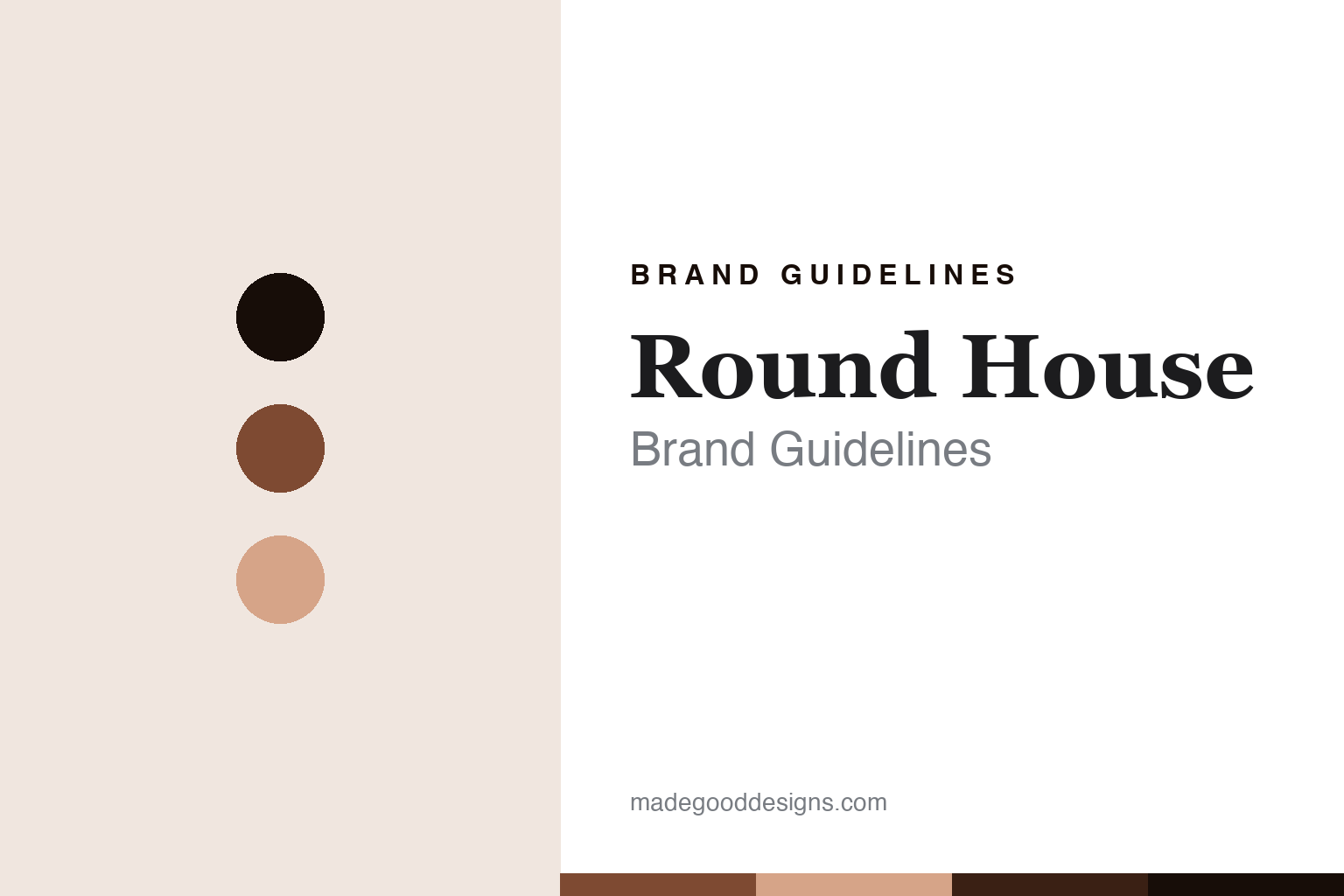
Round House Brand Guidelines
The Oklahoma overall.
Aa
Two constants: a worn-duck palette and a heritage-serif register. Abstract homage — not a Round House garment or mark.
The Oklahoma overall
Round House is the American overall maker from Shawnee, Oklahoma, making workwear in its own factory since 1903, with a small clearly-labelled non-USA line.
Round House is the round’s American overall, made in one Oklahoma town for over a century. From Shawnee, Oklahoma, Round House makes bib overalls, dungarees, chore coats, carpenter pants and work shirts, in denim, duck canvas and hickory stripe. Its answer to how a maker becomes a name is a factory that endured: make American overalls in the same Oklahoma town since 1903. An American overall, made in Oklahoma.
Its identity is the Oklahoma overall. Round House’s made-in-Oklahoma factory, its overalls and chore coats and its 120-year heritage are the work it is known for. An overall, made in the USA. Work clothing from one town.
(Honest notes, so the story stays precise. Round House — at round-house.com, with the hyphen — was founded in 1903 in Shawnee, Oklahoma. On what it makes, bib overalls and dungarees above all, plus chore coats, carpenter pants and work shirts, in denim, duck canvas and hickory stripe. On where it is made — a theme of this round — its core workwear is made in the USA, in its own Shawnee factory, in the current plant since 1995; honestly, it says its jeans and overalls are made in Oklahoma “and other locations,” and it separately, transparently offers a small number of items expressly labelled “Not Sewn in USA,” so we say made in the USA for the heritage line with a small clearly-labelled non-USA line, rather than a blanket all-American claim. On ownership, it has long been under the Antosh family — Edward Antosh from 1964, his son Jim Antosh president from 1986 — though the exact 2026 ownership we could not confirm, so we present the family stewardship as reported. Its superlatives — “largest and oldest American overall maker,” a Guinness record, about a thousand pairs a day — we attribute as the company’s own claims. Its name and marks are IP, described but never reproduced, and there is no official brand hex; these tones are an unofficial interpretation. This is design commentary and does not promote any product.)
Colour
Round House lives in a worn-duck palette. Click a swatch to copy the hex.
Round House’s identity is work-built, American and made — a worn duck, an ink, a wheat, a deep canvas, and a paper. The palette leans worn duck and wheat: the register of aged duck canvas and worn denim. It signals a century-old overall. The honest caveat: with no published brand hex, these values are an original, unofficial interpretation, not first-party colours.
The lesson is a worn-duck palette signals a work-built, made-in-USA identity. Round House’s world is a work-built, cotton, American object. For designers, it is a reminder that a warm worn duck and a soft wheat can carry an overall maker — the tan of aged duck and the neutral of worn denim. Because these tones can fail as small text, keep type dark and let the colour live in the accents, palette and band. The takeaways: keep the factory; make it at home; label the exceptions honestly; and treat any single hex as unofficial.
Typography
The register is a heritage serif — classical, plain, made.
Round House’s identity carries a classical, plain, made spirit — a century-old overall factory, not a fashion label. A heritage serif captures the mood: traditional, honest and steady, the register of a Shawnee factory. Set in a worn-duck palette, the heritage serif feels classical and made — exactly the personality Round House carries. It is work-clothing heritage rather than a logo, mirroring a bib overall. (Round House’s real wordmark is a thing we describe but do not reproduce, and the exact typeface is not ours to use.) Because it is not ours to use, the honest description is “a heritage-serif spirit,” shown here in a stand-in. The type behaves like the factory: classical, plain and made.
Aa
A heritage-serif spirit — plain and made. (Specimen set in Cormorant Garamond, a heritage-serif STAND-IN; NOT the Round House logo.)
The work jacket around the world
Round House stands for the American overall, made in Oklahoma since 1903.
Round House is a lesson in how a century in one town can be an identity. A worn-duck palette, a heritage serif and a bib overall make one thing — the Oklahoma overall — the whole identity: work-built, American and made. The made-in-Oklahoma factory is the differentiator, and the 120-year heritage is the meaning. The point is an overall maker that has cut and sewn in the same Oklahoma town since 1903, and is honest about the small part of its range that is not US-sewn.
Put to work, the identity is endurance, honestly told, as design. A maker in this spirit would keep the factory, make at home, and label the exceptions — overalls, chore coats, made in the USA, with a small non-USA line clearly marked. A brand learning from it would see that a century in one town, plus honest labelling, is a durable identity — that an overall made in the same Oklahoma factory for 120 years carries a rootedness a new brand cannot, and that labelling the non-USA items plainly builds rather than costs trust — and that being precise, founded 1903 in Shawnee, made in the USA with a clearly-labelled non-USA line, keeps the story honest. Round House holds a United States pole of the round, alongside the French and Italian houses at the made-at-home end, and it models the round’s honesty about the make: it does not hide the small imported part, it labels it. The honest editorial moves are to say made in the USA for the heritage line rather than a blanket claim, to attribute the “largest/oldest” and Guinness claims, and to present the Antosh-family stewardship as reported. The lesson Round House teaches is that endurance plus honesty can hold an identity: the Oklahoma factory gives it substance, and the plain labelling keeps it credible. The factory is the personality, and the Oklahoma-made overall is the proof.
For designers and brand-builders, Round House holds a United States pole in the work jacket around the world: keep the factory, and label the exceptions honestly. The lessons: stay in your town; make at home; mark any non-local line plainly; attribute the superlatives; and never reproduce a logo. It is also a reminder to stay precise: Round House is the American overall maker from Shawnee, Oklahoma, making workwear in its own factory since 1903, with a small clearly-labelled non-USA line — with the palette here an unofficial interpretation. Round House made endurance the identity — proof that the American overall, honestly told, can be the difference.
Explore & save
Keep Round House’s identity on hand — save it to a board in the Made Good inspiration library.
Round House identity set
Pin the worn-duck palette and the heritage-serif register to your own board.