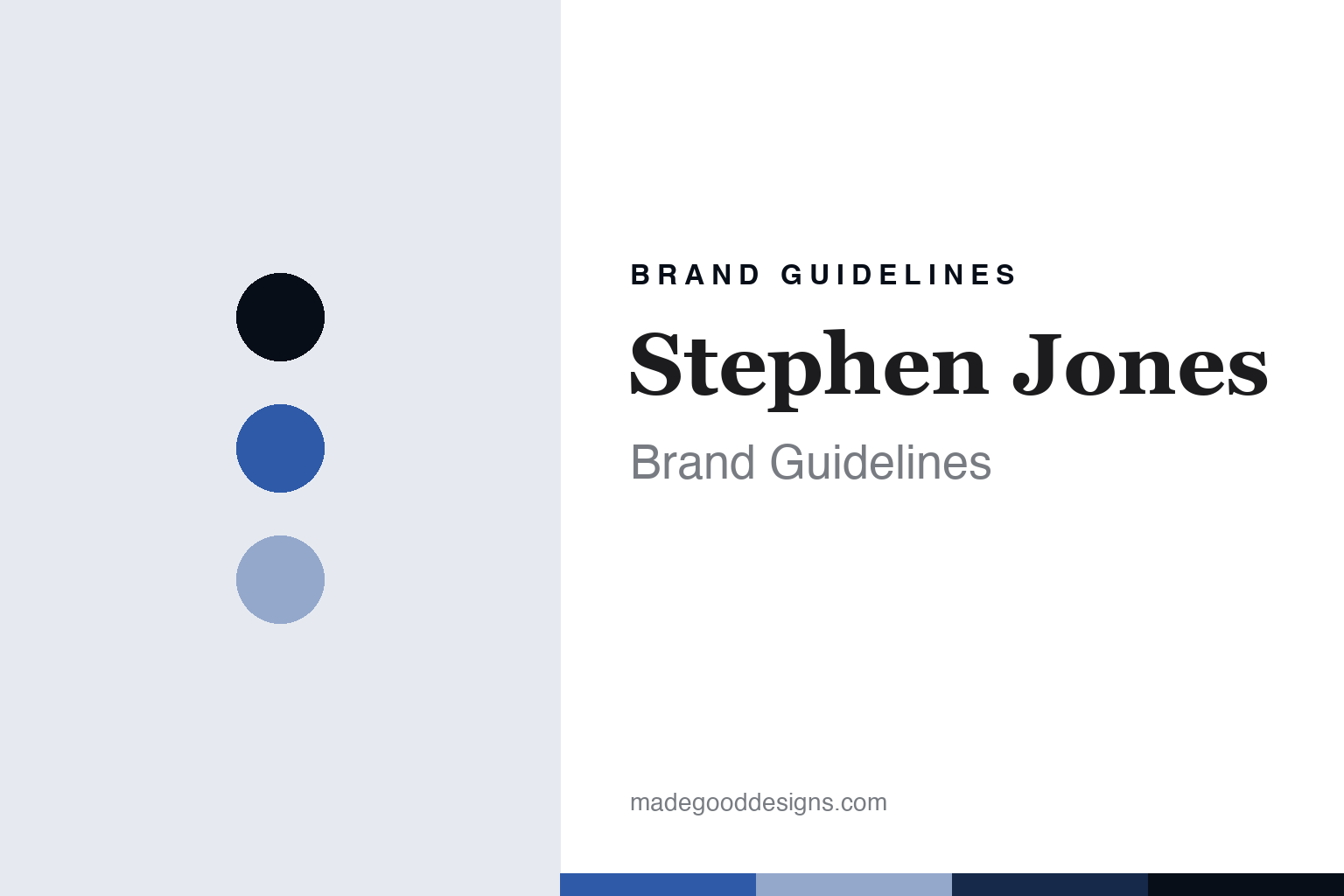
Stephen Jones Brand Guidelines
The hat on the runway.
Aa
Two constants: an electric-blue palette and an atelier-serif register. Abstract homage — not a Stephen Jones hat, label or design.
The runway milliner
Stephen Jones is the influential London milliner who founded his salon in 1980 and has headed Dior’s haute-couture millinery since 1996.
Stephen Jones is a lesson in how a milliner can shape fashion from the runway. One of the most influential milliners in the world, Jones makes couture and ready-to-wear hats from his London atelier, and has designed the millinery for many of fashion’s biggest runway houses. His answer to how a hat becomes a name is the catwalk: make hats that complete a designer’s vision, and become the milliner the couture houses call. A milliner whose hats crown the runway.
Its identity is the runway milliner. Jones’s couture and ready-to-wear hats, and his long collaboration with Dior, are the work the name is known for. A hat, made for the catwalk. A name that shaped modern millinery.
(Honest notes, so the story stays precise. Stephen Jones was born in 1957, on the Wirral, in what was then Cheshire (a “West Kirby” birthplace is reported but not confirmed, so we say the Wirral); he trained at Saint Martin’s School of Art (now Central Saint Martins) and rose from the late-1970s and 1980s London club and New Romantic scene, opening his first salon in Covent Garden in 1980. Since 1996 he has headed the haute-couture millinery studio at Dior — reported as the first British milliner to do so — beginning with John Galliano and continuing under later Dior creative directors, so we date the Dior work to 1996, not his 1980 salon founding. He has also worked with houses including Comme des Garçons, Thierry Mugler, Jean Paul Gaultier, Vivienne Westwood and Maison Margiela, which we present as reported collaborations, and his hats have been worn by figures from Diana, Princess of Wales to Rihanna, which we attribute as reported. The 2009 Victoria and Albert Museum exhibition “Hats: An Anthology by Stephen Jones,” co-curated with Oriole Cullen, marked his standing; he was appointed OBE in 2010. His couture “Model Millinery” is handmade at his London atelier; we do not claim the whole ready-to-wear range is London-made. As this is a living maker, we keep to public professional facts and reproduce no specific design. His name and marks are his IP, and there is no official brand hex; these tones are an unofficial interpretation. This is design commentary and does not promote any product.)
Colour
Stephen Jones lives in an electric-blue palette. Click a swatch to copy the hex.
Stephen Jones’s identity is witty, influential and couture — an electric blue, an ink, a slate, a navy, and a paper. The palette leans electric blue and slate: the register of a runway milliner with a playful edge. It signals wit and craft together. The honest caveat: with no published brand hex, these values are an original, unofficial interpretation, not first-party colours.
The lesson is an electric-blue palette signals a runway, couture identity. Jones’s world is a witty, influential, couture object. For designers, it is a reminder that a vivid blue and a soft slate can carry a name built on the catwalk and a sense of humour — the electricity of a runway and the calm of an atelier. Because these tones can fail as small text, keep type dark and let the colour live in the accents, palette and band. The takeaways: crown the runway; keep the wit; attribute the collaborations; and treat any single hex as unofficial.
Typography
The register is an atelier serif — refined, witty, couture.
Jones’s identity carries a refined, witty, couture spirit — an influential milliner, not a mass maker. An atelier serif captures the mood: fine, playful and considered, the register of a runway hat. Set in an electric-blue palette, the atelier serif feels refined and witty — exactly the personality Jones carries. It is couture rather than commercial, mirroring a catwalk hat. (Jones’s real designs and marks are things we describe but do not reproduce, and the exact typeface is not ours to use.) Because it is not ours to use, the honest description is “an atelier-serif spirit,” shown here in a stand-in. The type behaves like the atelier: refined, witty and couture.
Aa
An atelier-serif spirit — refined and witty. (Specimen set in Playfair Display, an atelier-serif STAND-IN; NOT the Stephen Jones wordmark or any design.)
The milliners
Stephen Jones stands for the hat that shapes the runway.
Stephen Jones is a lesson in how a milliner shapes fashion from behind the runway. An electric-blue palette, an atelier serif and a couture hat make one thing — the milliner the couture houses call — the whole identity: witty, influential and couture. The runway work is the differentiator, and the influence is the meaning. The point is a designer who rose from a London club scene to head Dior’s millinery, and to shape how hats complete a collection.
Put to work, the identity is influence, honestly told, as design. A milliner in this spirit would build a couture practice, collaborate widely, and let the runway carry the name — while being described in public professional facts, with collaborations attributed. A brand learning from it would see that being the milliner behind the houses is a durable identity — that a hat that completes a designer’s vision has a quiet power — and that being precise, a salon from 1980, Dior millinery from 1996, keeps the story honest. A brand learning from it would also value the wit: a playful, inventive sensibility is exactly what made Jones the milliner the runway relies on. The lesson Jones teaches is that influence can be an identity: the couture work gives it reach, and the honest attribution keeps it credible. The runway is the personality, and the hat is the proof.
For designers and brand-builders, Stephen Jones holds the runway pole in this round of the milliners, from London: shape the runway, and attribute the work honestly. The lessons: build the couture practice; collaborate widely; date the Dior work precisely; keep to public facts; and never reproduce a signature design. It is also a reminder to stay precise: Stephen Jones is the influential London milliner who founded his salon in 1980 and has headed Dior’s haute-couture millinery since 1996 — with the palette here an unofficial interpretation. Jones made runway influence the identity — proof that shaping the catwalk can be the difference.
Explore & save
Keep Stephen Jones’s identity on hand — save it to a board in the Made Good inspiration library.
Stephen Jones identity set
Pin the electric-blue palette and the atelier-serif register to your own board.