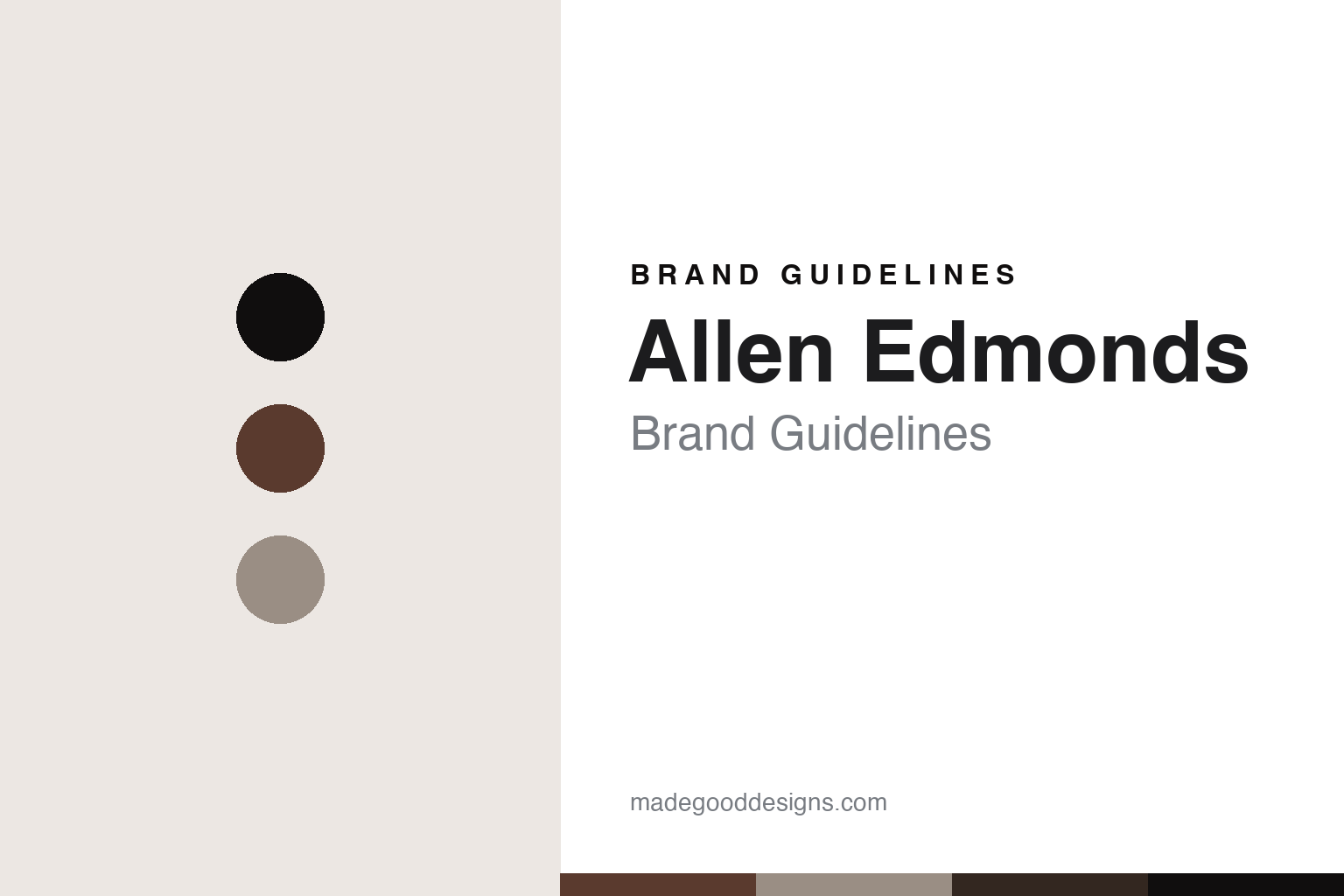
Allen Edmonds Brand Guidelines
The American welted shoe.
Aa
Two constants: a walnut palette and an American-sans register. Abstract homage — not an Allen Edmonds shoe, last or wordmark.
The American welted shoe
Allen Edmonds is a Wisconsin house whose Goodyear-welted dress shoes anchor American shoemaking, now owned by Caleres.
Allen Edmonds is a lesson in a welted construction, made in America, as the identity. From Port Washington, Wisconsin, it makes Goodyear-welted dress shoes the durable way — it markets a welt running the full 360 degrees of the shoe — and it runs a recrafting program that rebuilds worn pairs. Its answer to how a welted shoe is made, around the world, is American and repairable: build it to be resoled, and take it back to rebuild it. A dress shoe designed to come home for repair.
Its identity is the American welted shoe, rebuilt not replaced. Allen Edmonds’s Goodyear welting, its Wisconsin heritage and its recrafting program are the work it is known for. A method, made a signature. A house that made repair part of the brand.
(Honest notes, so the story stays precise. Allen Edmonds was founded in 1922 by Elbert W. Allen in Wisconsin and took the name Allen Edmonds in 1931, after a later partner, Bill Edmonds. Two honest points on status: it is no longer independent — it has been owned by the public company Caleres since 2016, after two private-equity owners — so we describe it in the present as a Caleres brand; and it is not wholly made in the USA. Its core Goodyear-welted dress line is genuinely made in Port Washington, but some hand-sewn styles are reported to be cut and sewn in the Dominican Republic and finished in Wisconsin, and it has carried imported lines, so we say American-made dress shoes with some lines produced offshore, not a blanket made-in-USA claim. Its presidential-inauguration association is a “worn by,” not an endorsement. Its designs and marks are its and Caleres’s IP, described but never reproduced, and there is no official brand hex — these tones are an unofficial interpretation. This is design commentary and does not promote any product.)
Colour
Allen Edmonds lives in a walnut palette. Click a swatch to copy the hex.
Allen Edmonds’s identity is American, sturdy and repair-minded — a walnut, an ink, a calf stone, an umber, and a chalk. The palette leans walnut and calf stone: the register of a mid-brown dress shoe and a Midwestern factory. It signals durability and repair over disposability. The honest caveat: with no published brand hex, these values are an original, unofficial interpretation, not first-party colours.
The lesson is a walnut palette signals a welted, recraftable identity. Allen Edmonds’s world is a resoleable, rebuildable, American-made object. For designers, it is a reminder that a warm walnut and a soft calf stone can carry a brand built on repair — the brown of a work-worn shoe and the stone of the last. Because these tones can fail as small text, keep type dark and let the colour live in the accents, palette and band. The takeaways: build to be rebuilt; be honest about where lines are made; own the ownership story; and treat any single hex as unofficial.
Typography
The register is an American sans — plain, solid, functional.
Allen Edmonds’s identity carries a plain, solid, functional spirit — a working American house, not a fashion label. An American sans captures the mood: even, sturdy and no-nonsense, the register of a Midwestern factory. Set in a walnut palette, the American sans feels plain and solid — exactly the personality Allen Edmonds carries. It is functional rather than showy, mirroring a recraftable welted shoe. (Allen Edmonds’s real designs and marks are things we describe but do not reproduce, and the exact typeface is not ours to use.) Because it is not ours to use, the honest description is “an American-sans spirit,” shown here in a stand-in. The type behaves like the maker: plain, solid and functional.
Aa
An American-sans spirit — plain and solid. (Specimen set in Archivo, an American-sans STAND-IN; NOT the Allen Edmonds wordmark or any shoe design.)
The dress shoe around the world
Allen Edmonds stands for the recraftable American welt.
Allen Edmonds is a lesson in making a welted construction and repair the identity. A walnut palette, an American sans and a Goodyear-welted shoe make one thing — a dress shoe built to be resoled and rebuilt — the whole maker: American, sturdy and repair-minded. The welt is the differentiator, and the recrafting program is the meaning. The point is a genuinely rebuildable object, its core line made in Wisconsin, with a service that takes worn shoes back and remakes them.
Put to work, the identity is repair as design. A maker building in this spirit would make repair a visible part of the brand, keep its core making at home, and be candid that not every line is domestic and that ownership has changed. It would treat a resole as a promise kept, not a cost. A brand learning from it would see that offering to rebuild what you sold is a powerful, durable identity — that a shoe you can send back to be remade earns a loyalty a disposable one cannot — and that being honest about offshore lines and a corporate owner, Caleres since 2016, is more credible than a blanket made-in-USA slogan. A brand learning from it would also frame a famous customer as a fact, not an endorsement. The lesson Allen Edmonds teaches is that a welted construction plus a repair promise can hold an identity: the method gives it substance, and the recrafting gives it meaning. The craft is the personality, and the recraftable welted shoe is the proof.
For designers and brand-builders, Allen Edmonds holds the American pole in this round about the dress shoe around the world: make repair part of the brand, and be candid about making and ownership. The lessons: build to be rebuilt; keep the core line home; disclose offshore lines and the owner; and never reproduce a protected design. It is also a reminder to stay precise: Allen Edmonds is a Wisconsin house founded in 1922, its Goodyear-welted core line made in Port Washington with some lines offshore, now owned by Caleres — with the palette here an unofficial interpretation. Allen Edmonds made the recraftable welt the identity — proof that repair can be the difference.
Explore & save
Keep Allen Edmonds’s identity on hand — save it to a board in the Made Good inspiration library.
Allen Edmonds identity set
Pin the walnut palette and the American-sans register to your own board.