Paraboot Brand Guidelines
The French rubber-soled welt.
Aa
Two constants: a forest-green palette and a utility-sans register. Abstract homage — not a Paraboot shoe, last or wordmark.
The French rubber-soled welt
Paraboot is a French family house making Norwegian-welted, rubber-soled shoes in France since 1908, with its own rubber soles.
Paraboot is a lesson in a welt and a rubber sole as the identity. From Isère, in France, it makes welted shoes the weatherproof way — its signature is the Norwegian welt, the heavy, externally-stitched construction — married to a rubber sole it casts itself. Its answer to how a welted shoe is made, around the world, is French and self-reliant: sew a rugged welt, and put your own rubber under it. A welted shoe built on rubber the maker makes.
Its identity is the French rubber-soled welt, made in France. Paraboot’s Norwegian welting, its French making and its own rubber soles are the work it is known for. A method and a material, made a signature. A family house that makes its own soles.
(Honest notes, so the story stays precise. Paraboot — the brand of Richard-Pontvert — is made in France, at Saint-Jean-de-Moirans in Isère, its historic origin being nearby Izeaux; it is a family-owned, independent business now in its fourth generation. Its founder was Rémy Richard, and it dates to 1908, with the name “Paraboot” registered in 1927 — the name coming from Pará, the Brazilian port from which rubber was shipped, plus “boot.” Two construction points to be exact about: its signature and most-associated construction is the Norwegian welt (cousu norvégien), not the Goodyear welt, but the house has used both across its range, so we call the Norwegian welt its hallmark rather than its only method. And it genuinely casts its own rubber soles — a real differentiator among welted makers. Its designs, model names and marks are its IP, described but never reproduced, and there is no official brand hex — these tones are an unofficial interpretation. This is design commentary and does not promote any product.)
Colour
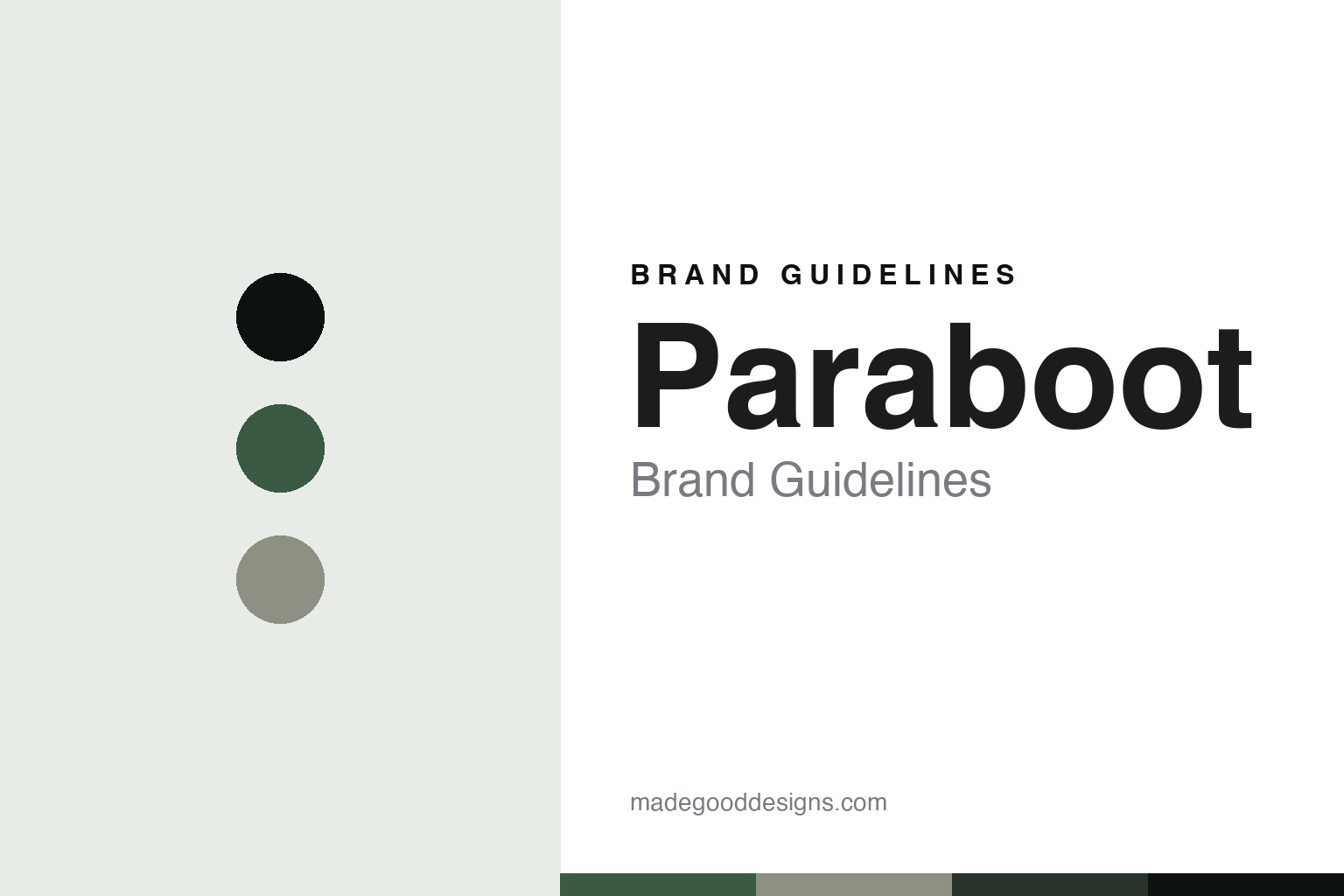
Paraboot lives in a forest-green palette. Click a swatch to copy the hex.
Paraboot’s identity is French, rugged and self-reliant — a forest green, an ink, a calf grey, an umber, and a chalk. The palette leans forest green and calf grey: the register of a country-and-city French shoe and a rubber sole. It signals utility and durability over polish. The honest caveat: with no published brand hex, these values are an original, unofficial interpretation, not first-party colours.
The lesson is a forest-green palette signals a Norwegian-welted, made-in-France identity. Paraboot’s world is a resoleable, rubber-soled, French-made object. For designers, it is a reminder that a deep forest green and a soft calf grey can carry a brand built on a welt and a sole — the green of the country and the grey of the leather. Because these tones can fail as small text, keep type dark and let the colour live in the accents, palette and band. The takeaways: sew a rugged welt; make your own sole; name the welt precisely; and treat any single hex as unofficial.
Typography
The register is a utility sans — plain, robust, functional.
Paraboot’s identity carries a plain, robust, functional spirit — a utilitarian French house, not a dandy. A utility sans captures the mood: even, sturdy and practical, the register of a rubber-soled country-city shoe. Set in a forest-green palette, the utility sans feels plain and robust — exactly the personality Paraboot carries. It is functional rather than ornamental, mirroring a Norwegian-welted, rubber-soled shoe. (Paraboot’s real designs and marks are things we describe but do not reproduce, and the exact typeface is not ours to use.) Because it is not ours to use, the honest description is “a utility-sans spirit,” shown here in a stand-in. The type behaves like the maker: plain, robust and functional.
Aa
A utility-sans spirit — plain and robust. (Specimen set in Mulish, a utility-sans STAND-IN; NOT the Paraboot wordmark or any shoe design.)
The dress shoe around the world
Paraboot stands for the French welt on its own rubber.
Paraboot is a lesson in making a welt and a self-made sole the identity. A forest-green palette, a utility sans and a Norwegian-welted shoe make one thing — a rugged welted shoe on a rubber sole the maker casts itself — the whole house: French, rugged and self-reliant. The Norwegian welt is the differentiator, and the own-rubber-sole is the meaning. The point is a genuinely weatherproof welted object, made in France, by a family that controls even its soles rather than buying them in.
Put to work, the identity is self-reliance as design. A maker building in this spirit would own an unusual part of its own supply — here, the rubber sole — keep the making at home, and name its construction precisely rather than defaulting to the better-known label. It would let a rugged welt and a distinctive sole be the whole look. A brand learning from it would see that making a key component yourself is a durable identity — that a maker who casts its own soles can promise something a mere assembler cannot — and that being exact, Norwegian welt as the hallmark, not Goodyear, and a name that honestly comes from a rubber port, builds credibility. A brand learning from it would also resist inventing a romantic origin when the real one, rubber shipped from Pará, is better. It would treat weatherproofing as something to build in rather than bolt on, since a rugged welt and a moulded rubber sole answer rain and road together, and a shoe that bridges country and city earns a wider life than one built for either alone. The lesson Paraboot teaches is that a welt plus a self-made sole can hold an identity: the construction gives it substance, and the rubber gives it meaning. The craft is the personality, and the rubber-soled welt is the proof.
For designers and brand-builders, Paraboot closes this round about the dress shoe around the world on the self-reliant pole: make a key part yourself, and name your construction precisely. The lessons: sew a rugged welt; cast your own sole; call the welt what it is; and never reproduce a protected design. It is also a reminder to stay precise: Paraboot is a French family house making Norwegian-welted, rubber-soled shoes in France since 1908, casting its own rubber soles — with the palette here an unofficial interpretation. Paraboot made the rubber-soled welt the identity — proof that self-reliance can be the difference.
Explore & save
Keep Paraboot’s identity on hand — save it to a board in the Made Good inspiration library.
Paraboot identity set
Pin the forest-green palette and the utility-sans register to your own board.