North Star Brand Guidelines
Not made offshore or imported.
Aa
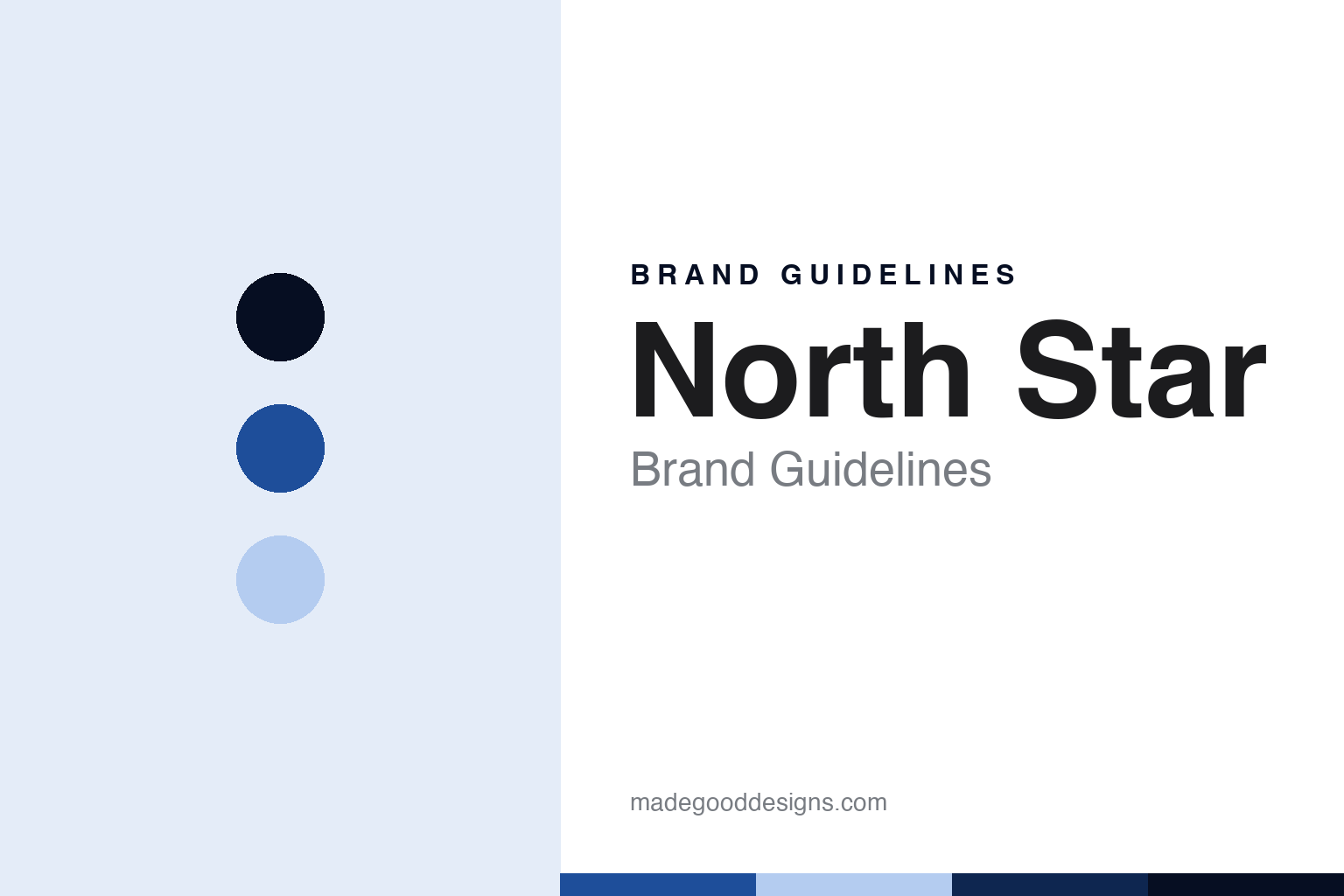
Two constants: a star-blue palette and a workshop-sans register. Abstract homage — not a North Star product or mark; no roller, extruder or logo is reproduced.
A founder, a slab roller and no catalogue
North Star is a small company that says so — repeatedly.
North Star Equipment’s about page tells its origin in one sentence: the company was “founded by Robert J. Creighton almost 50 years ago. He developed the slab rollers and extruders we still manufacture today.” It does not give a year. Archived versions of the page let us bracket it: in 2010 and 2015 it said “more than thirty five years”; from 2016 it said “more than forty five years.” By its own reckoning, then, North Star dates from the late 1960s or early 1970s — we give the range, because the company does not give the date.
It is based in Cheney, Washington, a small university town near Spokane, and it says what it is with unusual candour: “We don’t have an 800-page catalog. We’re a small manufacturing company.” Its tagline is “Slab Rollers & Extruders That Work!” — exclamation mark included — and its products carry a star theme: the Polaris and Sirius Star slab rollers, an 18-inch Porta Roller, extruders, throwing bats, work tables and a “Wedgit!” table. Its website still has the look of an early-2000s page, which suits a business that sells machines rather than marketing, and has not felt the need to redesign it.
We did not verify who owns North Star today; the state register was not readable in the form we could reach, and the company does not say. We give the founder as the company names him and go no further.
Colour
“Our products are not made offshore or imported.”
North Star’s origin claim is the most emphatic in this round. “We make them in our own facility, on our own machinery… Our products are not made offshore or imported.” In a trade where several brands in this series sell machines or kilns made elsewhere under their own names, that sentence is a positioning statement as much as a fact — and we report it as the company’s own.
The archive shows the claim used to be stronger still. Between February 2015 and January 2016, two lines disappeared from the about page: that its parts were made in-house — “they’re not subbed out” — and that “in all that time, we have charged only two people for repairs or replacement parts.” Over the same period the company’s address changed from a post-office box to a street address in Cheney. We do not know why the lines were removed and do not speculate about it; we note them because a brand’s deletions can say as much as its claims.
Its guarantee survives, and it is the boldest in this series. Standard North Star slab rollers are “guaranteed for life if not used commercially or in a school”; its Super slab rollers are “guaranteed for life, period.” The company also says it regularly buys a competitor’s roller to compare — and that the last one “took one hundred forty six days to arrive and it was damaged.” That is the company’s anecdote, and it does not name the competitor.
Typography
A slab roller flattens clay. It also raises dust.
A slab roller does one job: it presses clay into an even sheet for hand-building, the work a potter would otherwise do with a rolling pin. North Star’s rival in the category is the slab roller that Bailey’s founder patented in 1980; between them, the two firms illustrate how a simple machine can carry two very different brands — one a founder-inventor in New York with patents in his own name, the other a small Washington company whose brand is its guarantee.
We searched for North Star patents under its founder’s name and under the company’s, and found none in the patent database we used; that is a limited search, and we do not conclude there are none. The brand’s case to buyers rests on its guarantee rather than on a patent portfolio.
The slab roller also sits at the dustiest point of the studio. Rolling, cutting and cleaning up clay sheets puts dried clay — and with it crystalline silica — into the air of a workroom, which is why the safety rules that this round follows apply to the studio before the kiln is ever lit.
The clearest evidence comes from a 1991 report by the US National Institute for Occupational Safety and Health, which sampled the air in West Virginia University’s pottery shop. The report filed the shop under the industrial category “Pottery, not elsewhere classified.” Only one sample showed measurable quartz: the one collected on the class instructor, at 169.5 micrograms of respirable quartz per cubic metre of air. Because clay was not mixed eight hours a day, NIOSH concluded that exposure did not exceed its criteria — but it still found “a potential health hazard” and said “it would be prudent to install dust control systems in the mixing room.” Today’s US limit for workers, set in 2016 and fully in force from 23 June 2018, is 50 micrograms over an eight-hour day. A slab roller does not create silica; it is simply one more place in the studio where clay gets handled, cut and swept. Britain’s regulator explains why that matters: respirable silica dust “is very fine and invisible under normal lighting” and “can get deep into the lungs.” The hazard is the dust nobody sees.
Aa
A plain workshop sans with a hint of the space age — like a star on a machine plate. (Specimen set in Exo 2, a sans STAND-IN; NOT the North Star logo or products.)
A star and a guarantee
The logo is chrome and blue. The brand is a promise.
North Star’s logo sets “NORTH STAR” in chrome-blue capitals with a large stylised N and a glowing blue star at the top left, over “EQUIPMENT, INC.” in small capitals. It is a period piece, and the star-named products — Polaris, Sirius — carry the theme into the range.
But the real identity is the guarantee. A small manufacturer that promises its top machines for life, “period,” is making the strongest claim a maker can make about where and how its things are built. It is the same claim, in a different form, as its line about not being made offshore; the two statements support each other.
For this guide we use a star blue and a pale sky with a plain workshop sans. These are an unofficial interpretation, not North Star’s own colour values, and nothing of its logo is reproduced.
Explore & save
Keep North Star’s identity on hand — save it to a board in the Made Good inspiration library.
North Star identity set
Pin the star-blue palette and the workshop-sans register to your own board.