Evenheat Brand Guidelines
A kiln for china painting, then for knives.
Aa
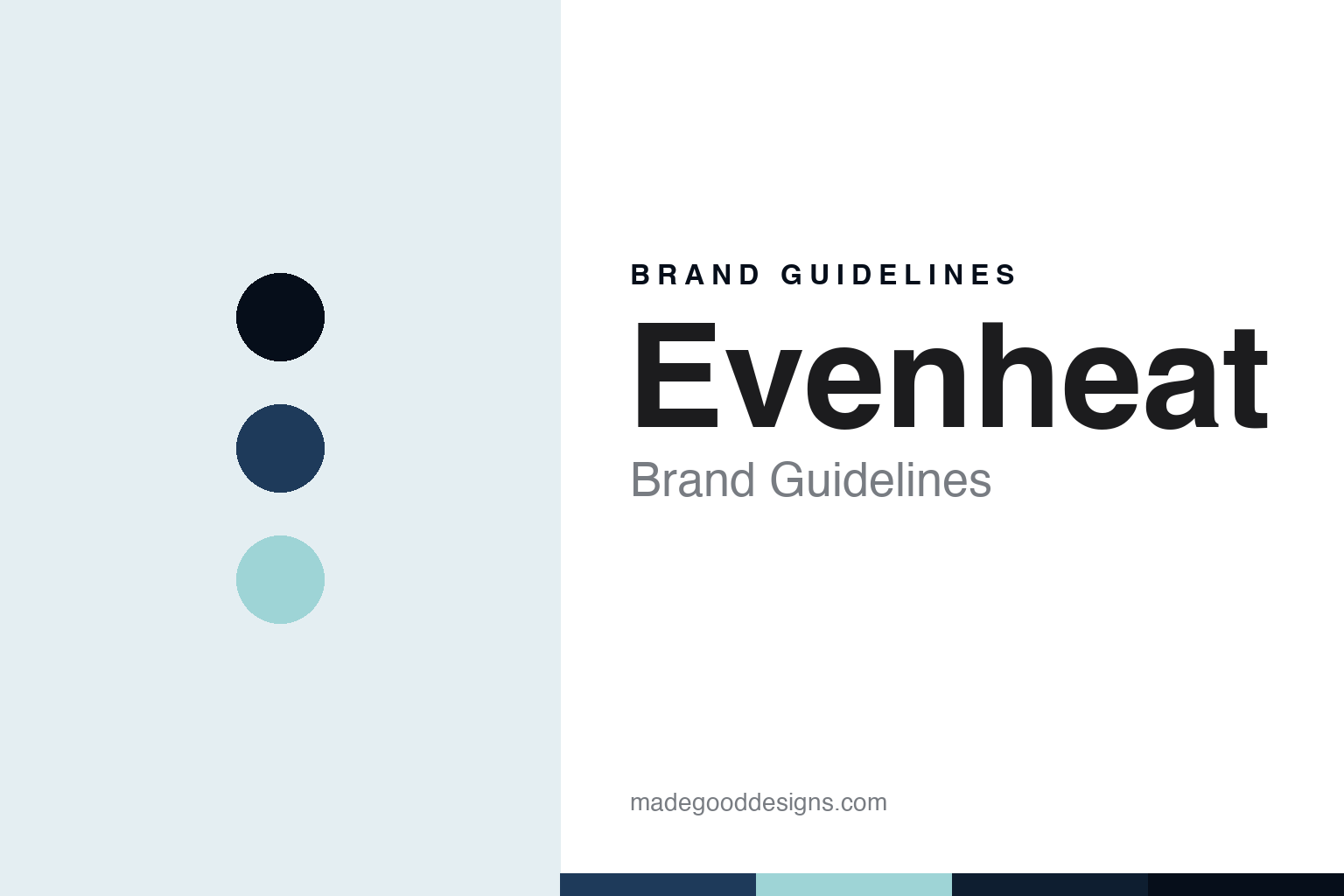
Two constants: a Caseville-navy palette and a friendly-sans register. Abstract homage — not an Evenheat product or mark; no kiln, oven or logo is reproduced.
A husband, a wife and a china-painting kiln
Evenheat’s story begins with a craft that is not pottery at all.
The founding account, as one of Evenheat’s dealers tells it, is domestic and specific. Evenheat was “Founded in 1948 by John and Margaret Watson.” John built a kiln to fire Margaret’s china painting — the decoration of white porcelain with overglaze enamels, which have to be fired at a relatively low temperature to fuse — and the craft, the same account says, ran back in Margaret’s family to her grandmother, a china painter in the late 1890s. The company itself calls Evenheat “one of the pioneers” of personal kilns.
That origin matters to the brand. Evenheat’s tagline is “Better by Design™ Since 1948,” and the year is part of the mark. The corporation behind it is younger: Michigan’s register records the articles of incorporation of Evenheat Kiln, Inc. on 30 June 1971. Like several companies in this series, the brand counts from the workshop and the company counts from the paperwork; both dates are true, and they measure different things.
Evenheat is based in Caseville, a small town on the shore of Lake Huron in Michigan’s Thumb, and its footer reads simply: “EVENHEAT KILN, INC. – CASEVILLE MICHIGAN – USA.” Its homepage banner says “PROUDLY MADE IN THE USA.” We report both as the company’s own statements.
Colour
The register shows the company’s agent changing from a Watson to a Kelly in 2008.
Who owns Evenheat today is not stated on its site, and we did not find a sale announcement. What the Michigan register does show is a change of registered agent on 13 May 2008: the filing records the previous agent as John D. Watson, and the current registered agent is Michael Kelly, in Caseville. A business-networking profile lists Mike Kelly as Evenheat’s president. We report exactly that — an agent change and a listed title — and do not describe it as a purchase, because no document we read says one occurred.
The company has filed its annual reports regularly; the latest we saw was in April 2024. It also holds trademarks for its controllers, among them RAMPMASTER and SET-PRO. For a kiln maker, a controller’s name is worth protecting: as our guides to Skutt and Paragon showed, the brain of the kiln is where much of a modern kiln’s engineering lies.
Its controllers include the Rampmaster, TAP and what it calls a “Quiet Drive Solid State” system. Whoever makes the circuitry, the potter still checks the result against a pyrometric cone, which in North America usually comes from the Orton foundation — whose own site says plainly that controllers “cannot measure heat-work.”
Typography
Kilns for potters, glass and beads — and ovens for knifemakers.
Evenheat’s range shows a kiln maker following its customers. It sells ceramic kilns, glass and bead kilns and kilns for metal clay — and a line of heat-treating ovens for knifemakers, the KO, HT, LB and KF Extreme series. Hardening and tempering knife steel needs the same thing a china painter needed in 1948: accurate, repeatable heat in a small box. The company that built a kiln for porcelain enamels now sells ovens to people who make blades.
Those ovens carry the most precise safety statement on Evenheat’s site; one long-standing dealer’s listing for its HT-1 model goes further still, describing “All Models TUV listed (UL 499) United States and Canada.” Its knife-oven pages say: “NRTL Agency Listing: TUV Listed United States and Canada – Designed and Tested to CSA & U/L 499.” In other words, the ovens are listed by TÜV, one of the nationally recognised testing laboratories, to UL 499 — the US standard for electric heating appliances — and to the Canadian standard. Our earlier kiln guides found that UL 499 spends only a few clauses on kilns and never mentions the cone; Evenheat, like the New Jersey maker L&L, names its testing laboratory on its own pages, which many makers do not.
That puts Evenheat alongside Cress of Nevada, which also sells both pottery kilns and heat-treating furnaces with quench tanks. Two American kiln makers, from opposite ends of the country, both discovered that the potter’s kiln and the toolmaker’s furnace are cousins. In a pottery studio, the hazard that matters most is often not the heat but the dust — the silica in clay, which this round’s regulatory thread follows.
A 2025 report by the US National Institute for Occupational Safety and Health shows what that looks like in a real classroom. Evaluating a North Carolina school’s ceramics and visual-arts studio, which had two electric kilns, its investigators wrote: “We found no respirable dust, respirable crystalline silica, or respirable metals in the samples.” But they also found that “Metals were present on all surfaces tested,” noted that metals such as lead, cadmium or nickel are found in many art materials including clay and glaze, and concluded that “The ventilation system in the art studio was not sufficient for the space.” The kilns were not the focus of the findings; the surfaces and the air handling were. For a kiln maker whose customers include schools, that is a useful reminder that a well-made kiln is only one part of a safe room. NIOSH’s own wording is careful — silica was not detected in the samples it took — and we keep to it.
Aa
A friendly, rounded sans — approachable, workshop-casual. (Specimen set in Nunito Sans, a sans STAND-IN; NOT the Evenheat logo or products.)
Better by Design
A trademarked tagline with a date in it.
Evenheat’s identity is its line — “Better by Design™ Since 1948” — and a simple mark: a white, stylised lowercase “e” on navy, as it appears in the site’s icon. The trademark symbol on a tagline is a small sign of how seriously a company takes its words; Evenheat holds trademarks on its controllers’ names and marks its slogan with the trademark symbol too.
The year in the tagline does the same work as the dates in our heritage-brand guides: it promises continuity, and in this case seventy-eight years of it. Here the continuity is unusually personal — a husband, a wife, and a kiln for her porcelain — even as the corporate record moved on.
For this guide we use a Caseville navy and a lake teal with a friendly rounded sans. The teal echoes the site’s own accent colour, but these values are our interpretation, and nothing of the logo is reproduced.
Explore & save
Keep Evenheat’s identity on hand — save it to a board in the Made Good inspiration library.
Evenheat identity set
Pin the Caseville-navy palette and the friendly-sans register to your own board.