Laver & Wood Brand Guidelines
English willow, shaped in Hawke’s Bay.
Aa
Two constants: a bay-green palette and a workshop-serif register. Abstract homage — not a Laver & Wood product or mark; no bat or wordmark is reproduced.
From Taunton to Waipawa
An English bat-maker, a New Zealand mallet-maker, and a partnership.
James Laver did not set out to make bats. The Cricket Monthly’s 2015 profile, “The wizard of Waipawa,” describes a former London construction engineer who lost his job in the recession of 1992 and went to train with Millichamp & Hall, the Somerset bat-makers in Taunton. He rose to oversee all of its bat production. In September 1998 he left for New Zealand with his New Zealand-born wife, Nicola.
There he was, the profile says, “drawn to Waipawa by George Wood, who made polo and croquet mallets.” In 1999 the two formed a partnership — Laver & Wood — in Central Hawke’s Bay. The company’s site keeps the date simply: “Laver & Wood were established in 1999, Hawkes Bay, New Zealand.” In 2004, the local Hawke’s Bay Today reported, Laver bought out his partner; the present company, Laver & Wood Limited, was incorporated on 31 March 2004. The name kept both men — a bat-maker and a maker of polo and croquet mallets, two trades that turn a length of hardwood into a tool for hitting a ball.
The business grew in small rural premises — first at Otane, then from 2005 in a former St John ambulance depot on Ruataniwha Street in Waipawa — before moving on 30 August 2017 to Meeanee Quay in Westshore, Napier. The new workshop was opened by Stuart Nash, then Napier’s MP and the minister for small business. In December 2017 the Herald described four bat-makers producing around 50 bats a week, and reported that an operation had opened in Hyderabad, India. A company named Laver & Wood India Private Limited appears in corporate records; we have not confirmed how it relates to the New Zealand firm, and we do not suggest that any New Zealand-branded bat is made there.
Colour
English willow, from Essex, by sea.
Laver & Wood’s bats are made in New Zealand, but their wood is not grown there. The company says it uses “the very finest English willow sourced from the world’s top willow merchants, J.S. Wright & Sons” — the Essex willow grower that, it says, was founded in 1894 to supply willow for W.G. Grace’s bats. New Zealand press has described the same thing: imported English willow, shaped in Hawke’s Bay. Its site promises “Handcrafted Cricket Bats made in New Zealand,” and says “James enjoys custom making bats in our New Zealand workshop.”
The willow is the reason for the distance. English bat willow, Salix alba var. caerulea, is grown mainly in East Anglia, under a law with no parallel in most sports: the Watermark Disease (Local Authorities) Order 1974 lets an officer examine a willow “by cutting into the wood,” and order an infected tree felled and its branches destroyed by fire. A New Zealand maker buying English clefts is buying wood that has passed through that system. Wright, for its part, says that “Approximately 75% of the world’s English Cricket Bat Willow comes from us.”
The economics followed. In 2016 the company said it made about 1,200 custom bats a year, priced from NZ$300 to NZ$2,500, with 39 per cent of sales in the United States and 29 per cent in Australia. Laver had by then made more than 30,000 bats. A crowdfunding round that year missed its minimum target; private investors came in afterwards, and the register lists a second director, Simon Lusk, since 2017, while Laver and his wife retain the majority.
Typography
Clients, not endorsers — and a sticker question.
Laver keeps his professional roster quiet. The Cricket Monthly wrote in 2015: “He won’t reveal the active players on his roster, but Sachin Tendulkar, Brian Lara and Sanath Jayasuriya are among Laver’s more illustrious clients.” Some of those relationships began in the Taunton years — Laver said he made a bat for Jayasuriya in 1997–98, when he was still at Millichamp & Hall — so we describe them as Laver’s clients, not as Laver & Wood endorsements. He also described reshaping bats for New Zealand’s Jacob Oram — the kind of after-sales work a small custom maker can offer and a large factory rarely does.
In 2017 the Herald went further, reporting that “it’s understood many top batsmen … use Laver & Wood bats and rebadge them with the logos of their sponsors.” That is unconfirmed, and we leave it as the paper put it. But it describes the trade honestly: as earlier guides in this series have shown, the sticker on a professional’s bat is a sponsorship, and the maker of the blade underneath may be someone else entirely.
The game’s rules have now caught up with the willow. In October 2025 the Marylebone Cricket Club convened a conference at Lord’s on a “cricket bat emergency” of “a shortage of willow and spiralling prices,” and from 1 October 2026 its new Laws allow laminated bats in open-age cricket “as part of an attempt to slow the rising costs of bats around the world.” For a maker shipping willow halfway round the world, the price of the raw material is not an abstraction.
Aa
A workshop serif — two surnames joined by an ampersand. (Specimen set in Fraunces, a serif STAND-IN; NOT the Laver & Wood wordmark.)
Custom Made – High Performance – Hand Crafted
Two surnames, a ladder of grades, and a bat that does not exist yet.
The brand’s line is a list: “Custom Made – High Performance – Hand Crafted.” Its logo is a plain black wordmark of the two names. The grades do the rest of the storytelling. At the top is the Signature grade, made only by James Laver and serial-numbered; below it come Reserve, described as the “top 10%,” Private Bin, Special Reserve and Legend — names borrowed from the wine trade, which suits a product sold on the quality of a natural material.
In 2017 the company announced plans for a “Signature Black” bat to sell for NZ$50,000, and said it was still searching for a cleft good enough. We found no evidence that it was ever made, and we do not suggest it was. As a brand gesture it is revealing all the same: the most expensive thing Laver & Wood could imagine was not a design but a piece of wood.
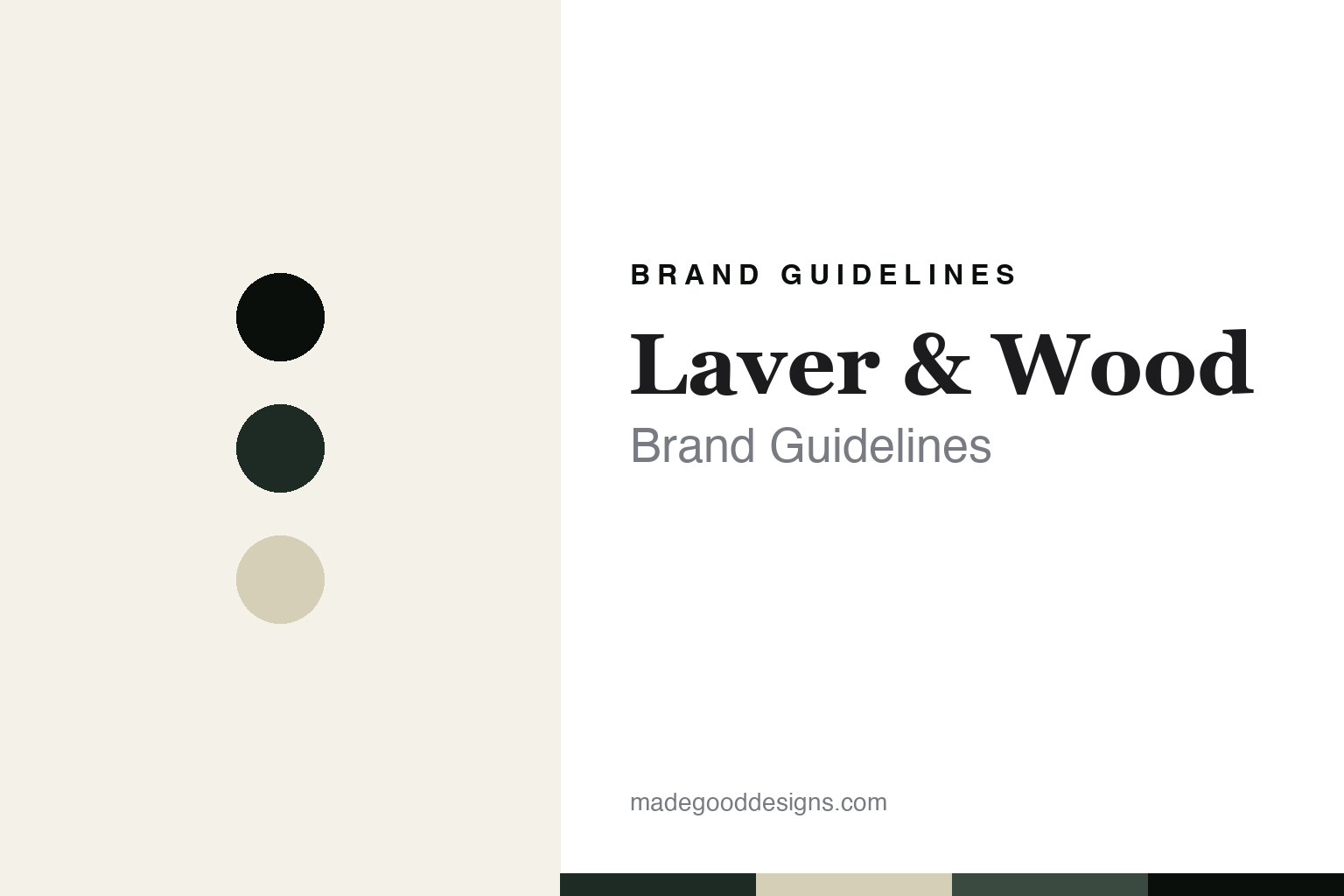
For this guide we use a deep green and a willow cream with a workshop serif. These are an unofficial interpretation, not the company’s colour values, and nothing of its wordmark is reproduced.
Explore & save
Keep Laver & Wood’s identity on hand — save it to a board in the Made Good inspiration library.
Laver & Wood identity set
Pin the bay-green palette and the workshop-serif register to your own board.