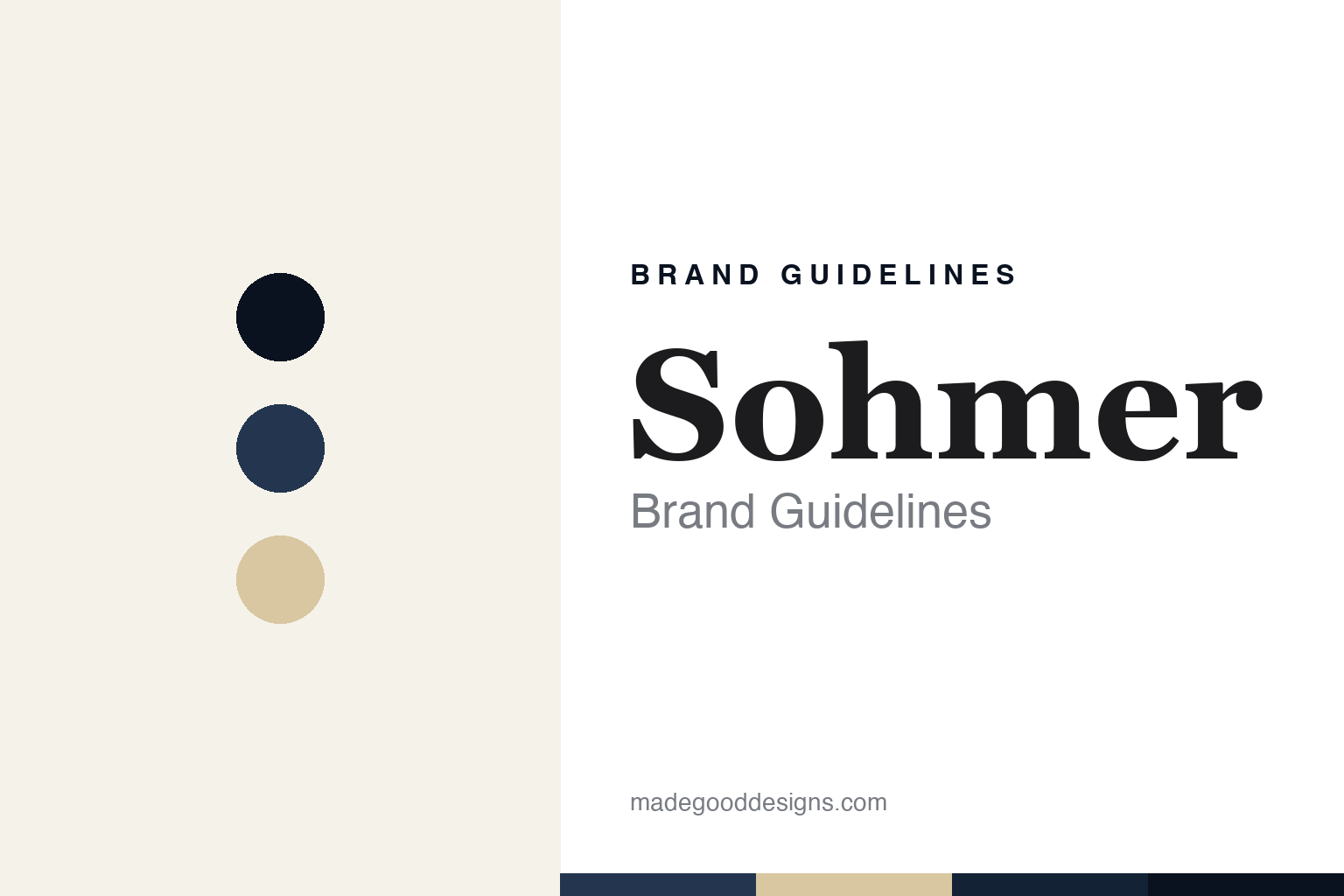
Sohmer & Co. Brand Guidelines
A New York name two companies sold.
Aa
Two constants: an Astoria-slate palette and a shield-serif register. Abstract homage — not a Sohmer product or mark; no piano or shield is reproduced.
A waterfront factory in Queens
Sohmer was a New York piano maker for 110 years.
Hugo Sohmer, born in 1845 in Dunningen in south-west Germany, founded Sohmer & Co. in New York in 1872 with Joseph Kuder, a Viennese craftsman who had been a foreman at Steinway. Its first premises were on East 14th Street. In 1886 it built a six-storey factory on the waterfront at Vernon Boulevard in Astoria, Queens; enlarged about two decades later, that building was designated a New York City landmark in 2007 and added to the National Register of Historic Places in 2014, and it has since been converted to housing. In 1919 the firm added an office and showroom on West 57th Street.
It was an inventive house. In 1884 it took a US design patent for a compact, symmetrical grand-piano case and advertised it as “the smallest grand ever manufactured” — a forerunner of the baby grand. Two patents of 1882 covered an agraffe bar and an action. English Wikipedia lists Calvin Coolidge, Victor Herbert and Irving Berlin among its owners, an uncited claim we report as such.
The family ran it for three generations. Hugo Sohmer’s son Harry took over in 1913, and Harry’s sons, Harry Jr. and Robert, in 1971. In 1982 they sold it to Pratt, Read & Co., a maker of piano actions and keyboards, which moved production to Ivoryton, Connecticut. After 110 years, New York piano-making under the Sohmer name was over.
Colour
A chain of buyers, then a lapse.
The 1980s turned Sohmer into a holding place for other names. In 1985, after the collapse of Aeolian, Sohmer bought the Mason & Hamlin and Knabe trade marks from Aeolian’s receivers. In 1986 investors led by Robert MacNeil bought Sohmer and moved production to Elysburg, Pennsylvania, the piano writer Larry Fine recorded; in 1989 MacNeil sold Sohmer — with Mason & Hamlin, Knabe and George Steck — to Bernard Greer of Falcone, Inc. magazine reported. The Pennsylvania factory had closed by the mid-1990s.
Then the name nearly disappeared. A federal court in Illinois later found that in 1996 the PianoDisc company Burgett bought Mason & Hamlin’s assets out of bankruptcy, including three SOHMER registrations — but made no Sohmer pianos from 1996 to March 2001, let the registrations lapse, so that all had been cancelled by the end of 2001, and in 1999 authorised the destruction of the five Sohmer plate patterns. The name’s physical tools were gone, and so was its legal protection.
Into that gap stepped a new applicant. Edward Richards of Persis International filed for SOHMER in February 2001; Burgett licensed its claimed rights to the Korean maker Samick, which sold “Sohmer & Co.” pianos from 2003 to 2009 — some $8.4 million worth, by Burgett’s own figure in court. For a time, Larry Fine noted, two different “Sohmer” pianos were on the American market, both made in Korea by different factories — Persis’s by a maker called Royale, in a Korean plant previously associated with Ibach and Daewoo. In December 2009 Samick assigned its claim to Persis, and on 7 September 2010 the US Patent and Trademark Office registered SOHMER for pianos to Persis International, Inc., of Chicago. In 2012 the court found that “Persis currently owns all right, title and interest” in the name.
Typography
How a name changes hands.
Sohmer’s story is the plainest illustration in this series of how a piano name is won and lost. US law says a mark is “abandoned” when “its use has been discontinued with intent not to resume such use,” and “Nonuse for 3 consecutive years shall be prima facie evidence of abandonment.” Five years without a Sohmer piano, lapsed registrations and destroyed patterns are exactly the facts on which a name changes hands, and the court’s findings set them out.
Where Sohmer pianos are made today, we could not establish. The current website shows only “Launching Soon,” and Samick, by Piano Buyer’s account as summarised by English Wikipedia, “no longer produces or distributes Sohmer-branded pianos.” We say only that the name is registered to a Chicago company and that current production is not clearly documented.
Where a piano is made also decides what it costs to import. The US tariff schedule charges a general duty of 4.7 per cent on upright and grand pianos, under headings 9201.10 and 9201.20. Pianos from China carry more: when the US Trade Representative published “List 4A” of Chinese goods on 20 August 2019, all three piano subheadings were on it, and an extra duty of 15 per cent from September 2019 was cut to 7.5 per cent from 14 February 2020 — a rate still in the 2026 schedule. Sohmer’s Samick-era pianos, made in Korea, sat outside that list.
The import pattern is old. A 1999 study by the US International Trade Commission found that pianos from Japan, Korea, China and Indonesia made up 93 per cent of American piano imports by quantity, and observed: “U.S. producers are major importers, buying foreign-produced pianos to complement their product lines.” Sohmer, a New York maker that ended up as a name on Korean pianos, is the history behind that sentence.
Aa
A shield serif — the lettering of a New York nameboard. (Specimen set in Cormorant Garamond, a serif STAND-IN; NOT the Sohmer shield or logo.)
The Sohmer shield
A stylized mark first used in 1872.
Sohmer’s historic identity is a shield — the trade mark a federal court described as “a stylized depiction” first used in 1872. The registration that protects the name today is different: a plain word mark, SOHMER, for pianos, which claims no particular lettering. The brand has thus been reduced, legally, to its five letters; the shield belongs to history and to the old instruments.
Its current website shows only “Launching Soon” and a 2025 copyright line. For a design guide, Sohmer is the clearest case in this series of a heritage name as a contested asset: a landmark factory, a family that ran it for three generations, a chain of owners, a lapse, a lawsuit and a new owner preparing a relaunch. Each stage changed who could put the name on a piano.
For this guide we use an Astoria slate and a shield gold with a high-contrast serif. These are an unofficial interpretation, not the owner’s colour values, and nothing of the Sohmer shield is reproduced.
Explore & save
Keep Sohmer & Co.’s identity on hand — save it to a board in the Made Good inspiration library.
Sohmer identity set
Pin the Astoria-slate palette and the shield-serif register to your own board.