Castagnari Brand Guidelines
The organetto family of Recanati.
Aa
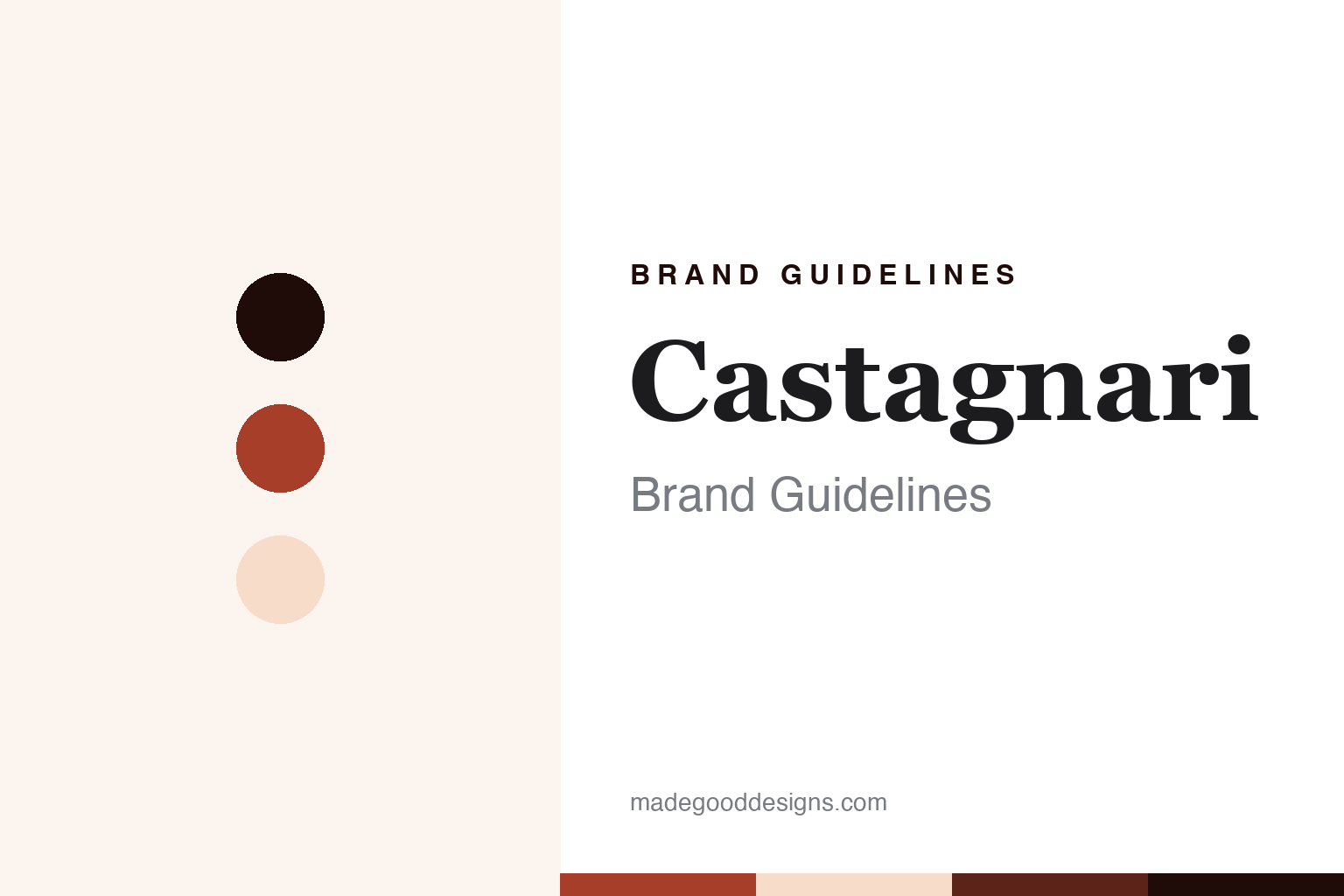
Two constants: a Castagnari rust and peach palette and a Folk serif register. Abstract homage — not a Castagnari product or mark; no instrument, logo or nameplate is reproduced.
The organetto family of Recanati
Castagnari has made diatonic accordions since 1914.
Castagnari makes organetti — small diatonic button accordions, which play a different note on the push and the pull of the bellows — in Recanati, a hill town in the Marche near Castelfidardo. Its own history starts with a date: “Dal 1914 a oggi, attraverso quattro generazioni” — from 1914 to today, through four generations.
The founder was Giacomo Castagnari, who began making organetti with his wife, Ida; the business passed to their sons, Mario and Bruno, and on down the family to the fourth generation that runs it now. Secondary sources say Giacomo had apprenticed with an earlier maker, Filippo Guzzini, and that his nickname was “Jà,” local dialect for Jacomo — the name the firm still uses for its video series, “La Bottega de Jà,” Jà’s workshop. We could not confirm the apprenticeship at first hand, and give it as reported.
The firm keeps its year in view — its social-media handle is castagnari1914 — and its town has its own place in accordion history. Paolo Soprani, whom Castelfidardo credits with founding the Italian accordion industry, was born in Recanati on 20 October 1844, according to Treccani’s biographical dictionary. Castagnari’s postcode puts it in the province of Macerata, while Castelfidardo is in the province of Ancona; the district Il Sole 24 Ore described in 2012 spans both.
Colour
The comeback of the button box.
Castagnari’s specialism is the diatonic organetto rather than the large chromatic accordion. The company says that at the end of the 1970s it took an active part in the organetto’s comeback, “dopo un periodo di oblio dovuto all’avvento della fisarmonica cromatica” — after a period of oblivion caused by the arrival of the chromatic accordion. In other words, it stayed with the older, simpler instrument, and says it helped bring it back.
The company today is Fisarmoniche Castagnari s.r.l., at Via Risorgimento 77 in Recanati. Its website does not use the words “made in Italy”; instead it shows the work, which is a stronger kind of claim. A virtual tour of “il nostro laboratorio” — our workshop — runs step by step: the sawmill, gluing the decorative mosaic, fretwork, bellows, tuning, testing, and finally “Pronti per la spedizione,” ready to ship. Each step is shown in the firm’s own workshop, in Recanati. We found no outside owner in the sources we checked; it describes itself as a family firm.
Its players come from folk music and from Italian pop music. The “La Bottega de Jà” videos feature musicians including Riccardo Tesi, Ambrogio Sparagna of the Orchestra Popolare Italiana, Andrea “Pupillo” De Rocco of the Italian band Negramaro, and Will Pound. The regional paper Il Resto del Carlino headlined a feature on the firm with Sting and Negramaro among its customers; we report that as the paper’s claim.
Typography
A craft not on the register.
Castelfidardo, a hill town near Ancona in the Marche, calls itself the home of the Italian accordion. Its municipality opened the Museo Internazionale della Fisarmonica on 9 May 1981, and its own description is plain: the town is known around the world for the instrument “grazie all’ingegno di Paolo Soprani che realizzò nel 1863 la prima industria italiana della fisarmonica” — thanks to the ingenuity of Paolo Soprani, who created the first Italian accordion industry in 1863.
The scale of that industry has changed. An exhibition by the Ancona chamber of commerce says Castelfidardo, with about 9,000 inhabitants, once “provided employment for about 10,000 workers,” and that “51,000 instruments were produced in 1938 compared to just over 500 in 1944.” In 2012 Il Sole 24 Ore reported that the district had once turned out 240,000 accordions a year, and that by then Castelfidardo and Recanati made “non più di 30mila” — no more than 30,000 — with about twenty firms still passing the trade “di padre in figlio,” from father to son. Il Sole 24 Ore also recalled that, fifty years earlier, accordions from the Marche had been “una delle prime voci dell’export nazionale” — one of Italy’s leading exports.
Italian law polices origin claims closely. Since 2003 it has been a “falsa indicazione” — a false indication — to stamp “made in Italy” on goods that do not originate in Italy under EU rules, and since 2009 “100% made in Italy” has required design, planning, processing and packaging all to take place in Italy. Castagnari makes no such claim in words, but its workshop tour amounts to one.
Italy now keeps a register of historic trademarks — the “Marchi storici” list maintained by the Ministry of Enterprises and Made in Italy (MIMIT) — for marks with a long record of use. Two of Castagnari’s neighbours are on it — Scandalli since 2020 and Paolo Soprani since 2025. Castagnari is not: we searched the 2026 list for the name and found nothing, though the same search found both of the others. The instrument itself is younger than the town’s industry might suggest. Cyrill Demian and his sons Guido and Karl were granted a Viennese patent for the “Accordion” on 23 May 1829, for a small box with bellows whose five keys each sounded a chord.
Aa
A folk serif — a family name over a button box. (Specimen set in Fraunces, a serif STAND-IN; NOT the Castagnari logo.)
Castagnari
A family name over a button box.
Castagnari’s website uses a warm, varied palette — yellow, orange, red and lavender — closer to the painted decoration of a folk instrument than to a corporate colour scheme. The family name carries the brand; the nickname of the founder titles its videos; the founding year is in its handle. Nothing in the identity is borrowed from outside the family or the town.
For a design guide, Castagnari shows how a specialist can build a brand on loyalty to an unfashionable product. It specialised in the button box, an instrument it says had fallen out of favour, and it now presents that loyalty — four generations, one instrument — as its story. Compare Paolo Soprani, whose name has passed through several owners, and Hohner, the German harmonica and accordion maker.
For this guide we use a rust and a peach with a serif, an unofficial interpretation of the website’s palette. No organetto, logo or decoration is reproduced.
Explore & save
Keep Castagnari’s identity on hand — save it to a board in the Made Good inspiration library.
Castagnari identity set
Pin the Castagnari rust and peach palette and the Folk serif register to your own board.