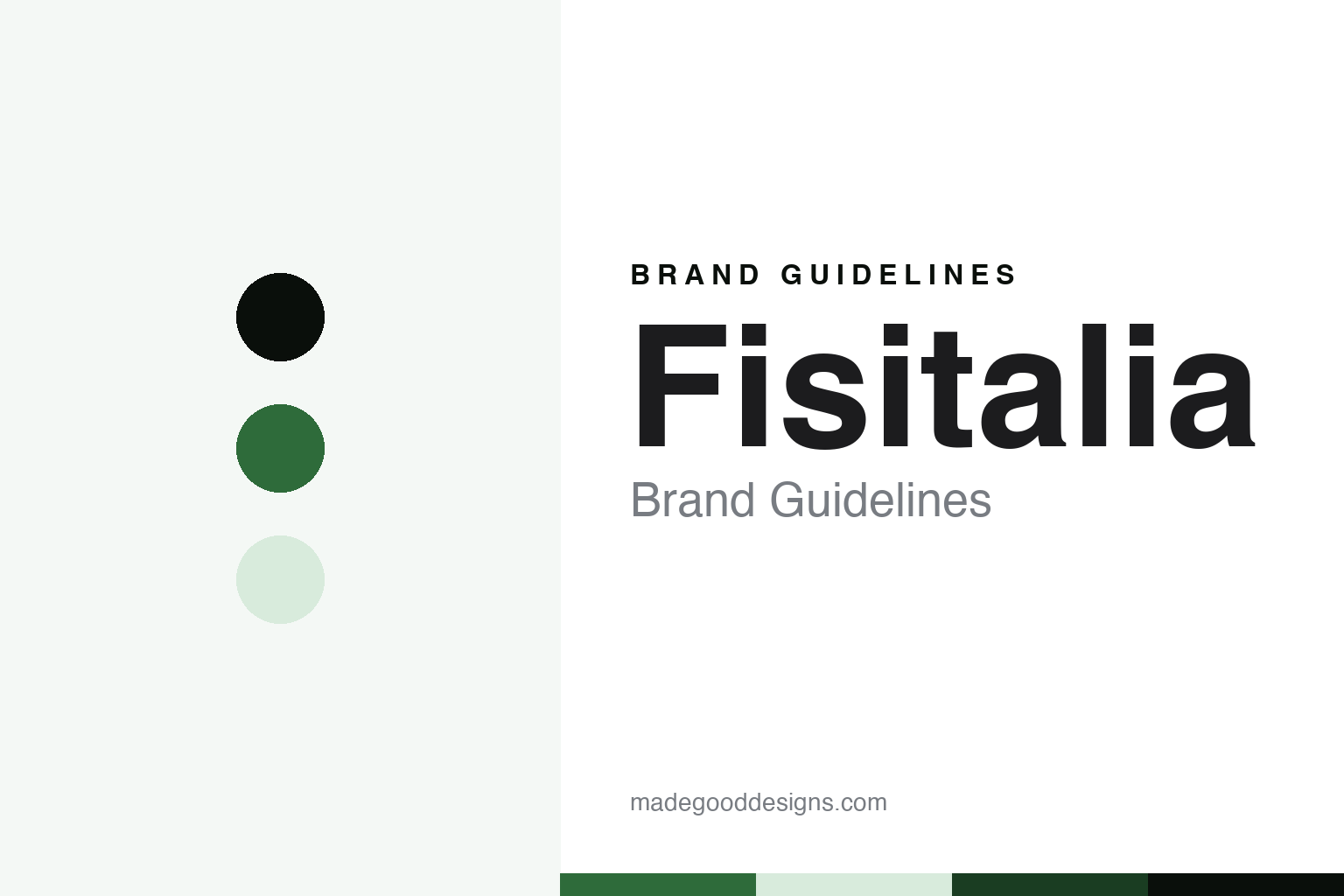
Fisitalia Brand Guidelines
A tuner, a mechanic and a certificate.
Aa
Two constants: a Fisitalia green and mint palette and a Certificate sans register. Abstract homage — not a Fisitalia product or mark; no instrument, logo or nameplate is reproduced.
A tuner and a mechanic
Fisitalia was launched in Castelfidardo in 1995.
Fisitalia is a Castelfidardo accordion brand with a precise origin story. It was “launched on the market in 1995 by Giuseppe CHIARALUCE, tuner and Piero Montecchiani, mechanical and keyboard specialist,” its website says — a reed tuner and a mechanic, who had learned their trades “at important companies in Castelfidardo.” Its badge reads “SINCE 1995,” and its homepage calls it “the brand of professional accordion makers since 1995” — a description of the founders’ trades as much as of the product.
Fisitalia is a brand, not the name of a company. Its site says “REGISTERED TRADEMARK … is a trademark owned by Ci. & Emme. Srl,” and its footer reads “Fisitalia by Ci. & Emme. srl, Via Carso, 8, 60022 Castelfidardo (AN).” We have not seen what the company’s initials stand for, and do not guess. We also found nothing on whether both founders are still involved; the privacy policy, revised in December 2025, names only the company.
The tuner’s skill became the brand’s technology. On 31 August 2000 Ci & Emme S.R.L. filed an Italian patent, with Giuseppe Chiaraluce — the tuner among the founders — as inventor, for a “System for tuning voices for accordions.” Fisitalia calls it a “UNIQUE WORLD FIRST system for tuning reeds” and says its reeds are “tuned with a magnetic system – patented by FISITALIA.” The patent is documented; the world first is the company’s claim.
Colour
Made in Castelfidardo, with a certificate.
Fisitalia states its origin insistently. Its site title is “Fisitalia – Accordions made in Castelfidardo”; its homepage says “MADE IN Castelfidardo” and promises “the true Italian accordion with certificate of origin and quality”; its logo line reads “HIGH QUALITY ITALIAN ACCORDIONS.” Each instrument, it says, carries a unique serial number and a certificate that “certifies the genuine origin of Italian production and the quality of the materials used.” The certificate is the company’s own, not a third party’s, and it travels with the instrument wherever it is sold.
Italian law polices origin claims closely. Since 2003 it has been a “falsa indicazione” — a false indication — to stamp “made in Italy” on goods that do not originate in Italy under EU rules, and since 2009 “100% made in Italy” has required design, planning, processing and packaging all to take place in Italy. A maker’s own certificate is not a legal designation, but it puts the claim in writing, on paper the buyer keeps, against a serial number, under laws that punish a false one.
The range covers the main accordion types, from piano-keyboard to button instruments: Piano Standard and Professional, Chromatic Standard and Professional, Piano and Chromatic Convertor models, and Diatonic. Its catalogues come in seven languages, including Chinese and Russian, and its site has an online shop — a direct line from a Castelfidardo workshop to players abroad. The 2009 decree also added a fine of €10,000 to €250,000 for using a trademark in a way that misleads buyers about a product’s origin.
Typography
No geographical indication — yet.
Castelfidardo, a hill town near Ancona in the Marche, calls itself the home of the Italian accordion. Its municipality opened the Museo Internazionale della Fisarmonica on 9 May 1981, and its own description is plain: the town is known around the world for the instrument “grazie all’ingegno di Paolo Soprani che realizzò nel 1863 la prima industria italiana della fisarmonica” — thanks to the ingenuity of Paolo Soprani, who created the first Italian accordion industry in 1863. The chamber of commerce’s exhibition describes Paolo Soprani, “son of a Castelfidardo farmer,” as “inventing an industry from scratch.”
The scale of that industry has changed. An exhibition by the Ancona chamber of commerce says Castelfidardo, with about 9,000 inhabitants, once “provided employment for about 10,000 workers,” and that “51,000 instruments were produced in 1938 compared to just over 500 in 1944.” In 2012 Il Sole 24 Ore reported that the district had once turned out 240,000 accordions a year, and that by then Castelfidardo and Recanati made “non più di 30mila” — no more than 30,000 — with about twenty firms still passing the trade “di padre in figlio,” from father to son.
We found no registered geographical indication or collective mark for Castelfidardo accordions, though we did not search the trademark databases. The European Union opened geographical indications to craft and industrial goods only on 1 December 2025, under Regulation 2023/2411. Until the district has one, a brand like Fisitalia has to certify itself — which is exactly what it does. The patent described the instrument simply: “Dieses Instrument hat die Gestalt eines kleinen Kästchens mit einem Blasebalge” — this instrument has the shape of a small box with a bellows. Il Sole 24 Ore also recalled that, fifty years earlier, accordions from the Marche had been “una delle prime voci dell’export nazionale” — one of Italy’s leading exports. The instrument itself is younger than the town’s industry might suggest. Cyrill Demian and his sons Guido and Karl were granted a Viennese patent for the “Accordion” on 23 May 1829, for a small box with bellows whose five keys each sounded a chord.
Aa
A certificate sans — origin stated, then stated again. (Specimen set in Inter Tight, a sans STAND-IN; NOT the Fisitalia logo.)
Fisitalia
A map, a flag and a script.
Fisitalia’s logo is a black oval badge with a grey map of Italy, a gold calligraphic “F,” the Italian tricolour and “SINCE 1995”; beneath it, “Fisitalia®” in black italic script over a rule, with “HIGH QUALITY ITALIAN ACCORDIONS” in sans-serif capitals. Its homepage runs a series of short lines: “HIGH QUALITY inside,” “OUR SOUND our Soul,” “VOICES from heart,” “REAL SHAPE of Art,” “THE CREATION of Sound.” Each pairs a capitalised promise with a lower-case feeling, a small typographic system of its own.
For a design guide, Fisitalia has perhaps the most explicitly national identity in this round: a map, a flag and the words “Italian” and “Castelfidardo” all in the mark or beside it. Where Scandalli and Paolo Soprani lean on age and the national register, Fisitalia, at just over thirty, leans on proof of place.
For this guide we use an Italian green and a mint with a sans serif, an unofficial interpretation of the tricolour. No accordion, badge or logo is reproduced.
Explore & save
Keep Fisitalia’s identity on hand — save it to a board in the Made Good inspiration library.
Fisitalia identity set
Pin the Fisitalia green and mint palette and the Certificate sans register to your own board.