Salvi Harps Brand Guidelines
All the magic of a great sound.
Aa
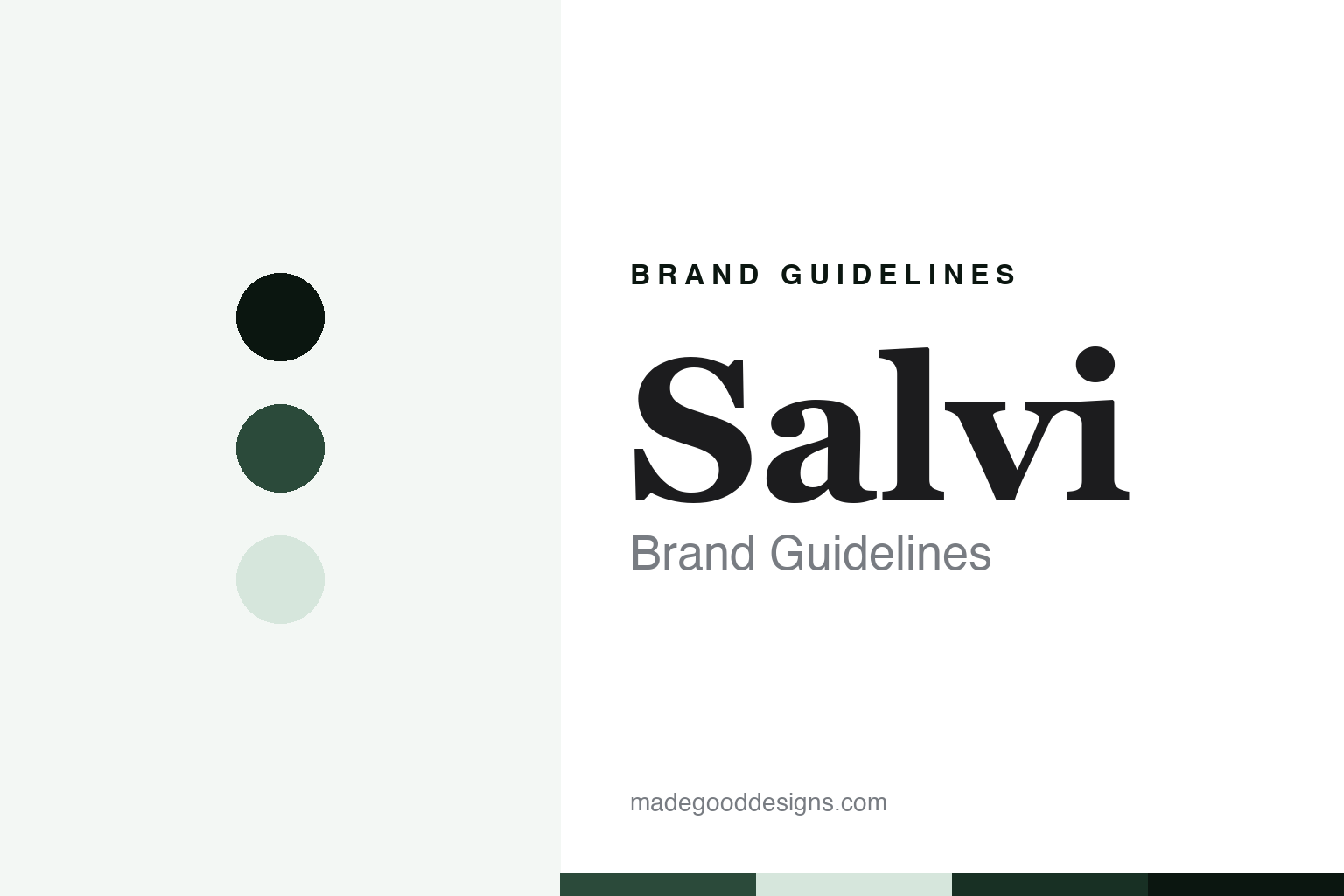
Two constants: a Salvi green and sage palette and a Piedmont serif register. Abstract homage — not a Salvi product or mark; no instrument, logo or nameplate is reproduced.
A Chicago harpist’s Italian workshop
Victor Salvi played for Toscanini, then built harps.
Salvi Harps is an Italian company founded by an American harpist. Victor Salvi was born in Chicago on 4 March 1920, into a family of instrument makers: his father, Rodolfo, had made harps, pianos and bowed instruments in Venice, according to the New York Times. As a boy Victor learned the harp from his sister Aida, played in a US Navy band during the Second World War, and opened a harp repair shop in Chicago in the mid-1940s.
Around 1950 he moved to New York, where, the Times says, he played with the New York Philharmonic under Dimitri Mitropoulos and the NBC Symphony under Arturo Toscanini, and opened a repair shop in Manhattan. “In 1954,” the paper says, he “built his first harp.” Within a year or two his company had moved to Italy, the country his father had come from: “In 1955, he moved to Italy and founded his company… in Genoa,” Salvi’s history says. The Times and Wikipedia give 1956, so we say the mid-1950s.
Salvi’s own history reaches further back, tracing the family to “the early 19th century in Vincenza with Giranimo Salvi” — the spelling is the website’s. We report it as the company’s account. In 1957 the young maker, already building harps in Genoa, told the Times: “Anyone can sit down to the harp and make sounds so that people don’t want to jump out of the window.”
Colour
Genoa, then Piasco — and Chicago.
The first workshop was in Genoa, his family’s country though not his birthplace, in a fifteenth-century villa reputedly once owned by Admiral Andrea Doria, according to Wikipedia. The company later moved inland. Salvi says Victor “settled his factory in the Piedmont region, in the town of Piasco, where it is still located today”; Wikipedia dates the move to 1974. The legal company in the website footer is N.S.M. S.p.a., of Via Rossana 7, Piasco, in the province of Cuneo.
Salvi built a group around the factory — what the New York Times later called “a genial global monopoly” in concert harps, once Lyon & Healy was part of it. The Times says he set up a workshop in Switzerland for harp mechanisms, staffed by craftsmen from the watch, music-box and automaton trades; Wikipedia says the group also acquired Bow Brand, the British string maker. And in 1987, Salvi says, “Victor acquired his main competitor Lyon & Healy Harps.” The Times put the company’s output at about 2,000 instruments a year, and Wikipedia gives staff of about 90 at Piasco and about 135 at Lyon & Healy, figures we report as its own.
Victor Salvi died in May 2015, aged 95, having run harp workshops on two continents; the Times gives 10 May, in Milan. We did not find a public record of who owns N.S.M. today, so we name the company and not its shareholders. The American Harp Society says his widow, Julia, runs the Victor Salvi Foundation. A Fondazione Victor Salvi was established in 2000, and a harp museum opened at Piasco in 2006 — “the first museum solely dedicated to this instrument,” the company says.
Typography
A harp for a prince.
In 2006 Salvi presented the then Prince of Wales with an ornate harp, known as the Prince of Wales harp, which the Times says was played by the royal harpist at the reception for the wedding of Prince William and Catherine Middleton in 2011.
The mechanism Salvi’s Swiss craftsmen build descends from a single patent. Sébastien Erard applied for an English patent, number 3332, in 1810, for a double-action harp in which each string had two forks worked by a pedal, so it could sound flat, natural or sharp. Erard’s own advertisement of October 1811 promised that the performer “can now play in every known key.” A Royal College of Music thesis by Fanny Guillaume-Castel says the design “remains the standard pedal harp mechanism today,” and that in 1812, its first full year on sale, Erard sold about a hundred — a twentieth of what the Times said Salvi’s company made each year. The Erard brothers’ French patents of August 1811 protected the invention for fifteen years; since then the design has been free for every maker, including Salvi’s Swiss mechanism workshop, to build.
Harp bodies are mostly maple and spruce, but the wider instrument trade has had to deal with timber law. In 2017 the CITES convention brought the whole rosewood genus, Dalbergia, under its Appendix II controls; from 26 November 2019 it exempted “finished musical instruments, finished musical instrument parts and finished musical instrument accessories.” The relief does not extend to Brazilian rosewood, which stays in Appendix I. CITES defines a finished musical instrument as one “that is ready to play or needs only the installation of parts to make it playable,” and says the term “includes antique instruments.” We found no source linking Salvi’s harps to either timber; the rule matters to any maker who ships finished instruments across borders.
Aa
A Piedmont serif — a harpist’s surname as a maker’s mark. (Specimen set in Fraunces, a serif STAND-IN; NOT the Salvi logo.)
Salvi
All the magic of a great sound.
Salvi’s homepage headline is “ALL THE MAGIC OF A GREAT SOUND,” and its copy speaks of “the experience and passion of skilled hands.” The brand is the founder’s surname — the name of a working harpist who played under Toscanini, which gives it a kind of authority with players that a corporate name would struggle to match.
For a design guide, Salvi is a lesson in owning a rival without erasing it. Since 1987 the same group has sold harps under an Italian name made in Piedmont and an American name made in Chicago, with separate websites, histories and identities. A buyer choosing between them is choosing a story, not an owner. Lyon & Healy’s website even links to its Italian sister brand, alongside Delta Harp and Harp.com, so the family resemblance is visible to anyone who looks. Compare Lyon & Healy, the American half, and Camac, the French maker outside the group.
For this guide we use a green and a sage with a serif, an unofficial interpretation; we did not verify the logo’s colours. No harp, mechanism or logo is reproduced.
Explore & save
Keep Salvi Harps’s identity on hand — save it to a board in the Made Good inspiration library.
Salvi identity set
Pin the Salvi green and sage palette and the Piedmont serif register to your own board.