Camac Harps Brand Guidelines
Fine French harps since 1972.
Aa
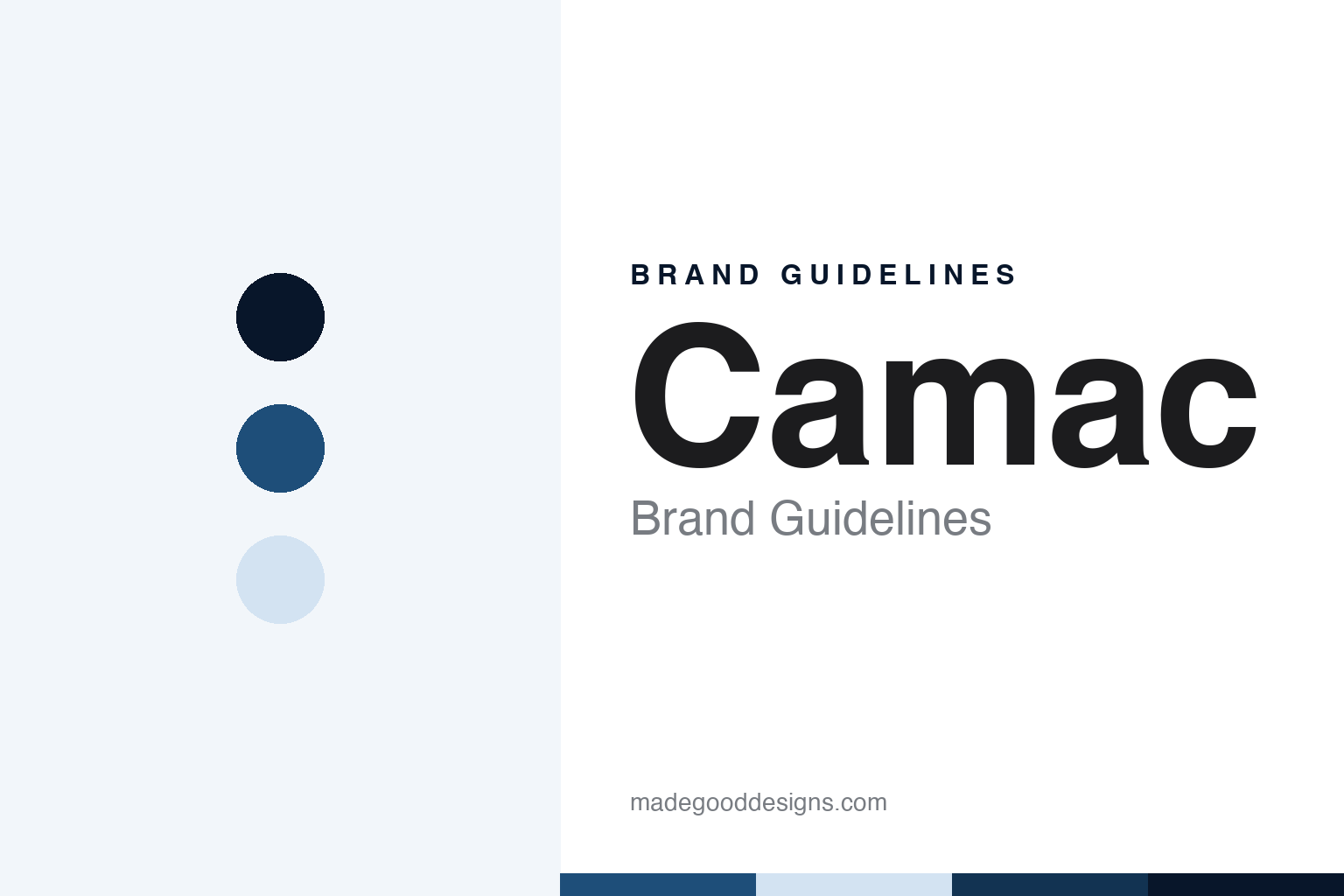
Two constants: a Camac blue and pale sky palette and a Atlantic sans register. Abstract homage — not a Camac product or mark; no instrument, logo or nameplate is reproduced.
Fine French harps since 1972
Two brothers, a hamlet near Nantes, and an Inca god.
Camac Harps was founded in 1972 by two brothers, in a hamlet in western France. Its timeline says: “1972: Gérard and Joël Garnier found the Camac Society in Mouzeil,” and adds that it “has always been based in the hamlet of Mouzeil, near Nantes in Brittany, France.” Mouzeil is officially in the Loire-Atlantique department; Brittany is Camac’s word, and the historic one.
The name is not French. “Our company name is inspired by Pachacamac, the Inca god of creation. ‘Camac’ means ‘Creation’ in the Quechuan language,” the company says. That fits its beginnings: Camac says it “began life making American Indian flutes,” then imported lever harps from Japan, before designing its own Bardic harp with a rectangular soundbox, with Jacques Rousseau and André Glemin.
Its harps then followed fast. Camac lists the Morgane and Mélusine lever harps in 1976, made with the harpist Mariannig Larc’hantec; a 36-string Electroharp in 1984, shown by Joël Garnier and the harpist Kristen Noguès at the Edinburgh International Harp Festival and, in 1985, at the World Harp Congress in Jerusalem; the Memory Harp, a pedal harp, in 1985; and, in 1987, its first acoustic pedal harps, shown at the World Harp Congress in Vienna, fifteen years after the company began — “the first pedal harps made in France since the time of Érard!”
Colour
Independent, and still in Mouzeil.
Camac is an independent company. The French business register lists it as Harpes Camac, a simplified joint-stock company (SAS) at La Richerais, Mouzeil, active and employing between 50 and 99 people in 2023, classed under musical-instrument manufacture. Its president is Jakez François, and its managing director is a company run by Éric Piron; Camac’s own site calls them “Jakez François, President” and “Eric Piron, CEO.” The register gives the current legal entity a creation date of 1985 — a later company carrying the 1972 brand. We found no parent group, and the shareholdings are not public.
The founding family is no longer at the head. Joël Garnier died in 2000, and, Camac says, “Jakez François became President of the company on Joël Garnier’s death.” François had joined in 1988, and Piron in 2000.
The making has stayed in the hamlet. Camac’s contact page reads: “Offices & workshops Camac Harps La Richerais – BP 15 44850 Mouzeil – France.” In 2006 the French state gave it the “Entreprise du patrimoine vivant” label, which recognises firms with rare craft skills, and in 2022 it marked its fiftieth anniversary: “2022 is Camac Harps’ 50th anniversary year!”
Typography
Electric harps, and a carbon spine.
Camac’s best-known innovations are electric. The Blue Harp, an electric pedal harp, launched in Paris in 1990, and the current range includes The Blue, Big Blue, Little Big Blue and Mini Blue, along with the DHC, a “wearable” electric lever harp made with the American harpist Deborah Henson-Conant in 2010 and “Weighing just 5kg.” Camac added a MIDI harp in 2009. Its electric line also includes the Electro Llanera, named for the harp of the South American plains. Its concert range includes the Clio and Atlantide Prestige (1996), the Élysée and Vendôme (2010) and the Canopée and Art Nouveau (2017).
Its engineering is borrowed and adapted. The metal core in its pedal-harp columns was, it says, “an idea taken from Pleyel,” the Paris piano maker, and “Today, the core is carbon fibre, lighter and even more stable than metal, and clad with wood.” The carbon is inside the column; the harp itself is still a wooden instrument.
Camac also supplies other makers. The American lever-harp maker Triplett, in San Luis Obispo, says: “Our sharpening levers are manufactured in France by Camac harps.” A French workshop’s hardware, in other words, sits on harps sold as built in the USA — and Triplett says so openly.
Camac’s 1987 boast — “the first pedal harps made in France since the time of Érard!” — points to the man who fixed the instrument’s form. Sébastien Erard applied for an English patent, number 3332, in 1810, and the Erard brothers took French patents in August 1811, for a double-action harp in which each string has two forks worked by a pedal, so it can sound flat, natural or sharp. A Royal College of Music thesis by Fanny Guillaume-Castel says the design “remains the standard pedal harp mechanism today.” Erard’s own 1811 advertisement promised that the player “can now play in every known key.” In 1812, the thesis says, Erard sold about a hundred of the new harps; Camac’s claim is that no French workshop built pedal harps again until its own in 1987.
Like every instrument maker, Camac works under timber law. In 2017 the CITES convention brought the whole rosewood genus, Dalbergia, under its Appendix II controls; from 26 November 2019 it exempted “finished musical instruments, finished musical instrument parts and finished musical instrument accessories,” though Brazilian rosewood stays in Appendix I. We found no source linking Camac’s harps to either timber; harp bodies are mostly maple and spruce. CITES defines a finished musical instrument as one “that is ready to play or needs only the installation of parts to make it playable,” and says the term “includes antique instruments.” Camac’s own homepage promises “Responsible manufacture.”
Aa
An Atlantic sans — a Quechua word on a French harp. (Specimen set in Inter Tight, a sans STAND-IN; NOT the Camac logo.)
Camac
A Quechua word on a French harp.
Camac’s line is plain and dated: “Fine French harps since 1972.” Its homepage pairs that with “Responsible manufacture and a passion for quality.” The name, from Quechua, gives a French harp maker an unexpected and memorable word — short, easy to say in any language, and with a story attached.
For a design guide, Camac is an independent maker in a field where two famous names, Lyon & Healy and Salvi, share an owner. Its brand leans on two things the others do not claim: Frenchness after Érard, and electric harps. We did not view its logo, so we make no claim about its form or colours. The name, the date and the word “French” do most of the work.
For this guide we use a blue and a pale sky with a sans serif, an unofficial interpretation. No harp, column or logo is reproduced.
Explore & save
Keep Camac Harps’s identity on hand — save it to a board in the Made Good inspiration library.
Camac identity set
Pin the Camac blue and pale sky palette and the Atlantic sans register to your own board.