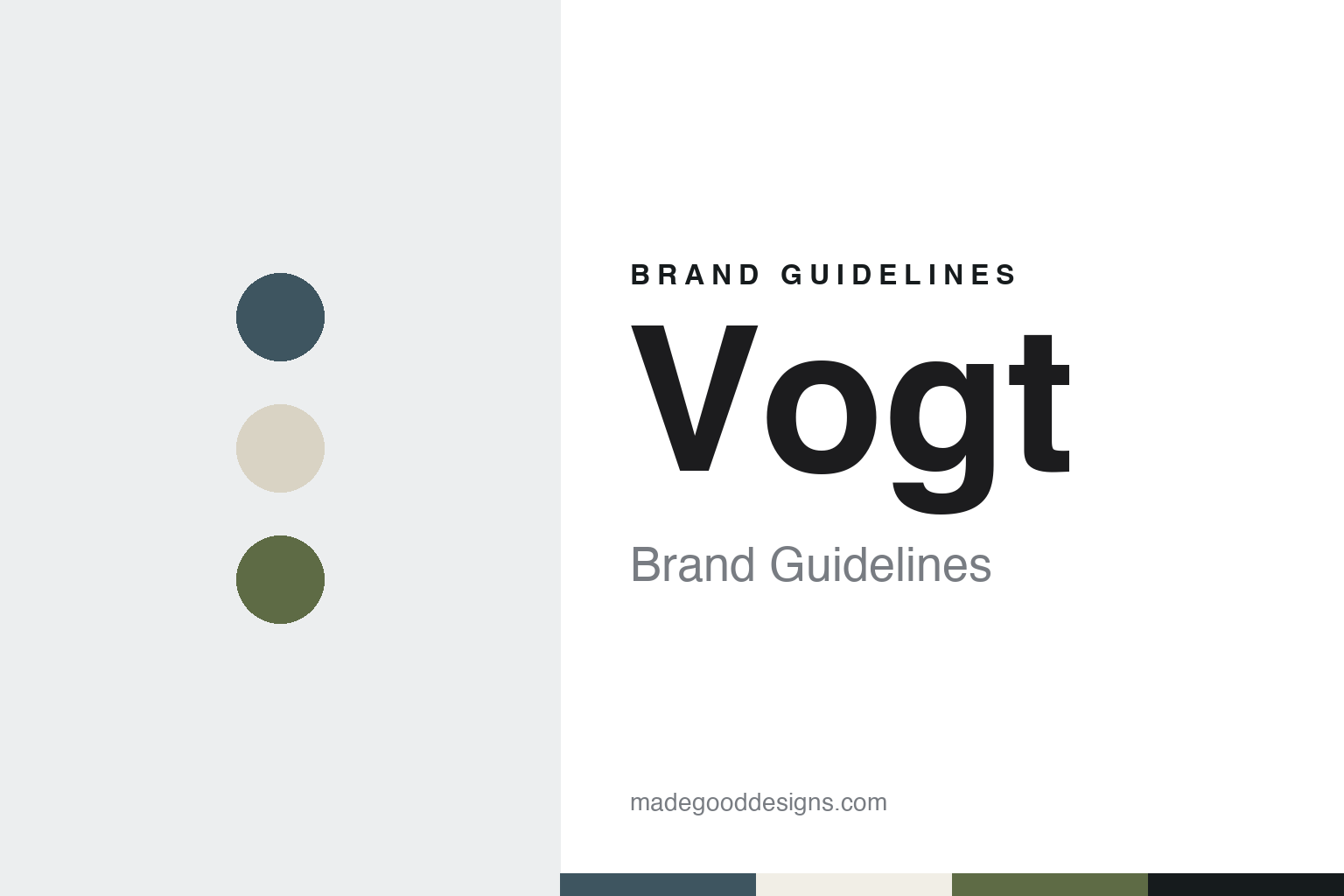
Vogt Brand Guidelines
Günther Vogt’s Zurich landscape practice with four offices.
Aa
Two constants: a lake slate, limestone and moss palette and a Swiss grotesque register. Abstract homage — not a Vogt design or mark; no plan, photograph or logo is reproduced.
From Kienast Vogt to Vogt
A Zurich partnership becomes a practice.
Vogt Landscape Architects was founded in Zurich in 2000 by the Liechtenstein-born landscape architect Günther Vogt. The practice’s own biography says it “emerged from the former partnership with Dieter Kienast” in Zurich. English Wikipedia sets out the steps: Vogt trained in horticulture in Bern, studied landscape architecture at the Intercantonal Technical College in Rapperswil, joined the office of Stöckli, Kienast and Köppel in 1987, and in 1995 founded Kienast Vogt Partner with Dieter Kienast. In 2000 the office became Vogt Landschaftsarchitekten, Zurich.
Branches followed. The practice says it opened its London studio in Shoreditch in September 2008, then offices in Berlin in 2010 and Paris in 2019. Its contact page in 2026 lists four offices under four names, one for each country: Vogt Landschaftsarchitekten AG in Zurich, Vogt Landscape Limited in London, Vogt Landschaft GmbH in Berlin and Vogt Paysage – Urbanisme in Paris. The website runs in English, German and French.
Teaching has run alongside the practice. English Wikipedia says Vogt taught at ETH Zurich from 2005 to 2023 and at the Harvard Graduate School of Design in 2012, and the Engadin Art Talks biography also describes him as professor emeritus. In 2010 he opened the Case Studio VOGT, which the practice describes as a platform for interdisciplinary projects between teaching and practice. The website names Günther Vogt as founding director, and Maren Brakebusch and Thomas Kissling as managing directors who head the four offices together; Brakebusch, the practice says, studied landscape architecture at Leibniz Universität Hannover, joined in 2002 after working in Berlin and Hanover, and has been professor of garden and landscape architecture at FH Potsdam since 2022. Kissling studied architecture at ETH Zurich, worked as a research and senior assistant at Vogt’s ETH professorship from 2010 to 2021, and joined the practice in 2021. Each branch also has its own head of office, named on the website with a short professional biography.
Colour
Landscapes made with architects.
Much of the practice’s work is made with architects, and its credits read as a list of collaborations. English Wikipedia credits Vogt with the landscape of Tate Modern in London, dated 1995 to 2007, and of the Allianz Arena football stadium in Munich, dated 2001 to 2005, both with the architects Herzog & de Meuron. It also credits the practice with the landscape of the Kolumba art museum in Cologne, dated 1997 to 2007, with the architect Peter Zumthor. Several of those dates begin before 2000, in the years of the Kienast Vogt partnership, and run on into the new office.
The most recent of the four is in Trafalgar Square. When the National Gallery’s Sainsbury Wing reopened in May 2025, designboom reported on 6 May 2025, the redesign by Selldorf Architects had been carried out with the heritage architects Purcell and the landscape designers Vogt. At its centre is a new public forecourt, described as a “square within a square,” made by removing a little-used courtyard between the Sainsbury Wing and the historic Wilkins Building. Vogt’s scheme, the magazine said, keeps things minimal, replacing the former courtyard with terrazzo-style benches made from reconstituted Portland limestone. Blooloop reported the same team of Selldorf, Purcell and Vogt Landscape the following day, ahead of the public reopening on 10 May.
Books are a steady part of the practice’s record, and most come from one Zurich publisher, Lars Müller. English Wikipedia lists Miniature and Panorama, on the practice’s work from 2000 to 2006, with a later edition covering projects to 2012, and Distance and Engagement of 2010, subtitled “Walking, Thinking and Making Landscape.” The practice adds Landscape as a Cabinet of Curiosities, Mutation and Morphosis and Solid-Fluid-Biotic, all edited, it says, by Thomas Kissling. Two further titles from Vogt’s ETH chair appeared with the same publisher in 2010 and 2011.
Typography
Design and documentation.
Landscape-architecture practices tend to present themselves through names rather than symbols. Many are called after their founders and partners, and the name often changes as partners join or leave, so a practice’s history page or interview record is frequently where a renaming, and its date, is set down. Others take a short invented or descriptive name, and some add a line such as “urban design & landscape architecture” to say what the studio does. Wordmarks and monograms appear as the practices publish them on their own sites, letterheads and project boards.
The work itself carries most of the identity. Practice websites usually open with project photography and group commissions by type, such as parks, squares, masterplans and public realm, with each project shown through photographs, site plans, sections and drawings. Competition boards, exhibition panels and monographs extend that record, and many practices publish brochures or books that collect their work over a period of years.
People are presented in their professional roles. Founders, partners and directors are usually named with their discipline, such as landscape architect, architect or urban designer, and team pages list wider staff by role. Offices are described plainly by city, and trade press profiles and interviews often record when a studio opened, how many people it employed at the time and where it was working.
This guide sets out what dated sources record about each practice: when and where it was founded, who founded it, how its name has changed, and which projects published sources credit to it. It describes what was designed and built, using the practices’ own descriptions only where they are attributed, and it makes no claims about what any landscape achieves.
Aa
A Swiss grotesque for a practice that writes its name in capitals. (Specimen set in Archivo, a sans STAND-IN; NOT the Vogt logo.)
VOGT
A name in capitals and a plain index.
On its website the practice writes its name in capitals, VOGT, and presents itself through a plain index: news, Case Studio, projects, exhibitions, publications, contact and jobs. The news feed reads as a running record of competitions, openings, lectures, exhibitions and book launches, with short entries and a “Read more” link for each, and the office pages pair each location with the people who run it, their training and their teaching posts. The London page, for example, opens with a single line on the studio’s founding in September 2008 before listing its team leaders and their roles.
The practice describes its own outlook in a few lines. Its biography calls Vogt “a passionate collector and curious traveller” who looks for ways to read, interpret and describe the landscape, and says the work is marked by exchange between disciplines and cooperation with artists. The books carry the same approach into print, setting the practice’s projects next to essays, collections and conversations rather than presenting them as a portfolio alone.
For a design guide, Vogt shows how a landscape practice can present itself with very little: one surname in capitals, a short index, four offices named country by country and a shelf of books. Compare Gustafson Porter + Bowman, another landscape practice with a London studio, and West 8, a European practice that also works across urban design and landscape. For this guide we use a lake slate, a limestone and a moss green with a sans, an unofficial interpretation; no product or logo is reproduced.
Explore & save
Keep Vogt’s identity on hand — save it to a board in the Made Good inspiration library.
Vogt identity set
Pin the Vogt lake slate, limestone and moss palette and the Swiss grotesque register to your own board.
Source & notes
Frequently Asked Questions
What font can I use to match the Vogt look?
This guide describes Vogt’s type as “A Swiss grotesque for a practice that writes its name in capitals”. Its type specimen is set in Archivo from Google Fonts as a stand-in; Archivo is not Vogt’s own lettering.
What colours are in the Vogt palette?
This guide’s Vogt palette is Lake slate #3E5560, Ink #161B1D, Limestone #D9D3C4, Moss #5E6B45 and Chalk paper #F1EEE6. The tones are the guide’s own unofficial interpretation, not official Vogt hex codes.
When was Vogt founded?
Vogt was founded in 2000, in Zurich, Switzerland. Vogt is known for Tate Modern, Allianz Arena, Kolumba, Sainsbury Wing.
Who founded Vogt?
Vogt was founded by Günther Vogt in 2000. Vogt is known for Tate Modern, Allianz Arena, Kolumba, Sainsbury Wing.