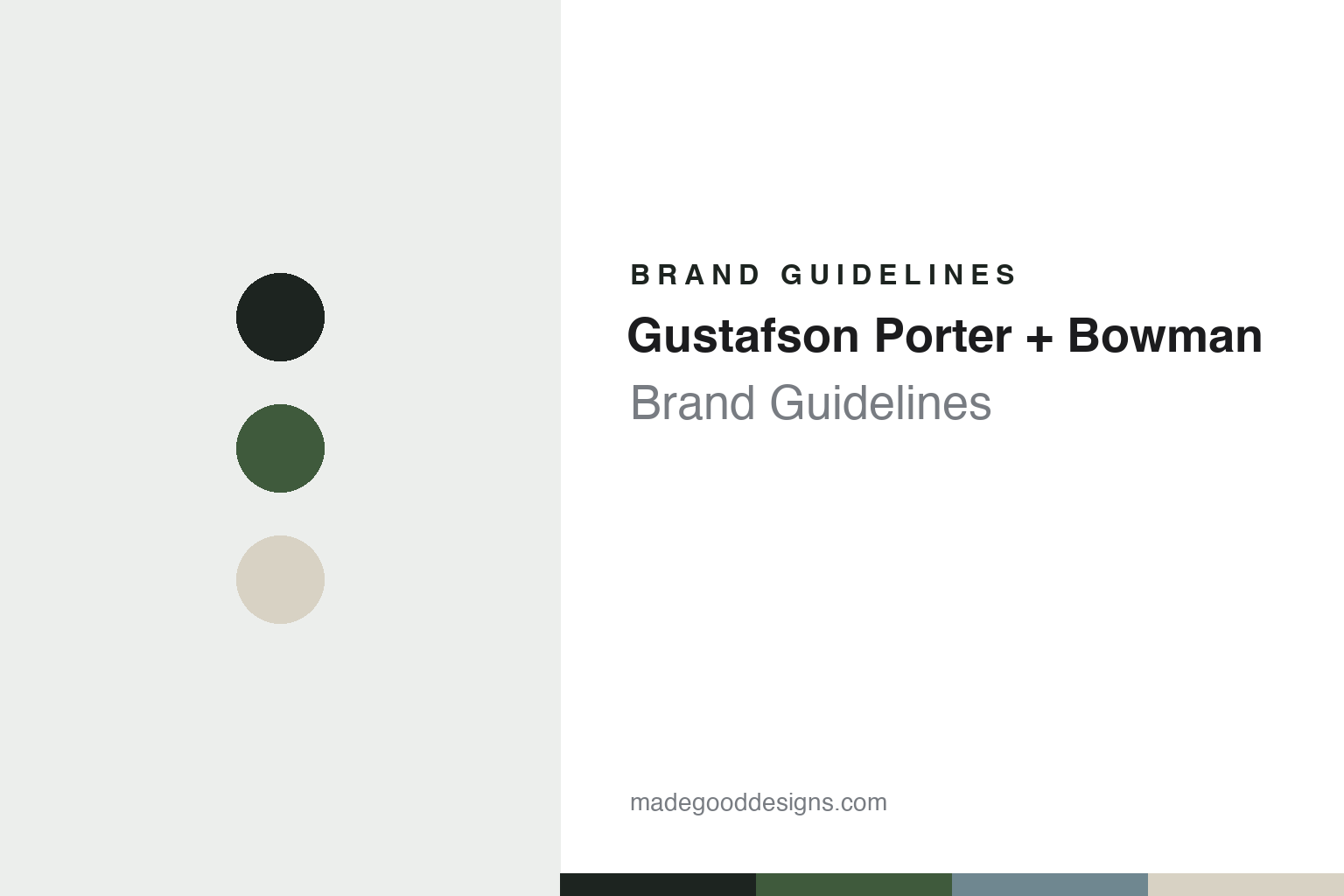
Gustafson Porter + Bowman Brand Guidelines
The London landscape practice that added a third name after twenty years.
Aa
Two constants: a yew green, moss and stone palette and a sculpted garden serif register. Abstract homage — not a Gustafson Porter + Bowman asset; no logo, drawing or project image is reproduced.
Gustafson Porter
A shared office in Shoreditch.
Gustafson Porter + Bowman is a landscape-architecture practice in London. It was established in 1997 as Gustafson Porter, when the landscape architect Kathryn Gustafson opened a London office with the architect Neil Porter, the practice says on its website. A profile published by Archinect in May 2017, written by Abigail Banfield, places that start in a shared office space on Curtain Road in Shoreditch, in East London.
The third name came later. Mary Bowman joined in 2002, when the studio had eight people, Archinect reported, drawn in part by its designs for Cultuurpark Westergasfabriek in Amsterdam and the Diana, Princess of Wales Memorial Fountain in London, which the practice had recently won in competition. Early in 2017, the year it marked twenty years of practice, the firm changed its name from Gustafson Porter to Gustafson Porter + Bowman, which Archinect described as a recognition of Bowman’s contribution as a partner.
The practice’s website now lists Gustafson and Bowman as founders and Porter as founding partner, together with three further partners, and says the partners are supported by a wider team of landscape architects and architects from around the world. By 2017 the studio had grown to more than 30 architects and landscape architects, based in Camden and working across Europe, Africa, the Middle East and Asia, Archinect reported. The practice told the magazine that it kept roughly an even split between architects and landscape architects, that three of its five partners at the time had qualified as architects, and that it worked with local landscape architects abroad rather than running an overseas office.
Colour
Parks, squares and memorials in several countries.
The practice groups its work on its website under headings that include culture and heritage, parks and gardens, plazas, masterplans, public realm, residential and commercial. Its own summary of selected work dates the Diana, Princess of Wales Memorial Fountain in Hyde Park to 2004 and Cultuurpark Westergasfabriek in Amsterdam to 2006, and the Old Market Square in Nottingham to 2007.
Westergasfabriek is the project the practice singled out in its 2017 interview with Archinect, calling it one of its defining projects. It described the work as brownfield reclamation on a dense urban site with a complex set of stakeholders, and said its design for the park remained unaltered. The practice also said it had engaged with the local community during the work, and described a balance in the design between contamination and accessibility, and between invention and interpretation.
In Beirut the practice worked on Harbour Square between 2008 and 2011, a project it cited in the same interview as an example of designing and building its own structures, which it linked to having architects and landscape architects in the same studio. It also told Archinect that its commissions had included parks, memorials, plazas and masterplans as well as infrastructure such as pylons and bridges, that many had been won in design competitions, and that it had begun working on architectural interiors that link a landscape outside to the spaces inside a building.
The practice describes its own work in terms of form. On its website it speaks of “sensual and sculptural features,” and in the 2017 interview it said it was known for three-dimensional landscape forms, modelling the ground plane to enclose and frame a sequence of spaces, and that its designs often draw on art and history. Asked by Archinect to sum up its ethos, it said it aimed for strong concepts carried through to the details; the magazine itself described the practice’s work as ranging from the conservation of significant sites to the rethinking of urban brownfield land. The practice’s phrases here are its own descriptions of its approach, and this guide gives them as such.
Typography
Design and documentation.
Landscape-architecture practices tend to present themselves through names rather than symbols. Many are called after their founders and partners, and the name often changes as partners join or leave, so a practice’s history page or interview record is frequently where a renaming, and its date, is set down. Others take a short invented or descriptive name, and some add a line such as “urban design & landscape architecture” to say what the studio does. Wordmarks and monograms appear as the practices publish them on their own sites, letterheads and project boards.
The work itself carries most of the identity. Practice websites usually open with project photography and group commissions by type, such as parks, squares, masterplans and public realm, with each project shown through photographs, site plans, sections and drawings. Competition boards, exhibition panels and monographs extend that record, and many practices publish brochures or books that collect their work over a period of years.
People are presented in their professional roles. Founders, partners and directors are usually named with their discipline, such as landscape architect, architect or urban designer, and team pages list wider staff by role. Offices are described plainly by city, and trade press profiles and interviews often record when a studio opened, how many people it employed at the time and where it was working.
This guide sets out what dated sources record about each practice: when and where it was founded, who founded it, how its name has changed, and which projects published sources credit to it. It describes what was designed and built, using the practices’ own descriptions only where they are attributed, and it makes no claims about what any landscape achieves.
Aa
A sculpted garden serif for a practice that models the ground. (Specimen set in Cormorant Garamond, a serif STAND-IN; NOT the Gustafson Porter + Bowman logo.)
Gustafson Porter + Bowman
Three surnames and a plus sign.
The name is the identity’s main device: three surnames, the first two joined by a space and the third added with a plus sign in 2017. The practice uses the plus sign in its headings and its own descriptive text, and also writes the name without it, as “Gustafson Porter Bowman,” on parts of its website; Archinect used the form with the plus sign in its 2017 headline. The change kept the original two names in their original order, so the earlier Gustafson Porter projects sit under the same opening words as the later work.
The practice presents itself mainly through its projects. Its website opens with a slideshow of project images and groups the work by type, and it offers studio brochures titled Portfolio and Landform alongside a video overview of the practice. The site is published in English with versions in German, Spanish, French, Italian and Chinese, and the practice states that it is registered with the Landscape Institute, the professional body for landscape architects in the United Kingdom. Its team page lists the founders and partners by name and role first, followed by senior landscape architects, landscape architects and the staff who run the studio.
For a design guide, Gustafson Porter + Bowman shows how a practice can change its name to reflect a partnership while keeping its founding names and order intact. Compare Grant Associates, another British landscape practice, and West 8, a Rotterdam practice with public work in several countries. For this guide we use a yew green, moss and Portland stone with a serif, an unofficial interpretation; no product or logo is reproduced.
Explore & save
Keep Gustafson Porter + Bowman’s identity on hand — save it to a board in the Made Good inspiration library.
Gustafson Porter + Bowman identity set
Pin the Gustafson Porter + Bowman yew green, moss and stone palette and the sculpted garden serif register to your own board.
Source & notes
Frequently Asked Questions
What font can I use to match the Gustafson Porter + Bowman look?
This guide describes Gustafson Porter + Bowman’s type as “A sculpted garden serif for a practice that models the ground”. Its type specimen is set in Cormorant Garamond from Google Fonts as a stand-in; Cormorant Garamond is not Gustafson Porter + Bowman’s own lettering.
What colours are in the Gustafson Porter + Bowman palette?
This guide’s Gustafson Porter + Bowman palette is Yew green #1D2420, Moss #3F5A3C, Water grey-blue #6F8790, Portland stone #D8D2C4 and Paper #F7F5F0. The tones are the guide’s own unofficial interpretation, not official Gustafson Porter + Bowman hex codes.
When was Gustafson Porter + Bowman founded?
Gustafson Porter + Bowman was founded in 1997 (as Gustafson Porter), in London, United Kingdom.
Who founded Gustafson Porter + Bowman?
On who started Gustafson Porter + Bowman, this guide’s facts panel reads: Kathryn Gustafson and Neil Porter; Mary Bowman joined 2002.