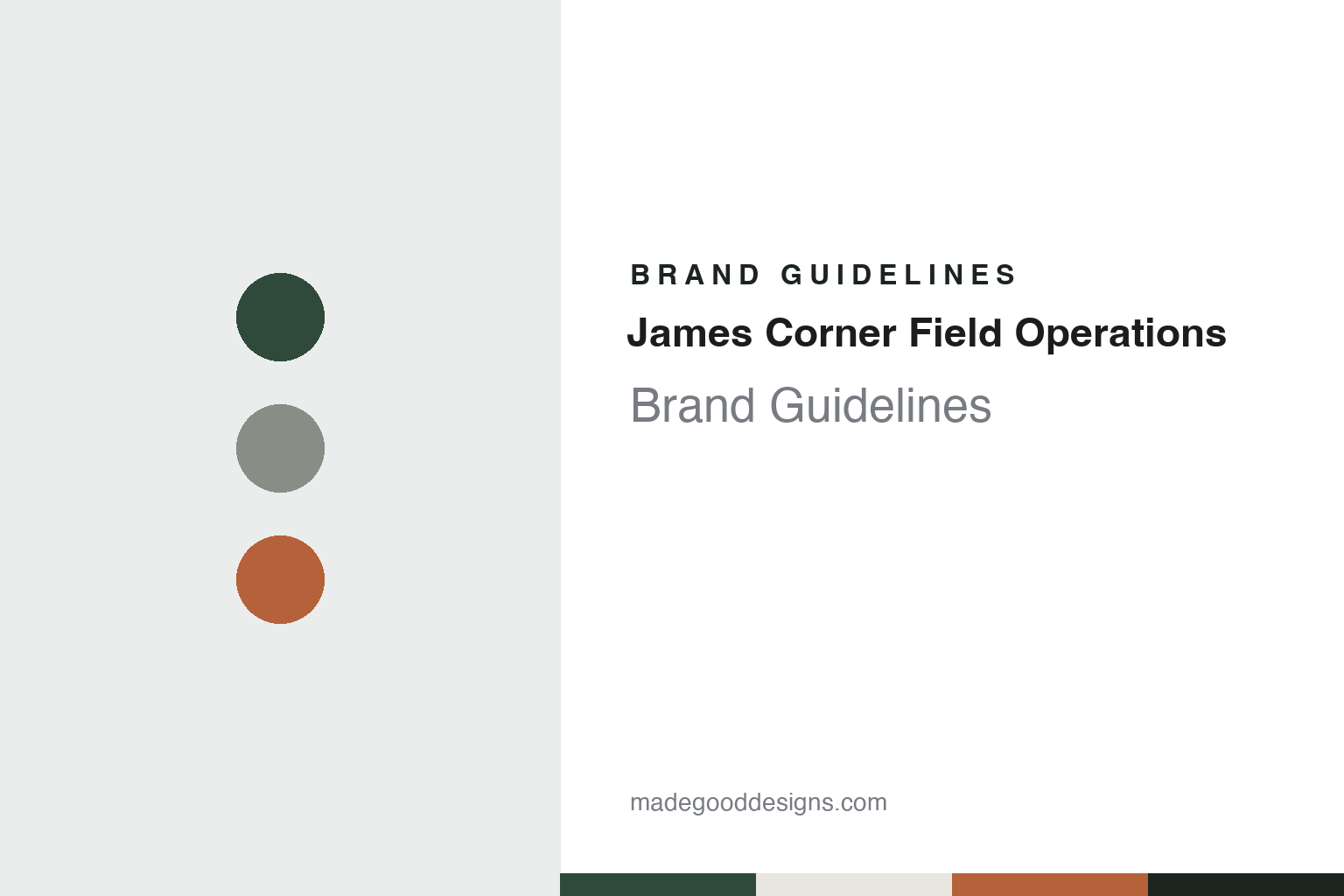
James Corner Field Operations Brand Guidelines
The New York landscape studio now called Field Operations.
Aa
Two constants: a meadow green, concrete and rust palette and a grotesque sans register. Abstract homage — not a Field Operations drawing or mark; no plan, photograph or logo is reproduced.
Two names, one studio
A landscape architect and an architect in New York.
The practice began in New York in 1998. The Pacific Coast Architecture Database at the University of Washington lists James Corner as co-founder and partner of Field Operations/Stan Allen + James Corner from 1998 to 2005, a firm set up by Corner, a landscape architect, and the architect Stan Allen. The two separated their practices in 2005, the database says, and from then the office worked as James Corner Field Operations. A company profile on the trade site Land8 also gives 1998 as the year of foundation.
Corner trained in England and in the United States. English Wikipedia says he took an undergraduate degree at Manchester Metropolitan University in 1983 and a master’s degree in landscape architecture at the University of Pennsylvania in 1986, and that before setting up his own office he worked for Wallace, Roberts and Todd, for Richard Rogers and Partners and for William Gillespie and Partners. He began teaching at Penn in 1988; the database records him as chair of its department of landscape architecture from 2000 to 2012.
Writing runs alongside the office. English Wikipedia lists Taking Measures Across the American Landscape, made with the aerial photographer Alex MacLean and published by Yale in 1996, the essay collection Recovering Landscape of 1999, and The Landscape Imagination, his collected essays from 1990 to 2010, published by Princeton Architectural Press in 2014. The encyclopedia links the practice to “landscape urbanism,” an approach that mixes landscape architecture, urban design, ecology and engineering, and which Corner describes as a way of working rather than a style.
Colour
A rail viaduct, a landfill and two waterfronts.
The office’s longest-running public project is the High Line on Manhattan’s West Side, a park built on a disused elevated freight railway. English Wikipedia says Friends of the High Line ran a design competition in 2003 that drew more than 720 entries, and that the park was designed by James Corner Field Operations with the architects Diller Scofidio + Renfro and the Dutch garden designer Piet Oudolf, with lighting by L’Observatoire International. The southern section, from Gansevoort Street to 20th Street, opened as a city park on 8 June 2009; further sections followed in 2011 and 2014, the Spur in 2019 and the Moynihan Connector on 22 June 2023. On its own website the practice lists itself as project lead and gives the length as 1.45 miles.
On Staten Island, the city’s Department of City Planning held an international competition in 2001 for a master plan for Freshkills Park, on the site of the former Fresh Kills landfill. English Wikipedia says six teams were named finalists in August 2001, including James Corner Field Operations and Hargreaves Associates, and that in 2003 Corner’s office was selected and hired to prepare a draft master plan. The opening section of the park itself was completed and opened on 15 October 2023.
In Brooklyn the office designed Domino Park, on the East River waterfront in Williamsburg. English Wikipedia describes a 5-acre park running a quarter of a mile along the river at the Domino Sugar Refinery site, with salvaged factory equipment, including four syrup tanks, set along the riverside walk and an elevated walkway; it says the design took six years and that the park opened on 10 June 2018.
Further west, the practice says it led the master plan and the design of the Seattle Waterfront from 2010, for the City of Seattle’s Office of the Waterfront and Civic Projects, replacing the site of a former elevated highway with a promenade, piers and the Overlook Walk, which links Pike Place Market to the Seattle Aquarium. Its news page dates the grand opening of the 20-acre Waterfront Park to 6 September 2025.
Typography
How landscape practices present themselves.
Landscape-architecture practices tend to present themselves through names rather than symbols. Many are called after their founders and partners, and the name often changes as partners join or leave, so a practice’s history page or interview record is frequently where a renaming, and its date, is set down. Others take a short invented or descriptive name, and some add a line such as “urban design & landscape architecture” to say what the studio does. Wordmarks and monograms appear as the practices publish them on their own sites, letterheads and project boards.
The work itself carries most of the identity. Practice websites usually open with project photography and group commissions by type, such as parks, squares, masterplans and public realm, with each project shown through photographs, site plans, sections and drawings. Competition boards, exhibition panels and monographs extend that record, and many practices publish brochures or books that collect their work over a period of years.
People are presented in their professional roles. Founders, partners and directors are usually named with their discipline, such as landscape architect, architect or urban designer, and team pages list wider staff by role. Offices are described plainly by city, and trade press profiles and interviews often record when a studio opened, how many people it employed at the time and where it was working.
This guide sets out what dated sources record about each practice: when and where it was founded, who founded it, how its name has changed, and which projects published sources credit to it. It describes what was designed and built, using the practices’ own descriptions only where they are attributed, and it makes no claims about what any landscape achieves.
Aa
A plain grotesque, close to the wordmark on the practice’s own pages. (Specimen set in Archivo, a sans STAND-IN; NOT the Field Operations logo.)
Field Operations
From one name to a partnership.
In September 2023 the office changed its name. Archinect reported on 11 September 2023 that James Corner Field Operations would continue, after 24 years, as Field Operations, under a new partnership model. James Corner stays as founding partner, and that report names three new partners, among them Lisa Switkin and Richard Kennedy, with eight associate partners alongside them. The firm’s statement, quoted by Archinect, said that the office “has always been about more than one person.” On the practice’s own studio page today Corner is listed as founding partner and chief executive.
The current website carries the shorter name throughout: page titles, the footer and the copyright line all read “Field Operations,” and the address is fieldoperations.net rather than a .com domain. The practice lists studios in New York, where it keeps its main office, and in San Francisco, Philadelphia and London. Its project pages share one format: a large moving image or photograph, a short text, and a row of facts giving year, role, size and client. For the High Line that row lists five opening dates, from June 2009 to June 2023, one for each stage of the park.
The studio page groups its clients by type, with cities and public agencies at the top, among them the City of New York, the City of Seattle, the Presidio Trust and the London Legacy Development Company, followed by private developers, universities and cultural institutions. Below the client lists, a short line invites applications to the New York, Philadelphia and San Francisco studios, each with its own hiring address. For readers, the practical point is the name: older press, books and competition records use “James Corner Field Operations,” while material from late 2023 onwards uses “Field Operations,” and both refer to the same office.
For a design guide, James Corner Field Operations shows how a studio can move from a founder’s name to a shorter partnership name while keeping its record intact. Compare Diller Scofidio + Renfro, its partner on the High Line, and Hargreaves Jones, another US landscape practice. For this guide we use a meadow green, a concrete grey and a rail rust with a grotesque sans, an unofficial interpretation; no product or logo is reproduced.
Explore & save
Keep James Corner Field Operations’s identity on hand — save it to a board in the Made Good inspiration library.
Field Operations identity set
Pin the meadow green, concrete and rust palette and the grotesque sans register to your own board.
Source & notes
Frequently Asked Questions
What font can I use to match the James Corner Field Operations look?
This guide describes James Corner Field Operations’ type as “A plain grotesque, close to the wordmark on the practice’s own pages”. Its type specimen is set in Archivo from Google Fonts as a stand-in; Archivo is not James Corner Field Operations’ own lettering.
What colours are in the James Corner Field Operations palette?
This guide’s James Corner Field Operations palette is Meadow green #2F4A3A, Viaduct ink #1C2420, Concrete grey #8A8C86, Rail rust #B5623A and Plank paper #E9E6DF. The tones are the guide’s own unofficial interpretation, not official James Corner Field Operations hex codes.
When was James Corner Field Operations founded?
James Corner Field Operations was founded in 1998 (with Stan Allen), in New York, USA.
Who founded James Corner Field Operations?
James Corner Field Operations was founded by James Corner in 1998 (with Stan Allen).