Hargreaves Jones Brand Guidelines
A 1983 landscape practice that kept its founder’s name and added a second.
Aa
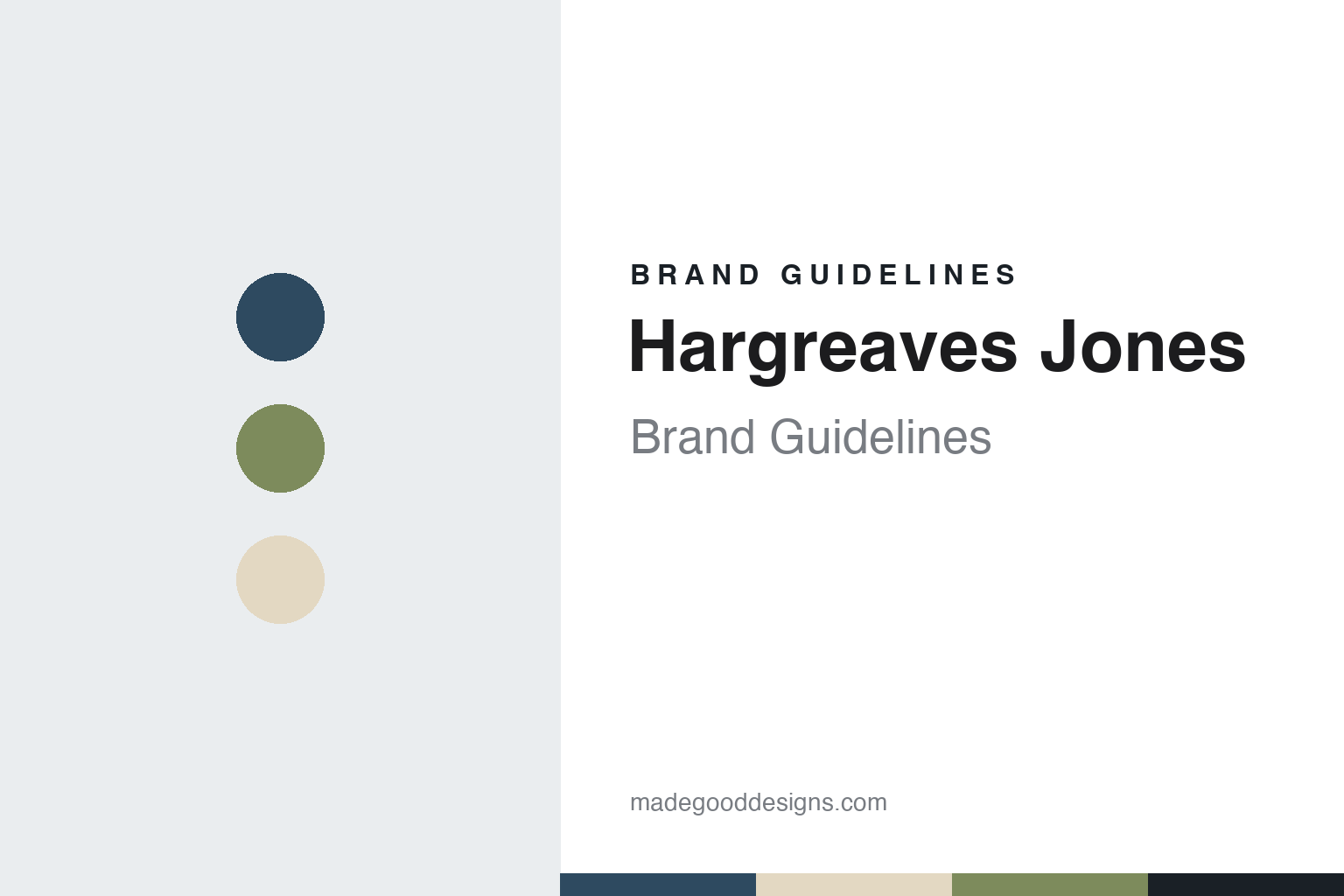
Two constants: a delta blue, meadow and sandbar palette and a quiet book serif register. Abstract homage — not a Hargreaves Jones mark; no logo, drawing or project photograph is reproduced.
Hargreaves Associates
A practice at work since 1983.
Hargreaves Jones is an American landscape architecture and planning practice that says it has been at work since 1983. It was founded as Hargreaves Associates: the firm’s website describes it as “Hargreaves Jones (formerly Hargreaves Associates),” and its people page lists the landscape architect George Hargreaves as founder. The website names three offices, in New York City, San Francisco and Cambridge, Massachusetts, and says they work “collectively.”
For most of its history the practice worked under the founder’s name alone. In July 2016 The Dirt, the blog of the American Society of Landscape Architects (ASLA), reviewed a monograph on the firm’s work and named its principals as George Hargreaves, Mary Margaret Jones and Gavin McMillan. The firm’s website now lists Mary Margaret Jones as president and chief executive and Gavin McMillan as senior principal, with George Hargreaves still listed as founder.
The firm’s own news pages show the change of name in progress. A news item dated May 2018 described Mary Margaret Jones as president of both Hargreaves Associates and Hargreaves Jones, overseeing the offices in San Francisco, Cambridge and New York, while items from 2020 onwards announce projects under the Hargreaves Jones name. Independent records follow the same pattern: The Cultural Landscape Foundation (TCLF), which keeps an online archive of American designed landscapes, credits the firm’s earlier work to “Hargreaves Associates (now Hargreaves Jones).”
The firm also says it is a certified women’s business enterprise, which it gives as “WBE certified” on its profile page. Its profile describes its subject matter as the transformation of “urban sites, waterfronts, and campuses,” and that grouping is visible in the projects that outside sources credit to it.
Colour
Waterfronts, parks and a London Games site.
One of the firm’s documented commissions is in London. In 2016 The Dirt pointed to Queen Elizabeth Olympic Park, the park created for the 2012 Games, as one of the firm’s public landscapes, and noted that it had been built on former industrial land. The same review described the monograph, Landscapes & Gardens, published by ORO Editions with an introduction by the Syracuse University architecture professor Julia Czerniak, as “mostly-photographic,” with work from New Orleans, San Francisco, California’s Stanford campus and China.
The book’s structure says something about how the firm presents its design language. The Dirt said it was organised by landscape features, with short chapters on striations, walls, islands and ribbons, and on core elements such as native plants, rain, and background and foreground. In the same review George Hargreaves was quoted writing that a successful park “has loyal followers” who identify it with their culture, region and city.
On Miami Beach, TCLF credits Hargreaves Associates, “now Hargreaves Jones,” with Savino Miller, with a 2009 redesign of South Pointe Park, a 22-acre park at the southern tip of the island beside the Government Cut shipping channel. TCLF describes entrance plazas that extend the city’s street grid, a serpentine landform and path at the centre, an 1,800-foot promenade along the channel, lawns planted with salt-tolerant grasses, palm bosques and fossilised coral used as paving.
In San Diego, TCLF says the firm and Schmidt Design Group redesigned the grounds of the County Administration Center, the 1938 civic centre on the bay, in 2014. The twelve-acre linear park contains a playground, an open lawn, two long wading pools on either side of the building and a series of gardens with winding paths, while significant parts of the 1930s landscape, including the East Courtyard, remain.
In Dallas the practice worked at both plan and park scale. TCLF says Mary Margaret Jones updated a downtown parks master plan in 2013 that included a redesign of Carpenter Park, a plaza first opened in 1981 beside the I-345 freeway. In 2021 the streets that had divided the site were closed and a continuous 5.75-acre park was created, with Robert Irwin’s steel sculpture reworked by the artist as Portal Park Slice and set through a new mound at the north end, and a path of hexagonal granite pavers running past a play area, a grove of redbuds and a splash pad.
Typography
How landscape practices present themselves.
Landscape-architecture practices tend to present themselves through names rather than symbols. Many are called after their founders and partners, and the name often changes as partners join or leave, so a practice’s history page or interview record is frequently where a renaming, and its date, is set down. Others take a short invented or descriptive name, and some add a line such as “urban design & landscape architecture” to say what the studio does. Wordmarks and monograms appear as the practices publish them on their own sites, letterheads and project boards.
The work itself carries most of the identity. Practice websites usually open with project photography and group commissions by type, such as parks, squares, masterplans and public realm, with each project shown through photographs, site plans, sections and drawings. Competition boards, exhibition panels and monographs extend that record, and many practices publish brochures or books that collect their work over a period of years.
People are presented in their professional roles. Founders, partners and directors are usually named with their discipline, such as landscape architect, architect or urban designer, and team pages list wider staff by role. Offices are described plainly by city, and trade press profiles and interviews often record when a studio opened, how many people it employed at the time and where it was working.
This guide sets out what dated sources record about each practice: when and where it was founded, who founded it, how its name has changed, and which projects published sources credit to it. It describes what was designed and built, using the practices’ own descriptions only where they are attributed, and it makes no claims about what any landscape achieves.
Aa
A quiet serif for a two-name practice. (Specimen set in Source Serif 4, a serif STAND-IN; NOT the Hargreaves Jones logo.)
Hargreaves Jones
A founder’s name, now paired with a second.
The current name keeps the founder’s surname and adds a second one. The firm’s website does not set out the reasoning behind the change, but it lists George Hargreaves as founder and Mary Margaret Jones as president and chief executive, and its pages from the late 2010s onwards use the two-name form for the practice, for its offices and for its project announcements.
The way the practice presents itself is spare. Its website is organised under seven headings, Profile, Work, News, Ideas, People, Careers and Contact, and its home page runs a sequence of projects, each given a place name and a short line, from waterfronts and campuses to downtown parks. Its news items are dated, so a reader can follow when a project moved from master plan to construction and opening, as with Carpenter Park, whose approval, groundbreaking and opening the firm reported between 2020 and 2022.
The firm’s web address also reflects its history. The practice still publishes at hargreaves.com, and many of the image files on the site keep the older Hargreaves Associates name in their file names. The older name also survives in published books and in outside credits: TCLF gives the firm as “Hargreaves Associates (now Hargreaves Jones)” across its records of South Pointe Park, the San Diego County Administration Center and Carpenter Park.
The practice is presented as a team rather than one designer. The Dirt in 2016 described it as a firm that had worked in the United States and abroad “for decades” and named three principals; the firm’s present people page runs from the founder and the chief executive through a senior principal, principals and associate principals to associates and designers.
For a design guide, Hargreaves Jones shows how a practice can keep a founder’s name as the anchor of its identity while adding a second name, and let photographs of built work carry most of the message. Compare SWA, an American practice whose name became a set of initials, and OLIN, another American landscape practice. For this guide we use a delta blue, a meadow green, a sandbar and paper with a serif, an unofficial interpretation; no product or logo is reproduced.
Explore & save
Keep Hargreaves Jones’s identity on hand — save it to a board in the Made Good inspiration library.
Hargreaves Jones identity set
Pin the Hargreaves Jones delta blue, meadow and sandbar palette and the quiet book serif register to your own board.
Source & notes
Frequently Asked Questions
What font can I use to match the Hargreaves Jones look?
This guide describes Hargreaves Jones’ type as “A quiet serif for a two-name practice”. Its type specimen is set in Source Serif 4 from Google Fonts as a stand-in; Source Serif 4 is not Hargreaves Jones’ own lettering.
What colours are in the Hargreaves Jones palette?
This guide’s Hargreaves Jones palette is Delta blue #2E4A60, Riverbank ink #1A2026, Meadow #7D8B5C, Sandbar #E3D8C2 and Paper #F6F4EF. The tones are the guide’s own unofficial interpretation, not official Hargreaves Jones hex codes.
When was Hargreaves Jones founded?
Hargreaves Jones was founded in 1983 (as Hargreaves Associates), in United States.
Who founded Hargreaves Jones?
Hargreaves Jones was founded by George Hargreaves in 1983 (as Hargreaves Associates).