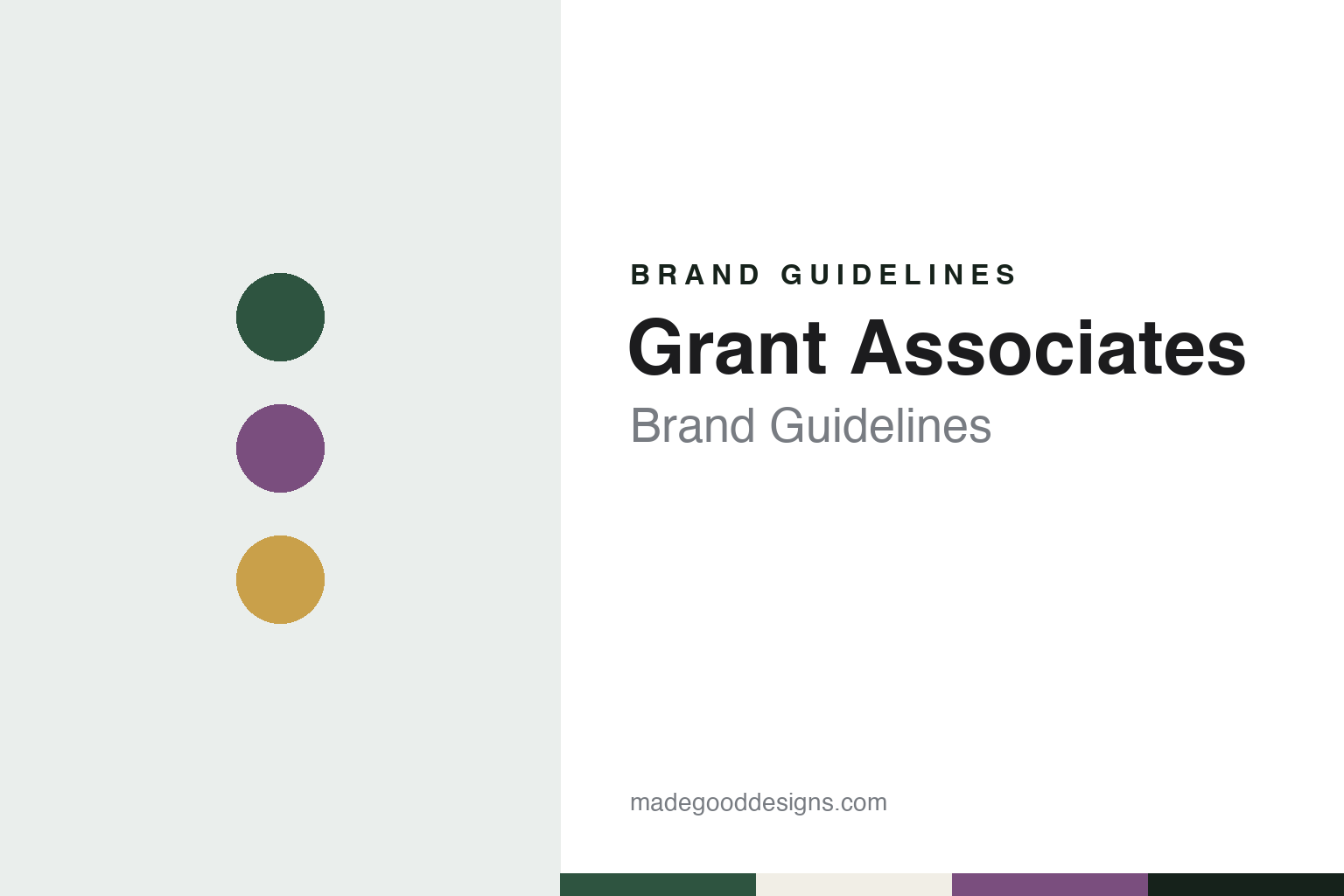
Grant Associates Brand Guidelines
The Bath practice behind Bay South at Gardens by the Bay.
Aa
Two constants: a canopy green, orchid violet and Bath stone palette and a soft serif register. Abstract homage — not a Grant Associates drawing or mark; no plan, photograph or monogram is reproduced.
A studio in Bath
A founder’s name and a Georgian city.
Grant Associates is a landscape architecture practice based in Bath, in the west of England. Its own history page says the practice was started in 1997, and its people page lists Andrew Grant as founder and director, with Peter Chmiel and Keith French as directors. The copyright line on the website names the company behind it as Grant Partnership Ltd.
The practice has two offices: Grant Associates UK in Bath, on Milk Street, and Grant Associates Singapore, on Tras Street, each with its own web address, grant-associates.uk.com and grant-associates.com.sg. The people page lists the two teams separately, with the Singapore studio led by associate director Stefaan Lambreghts, and describes a mixed staff of landscape architects, architects, 3D modelling and visualisation specialists and horticulturists.
Much of what is written about the practice in the press comes through its projects: architecture magazines, garden writers and encyclopedia entries on the places it designed, which credit Grant Associates alongside the architects, horticulturists and engineers it worked with. Its own pages follow the same habit, listing the full consultant team for each project rather than presenting the landscape as the work of one office.
Colour
Supertrees, conservatories and a moat.
In 2006 a team led by Grant Associates was selected in an international competition to design Bay South, the 54-hectare garden at Gardens by the Bay in Singapore. Dezeen, writing on 19 June 2012, described Bay South as one of three gardens on the 100-hectare site on reclaimed land beside the marina, built by Grant Associates with the British architects Wilkinson Eyre. It reported eighteen “Supertree” structures up to 50 metres tall, joined by bridges 20 metres above the ground, two large conservatories by Wilkinson Eyre, one for flowers from Mediterranean regions and one for tropical plants around a 30-metre artificial waterfall, as well as themed gardens, a lake, tree-lined walkways, a playground and an events space. English Wikipedia says Bay South opened to the public on 29 June 2012, that its master plan by Grant Associates takes the form of an orchid, Singapore’s national flower, and that the practice also designed the interior of the Cloud Forest conservatory.
Closer to home, the practice worked on the Superbloom in the moat of the Tower of London for Historic Royal Palaces in 2022. Gardens Illustrated reported on 7 June 2023 that more than 20 million seeds had been sown in the moat in 2022 for the Platinum Jubilee, that the horticulturist Nigel Dunnett was the planting designer, and that he worked with a team that included Grant Associates. The practice’s own project page describes new paths, walkways and viewing points over a 1.7-hectare site, a 17.5-metre four-lane slide into the moat and woven willow frames by the artist Spencer Jenkins, with the display open from 1 June to 18 September 2022. The planting came back the following summer: Gardens Illustrated reported that in 2023 the moat, now billed as “The Moat in Bloom,” flowered again largely from seed set the year before, with access included in the standard Tower of London ticket and the planting looked after by the Tower’s own gardens team.
The practice also names Accordia, the housing development in Cambridge built from 2003 to 2011 with houses by Feilden Clegg Bradley, Maccreanor Lavington and Alison Brooks, as a project it designed, and it says it drew up a new design for Victory Park and the Belvedere in East Village, east London, public spaces that housed athletes and officials during the 2012 Olympic and Paralympic Games.
Typography
How landscape practices present themselves.
Landscape-architecture practices tend to present themselves through names rather than symbols. Many are called after their founders and partners, and the name often changes as partners join or leave, so a practice’s history page or interview record is frequently where a renaming, and its date, is set down. Others take a short invented or descriptive name, and some add a line such as “urban design & landscape architecture” to say what the studio does. Wordmarks and monograms appear as the practices publish them on their own sites, letterheads and project boards.
The work itself carries most of the identity. Practice websites usually open with project photography and group commissions by type, such as parks, squares, masterplans and public realm, with each project shown through photographs, site plans, sections and drawings. Competition boards, exhibition panels and monographs extend that record, and many practices publish brochures or books that collect their work over a period of years.
People are presented in their professional roles. Founders, partners and directors are usually named with their discipline, such as landscape architect, architect or urban designer, and team pages list wider staff by role. Offices are described plainly by city, and trade press profiles and interviews often record when a studio opened, how many people it employed at the time and where it was working.
This guide sets out what dated sources record about each practice: when and where it was founded, who founded it, how its name has changed, and which projects published sources credit to it. It describes what was designed and built, using the practices’ own descriptions only where they are attributed, and it makes no claims about what any landscape achieves.
Aa
A soft, rounded serif for a practice that writes about gardens. (Specimen set in Fraunces, a serif STAND-IN; NOT the Grant Associates monogram.)
Grant Associates
A monogram, two offices and a lot of photography.
The website is built around pictures. The home page opens with a short line of text and then a grid of featured projects, from small London gardens to large overseas master plans; each project page is a long sequence of photographs, with every image credited to its photographer, followed by a block of project facts naming the client, the site area and the consultants. The Superbloom page, for example, credits the horticulture to Nigel Dunnett Studio, the soil work to Tim O’Hare Associates and the lighting to Nipek.
The practice uses a monogram on its web pages, and its menu is short: practice, people, clients, projects, latest news, careers and contact. A section called “Home Planet” sits beside the projects. The practice page sets out its working approach in five headings, from working at global and local scale to collaboration, and an illustrated timeline sets the practice’s projects beside wider events since 1997.
For press, the Gardens by the Bay project shows the usual pattern for a landscape practice. Credits are shared: Dezeen named the project “by Grant Associates and Wilkinson Eyre Architects,” while English Wikipedia credits Bay South and its master plan to Grant Associates and the conservatories to WilkinsonEyre, the spelling that encyclopedia uses for the architects. The split is the same in each case: the landscape architects for the gardens and Supertrees, the architects for the glasshouses.
Both offices publish under the same name and the same monogram on a single website, with the Bath and Singapore addresses printed side by side in the footer of every page.
For a design guide, Grant Associates shows a practice whose public identity is carried almost entirely by project photography and shared credits. Compare Gustafson Porter + Bowman, another British landscape practice, and James Corner Field Operations. For this guide we use a canopy green, an orchid violet and a Bath stone yellow with a serif, an unofficial interpretation; no product or logo is reproduced.
Explore & save
Keep Grant Associates’s identity on hand — save it to a board in the Made Good inspiration library.
Grant Associates identity set
Pin the canopy green, orchid violet and Bath stone palette and the soft serif register to your own board.
Source & notes
Frequently Asked Questions
What font can I use to match the Grant Associates look?
This guide describes Grant Associates’ type as “A soft, rounded serif for a practice that writes about gardens”. Its type specimen is set in Fraunces from Google Fonts as a stand-in; Fraunces is not Grant Associates’ own lettering.
What colours are in the Grant Associates palette?
This guide’s Grant Associates palette is Canopy green #2E5440, Grove ink #16221B, Orchid violet #7A4E7E, Bath stone #C9A04A and Limewash #F1EEE6. The tones are the guide’s own unofficial interpretation, not official Grant Associates hex codes.
When was Grant Associates founded?
Grant Associates was founded in 1997, in Bath, England. Grant Associates is known for Bay South, Gardens by the Bay; Superbloom.
Who founded Grant Associates?
Grant Associates was founded by Andrew Grant in 1997. Grant Associates is known for Bay South, Gardens by the Bay; Superbloom.