Aoyama Harp Brand Guidelines
A Fukui workshop since 1897.
Aa
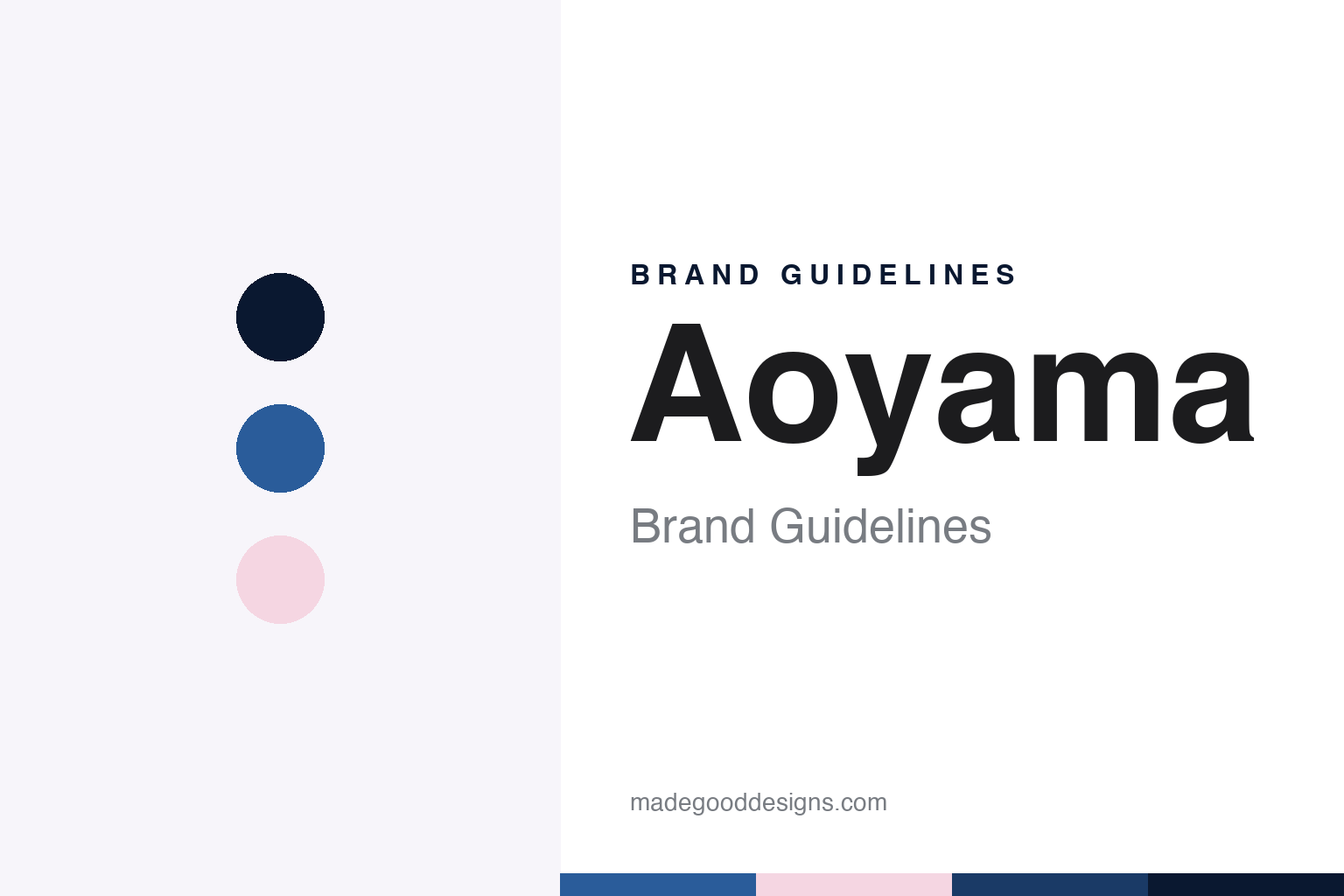
Two constants: a Aoyama blue and pink palette and a Fukui sans register. Abstract homage — not a Aoyama product or mark; no instrument, logo or nameplate is reproduced.
A Fukui workshop since 1897
An instrument works that became a harp maker.
Aoyama Harp is older than most of its rivals. It was founded in 1897 in Fukui City, on Japan’s Sea of Japan coast, as Aoyama Gakki Seisakusho — the Aoyama Musical Instrument Works — and the English Wikipedia and the travel magazine Tabizine name its founder as Aoyama Jitarō. The company confirms the date itself: its recruitment page, using figures from March 2025, reads “128年・・・・・創業1897年” — 128 years, founded 1897.
It was not always a harp maker. The English Wikipedia says folk harps were made commercially from the 1960s and that pedal harps were begun by Kenzo Aoyama; that article is lightly sourced, so we report it as its account. Tabizine says a 1974 concert marked Japan’s first domestically made grand harp. In 1989 the company took its present name, Aoyama Harp Co., Ltd.
It has stayed in Fukui. In 1992 it moved its head office and factory to Matsuoka, now part of Eiheiji Town, and opened a concert venue there, Aoyama Hall. The Japanese Wikipedia says it opened a Tokyo office in 1985 and an Osaka office in 1998, and names Kenzo Aoyama as its representative.
Colour
A factory, and closed to visitors.
Aoyama is a private, family-run company, now in its second century. Its address is in Matsuoka, Eiheiji Town, in Fukui Prefecture, and its own site is plain about what is there: “福井本社は工場であり” — the Fukui head office is a factory. It is also plain about visitors: “工場内の見学はすべてお断り” — all tours of the factory are declined.
The Japanese Wikipedia describes it as “日本国内では唯一のハープ専門メーカー” — the only specialist harp maker in Japan — and we report that as Wikipedia’s description. Tabizine, in 2021, said it made about 200 grand harps and about 600 Irish harps a year; those are the magazine’s figures, and its claim about world market share we leave out as unsourced.
The company publishes some figures of its own. Its recruitment page, as of March 2025, gives its staff an average age of 46.0 and an average length of service of 20.2 years, with women making up 33.3 per cent — the profile of a workshop that keeps its people. Tabizine adds that from 2003 the company provided harps and lessons to a local middle school as an elective.
Typography
Apollon, Princess Sakura and the Saul Harp.
Aoyama’s range is broad. Its full-size concert pedal harps carry names such as Apollon, Monarch, Musa, Princess SAKURA, Aeolian, Delphi, Amphion, Orpheus47 and Etude Wind; its semi-concert harps include Vega, Orpheus46 and Etude46. Its names mix Greek myth — Apollon, Orpheus, Delphi, Amphion — with Japanese imagery, and its numbers record string counts: 47 for a full concert harp, 46 for a semi-concert. It also makes non-pedal lever harps and a small harp it calls the Saul Harp — “「サウルハープ」はアオヤマハープの登録商標です,” it says: the Saul Harp is a registered trademark of Aoyama Harp. It announced price rises for its non-pedal harps from February 2026 and its pedal harps from April 2026.
Aoyama’s pedal harps descend, like its rivals’, from one patent. Sébastien Erard applied for an English patent, number 3332, in 1810, for a double-action mechanism: two forks on each string, worked by pedals, giving flat, natural and sharp. A Royal College of Music thesis by Fanny Guillaume-Castel says it “remains the standard pedal harp mechanism today,” and records that in 1812, its first full year on sale, Erard sold about a hundred. He received the English patent in October 1810, sold the first double-action harps in late 1811 and, the thesis says, about a hundred in 1812, “the first complete year of sale.” His advertisement promised strings “producing three distinct tones instead of two.”
Aoyama’s small harps belong to a family with a national emblem. Ireland’s government says it has “the distinction of being the only nation to have a musical instrument as a national emblem” — a gold harp with silver strings on blue, modelled on a fourteenth-century harp at Trinity College Dublin. Guinness says it registered its own harp as a trademark in 1876, and that this is why the two harps face opposite ways: Guinness’s with its straight edge to the left, the state’s to the right. Ireland’s Intellectual Property Office says the state harp is excluded “from registration or use as trade marks.” Guinness’s archive says the harp “has been synonymous with Guinness since 1862 when it was used as a symbol on the first bottle label,” and its Storehouse says it was trademarked in 1876, “the first year of trademark registration in the United Kingdom.” The Irish Times reported in 2013 that state archives show officials in the 1980s “feared Guinness could challenge” the state’s plans, and registered “a generic, nine-stringed harp facing in just one direction – left.” Tabizine’s figure of about 600 Irish-style harps a year puts Aoyama squarely in that tradition.
Timber law reaches Japan’s makers too. In 2017 the CITES convention brought the whole rosewood genus, Dalbergia, under its Appendix II controls, and since 26 November 2019 it has exempted finished musical instruments and their parts. CITES defines a finished musical instrument as one “that is ready to play or needs only the installation of parts to make it playable,” and says the term “includes antique instruments.” We found no source linking Aoyama’s harps to those timbers.
Aa
A Fukui sans — a blue name on a pink-and-blue building. (Specimen set in Inter Tight, a sans STAND-IN; NOT the Aoyama logo.)
Aoyama
A blue name on a pink-and-blue building.
Aoyama describes its own building as its landmark: “ピンクと水色の建物、青の「Aoyama」のロゴが目印” — a pink and light-blue building with a blue “Aoyama” logo. A company that describes its own building in its brand colours is treating architecture as part of its identity. Its copyright line reads “AOYAMA HARP Co.,” in capitals. We found no tagline. The model names do much of the brand’s work, mixing Greek mythology (Apollon, Orpheus, Delphi) with a Japanese flower (Sakura).
For a design guide, Aoyama is the counterpoint to Lyon & Healy and Salvi: a family firm in a provincial city, with a building painted in its brand colours, its own concert hall, and a factory closed to the public. Its long history is stated as a number — 128 years — rather than told as a story, and its building does the rest.
For this guide we use a blue and a pale pink with a sans serif, after the company’s own description of its building and logo. No harp, building or logo is reproduced.
Explore & save
Keep Aoyama Harp’s identity on hand — save it to a board in the Made Good inspiration library.
Aoyama identity set
Pin the Aoyama blue and pink palette and the Fukui sans register to your own board.