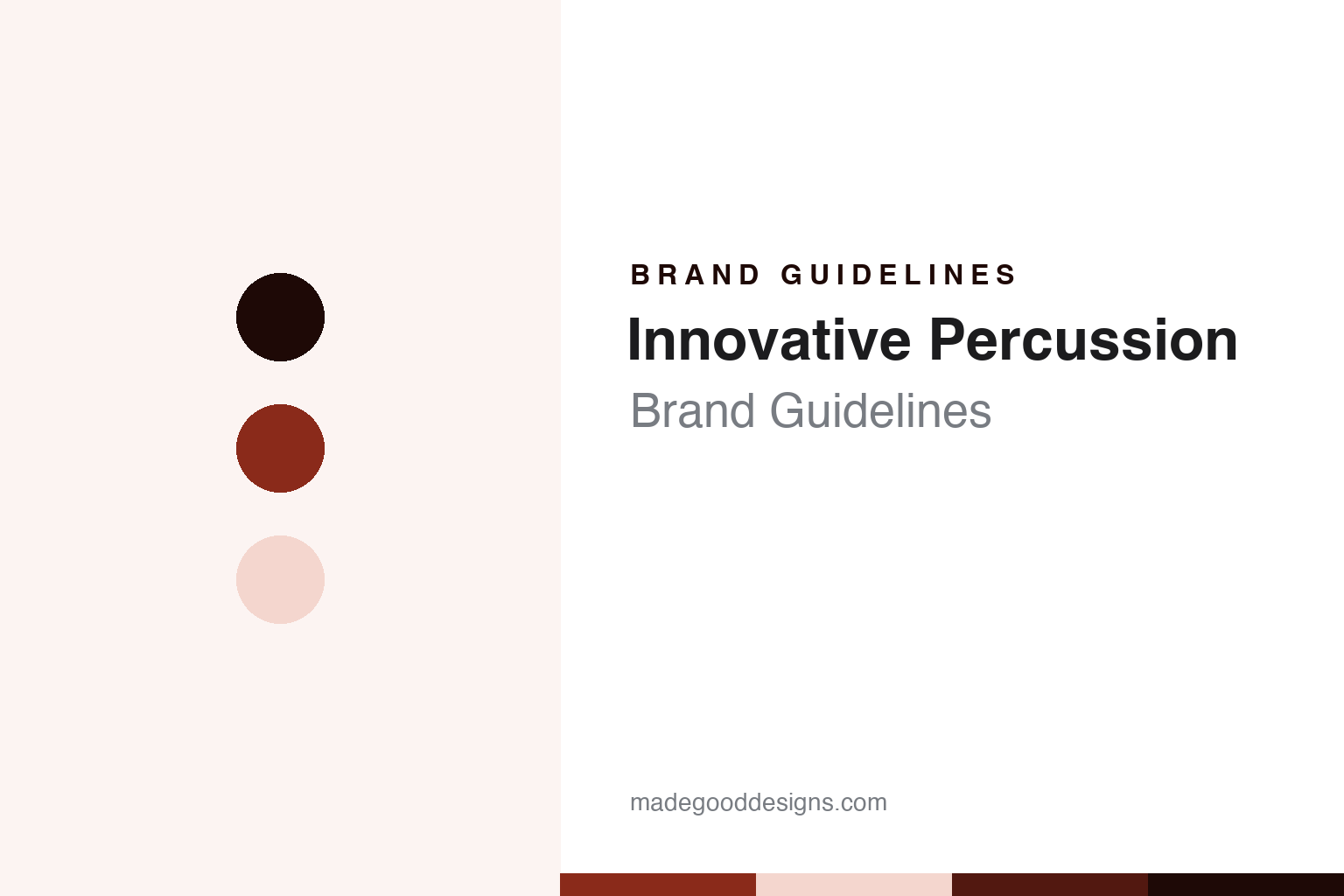
Innovative Percussion Brand Guidelines
Nashville sticks and mallets.
Aa
Two constants: a IP red and blush palette and a Drum-corps sans register. Abstract homage — not a Innovative Percussion product or mark; no instrument, logo or nameplate is reproduced.
A student who made his own mallets
Erik T. Johnson’s company, from 1991.
Innovative Percussion, of Nashville, Tennessee, was founded by Erik T. Johnson. Its own site says: “Erik T. Johnson is the president and founder of Innovative Percussion, Inc.,” and Drum Corps International confirms it, having inducted him into its Hall of Fame in 2026.
The company’s own timeline, archived in 2012, tells the start. Johnson made his own mallets as an undergraduate at Middle Tennessee State University in the 1980s; in 1991 he graduated from the University of North Texas and “Moves back to Tennessee with ideas to start a company,” creating the first Innovative Percussion logo that year. In 1992 it exhibited for the first time at the Percussive Arts Society convention in New Orleans, and Chris Long joined as a mallet craftsman — he is now vice-president of operations. In 1993 “Innovative Percussion, Inc. is established as a corporation.” So we say it began trading in 1991–92 and was incorporated in 1993.
Its products grew from there, mallets first and sticks later, each step dated on its own company timeline, which reads like a résumé. In 1996 it added the IP240, which it calls “the most popular mallet in company history”; in 1997 it developed and trademarked its current logo; and in 2000 it added drumsticks.
Colour
Drum corps and pitch-matched sticks.
Innovative Percussion grew up with the American drum corps. Its timeline says that in 2000 “The Cavaliers… become the first corps to win DCI and High Percussion using Innovative Percussion products exclusively” — a claim about a championship season that ties the brand to the marching arts, where its founder is now in the Hall of Fame.
It now makes everything it sells in one place, at its own Nashville headquarters, under one roof. In 2020 DRUM! magazine reported that the company “had recently moved its entire production operation to the Nashville headquarters,” at Metroplex Drive — which implies some production had been elsewhere before. The magazine said its sticks are “digitally pitch-matched” and “weight-matched to within two grams,” and counted “600-plus products.”
We found no evidence of a sale in the sources we checked; it trades as Innovative Percussion, Inc., with Johnson as president. We did not check the Tennessee company register for its current shareholders, so we describe it as founder-led rather than certainly independent.
Typography
Mallets for a rosewood instrument.
Innovative Percussion makes the mallets, not the bars, but its products exist for instruments built from some of the most closely regulated wood in music. The classic marimba bar is cut from Honduras rosewood, Dalbergia stevensonii, and that wood has been a treaty matter for years. Guatemala listed it in CITES Appendix III in 2008; in 2013 the convention moved it to Appendix II on a proposal from Belize, whose filing called it “the preferred species for the manufacture of bars for marimbas and xylophones,” noting “a high level of wastage, up to 80% … as only logs of the straightest grain are used to make marimba bars.” In 2017 the whole rosewood genus went into Appendix II, and only from 26 November 2019 did the listing exempt “finished musical instruments, finished musical instrument parts and finished musical instrument accessories.” Appendix II regulates trade through permits; it is not a ban. Belize’s filing added that the species is “superior to Brazilian Rosewood for this purpose due to greater density, toughness and resonance qualities,” that it is “restricted in distribution to broadleaf evergreen swamp forests of southern Belize and nearby regions of Guatemala and Mexico,” and that Belize had imposed a moratorium on cutting and export in March 2012.
The vibraphone has a precise history. According to a 2021 article in the Percussive Arts Society’s journal Percussive Notes, Herman Winterhoff of the Leedy company fitted rotating fans to a metal-barred instrument in 1921, Leedy’s sales manager George Way “first coined the name ‘vibraphone,’” and Deagan’s design was “released in 1927 as the first ‘Vibraharp,’ Deagan model no. 145,” with aluminium bars and a damper pedal. Leedy, the article says, “did not feel it necessary to apply for a patent.” The same article says Winterhoff had begun experimenting in 1916, and that the first recording, in 1924, billed the instrument as the “Leedy Vibratone-Bells.”
The marimba also has a place on UNESCO’s list of intangible heritage — though not the concert-hall kind. In 2015 UNESCO inscribed “Marimba music, traditional chants and dances from the Colombian South Pacific region and Esmeraldas Province of Ecuador,” replacing a 2010 Colombian listing, and describes an instrument “played on a palm wood xylophone with bamboo tube resonators, accompanied by drums and maracas.” The tradition is palm wood and bamboo; the orchestral marimba is rosewood and metal tubes. UNESCO’s 2010 decision described it as heritage of Afro-Colombian communities in the departments of Valle del Cauca, Cauca and Nariño, bound up with four rituals: Arrullo, Currulao, Chigualo and Alabao.
Aa
A drum-corps sans — initials for a corps-field brand. (Specimen set in Inter Tight, a sans STAND-IN; NOT the Innovative Percussion logo.)
Innovative Percussion
Initials for a corps-field brand.
Innovative Percussion builds its initials into its products, a simple and effective naming system: the IP240 is a model number with “IP” in front. Its logo, developed and trademarked in 1997, has carried the company ever since.
For a design guide, Innovative Percussion shows a brand built in a specific community — drum corps and university percussion — and kept close to its founder. Compare Malletech, whose founder also began with mallets and still leads the firm under new ownership, and Majestic, which addresses the same marching market from a Taiwanese group.
Drum corps is a demanding market for sticks and mallets: lines play outdoors, in rain and heat, for whole seasons. A company that matches sticks to within two grams is selling consistency to that market, and its own marketing leans heavily on the corps that use its products. Its founder’s path — mallets made as a student, a company built around the marching arts, a Hall of Fame induction in 2026 — is the brand’s story, and the company tells it on its own pages.
For this guide we use a red and a blush with a sans serif, an unofficial interpretation. No mallet, stick or logo is reproduced.
Explore & save
Keep Innovative Percussion’s identity on hand — save it to a board in the Made Good inspiration library.
Innovative Percussion identity set
Pin the IP red and blush palette and the Drum-corps sans register to your own board.