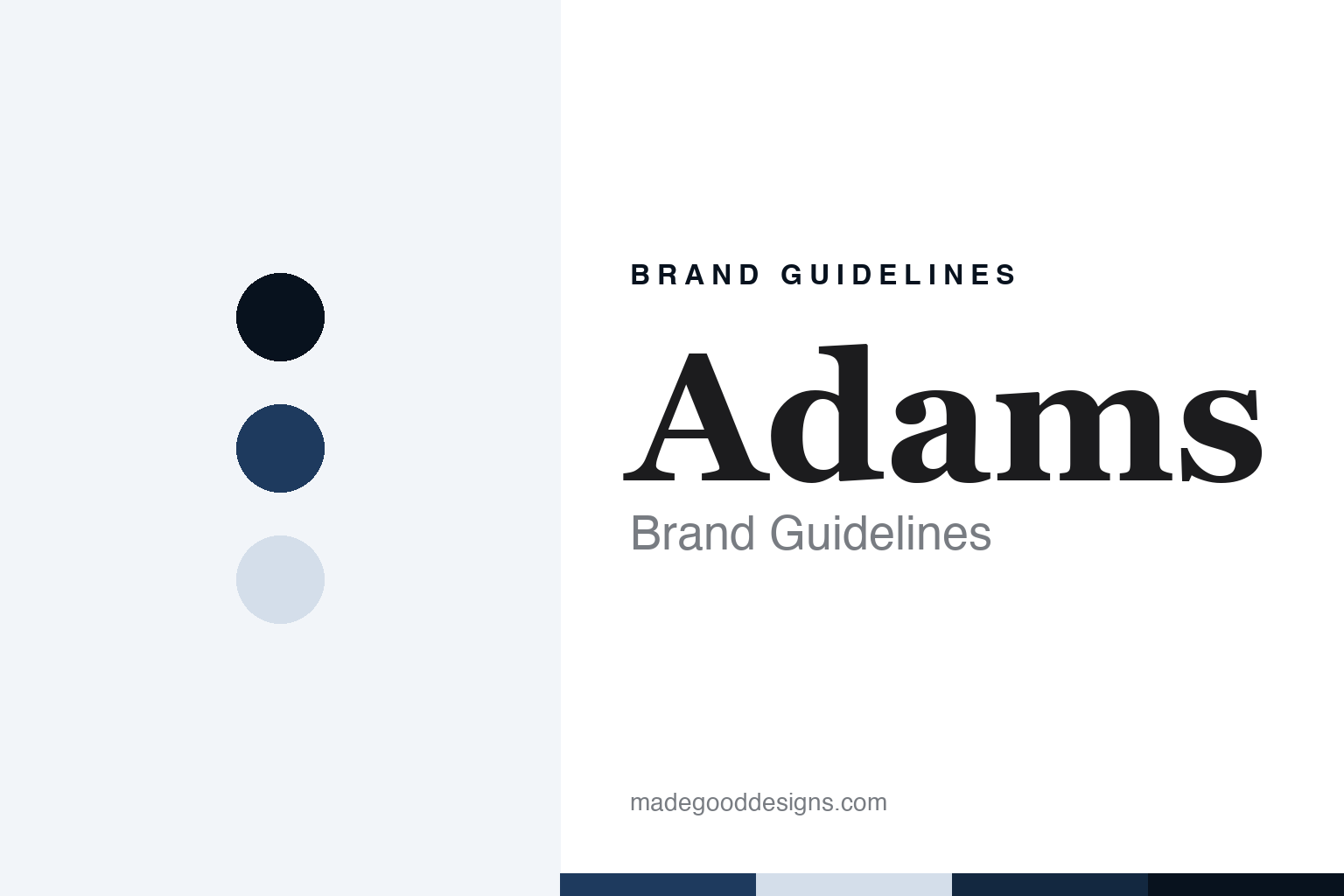
Adams Musical Instruments Brand Guidelines
Timpani from the Dutch countryside.
Aa
Two constants: a Adams navy and pale blue palette and a Limburg serif register. Abstract homage — not a Adams product or mark; no instrument, logo or nameplate is reproduced.
Timpani from the Dutch countryside
André Adams registered his business in 1970.
Adams Musical Instruments was founded by André Adams, born in 1945, in Thorn, a small town in the Dutch province of Limburg. Its history page says: “In 1970, the company was registered with the Chamber of Commerce under the name Muziekcentrale Adams,” and that its first timpani of its own design came in the same period.
It grew step by step. Adams says it opened a shop on the Casino square in Thorn in 1973, built a production hall of about 500 square metres at De Akker in Thorn in 1975, and in 1976 opened a branch in Hasselt, Belgium, and introduced the “Big Sound” name for its timpani. Frans Swinkels joined in 1987 to work on mallet instruments, and became director in 2001; the Adams Percussion Centre opened in 1989.
Then it moved, though not far. In 1997 Adams built a new factory hall in Ittervoort, a few kilometres from Thorn, and by 2006 had brought all its activities there. In 2007 it completed its first brass instrument of its own. It received the Limburg Export Award in 2008 and the Koning Willem I Prize, a Dutch award for enterprise, in 2010; in 2015 a dispatch hall took the site to “over 35,000 m².”
Colour
A family business without external investors.
Adams is unusually explicit about ownership, on its own website, in plain words: “The company is a family business without external investors… The third generation is now also active.” Wikipedia lists Frans Swinkels as owner. That makes Adams the counterpoint to its Dutch rival Majestic, which joined the Taiwanese KHS group in 2003 and whose mallet instruments, KHS says, were made in Tianjin, China, and later developed in Taiwan.
It is equally explicit, and just as plain, about where and how it makes things. Its brand page speaks of “in-house production in the Netherlands,” says “Adams Brass produces brass instruments in its own workshop,” and says “Adams Percussion develops and produces concert percussion.” Its range covers concert percussion and brass. A Dutch dealer calls it the market leader in concert percussion; that is the dealer’s claim, and we leave it there.
Its geography is distinctive, and it is part of the brand: a village-scale origin in Thorn, a factory in Ittervoort, and buyers abroad served from a site of more than 35,000 square metres. The firm never moved to a city.
Typography
Rosewood, vibraphones and a treaty.
The classic marimba bar is cut from Honduras rosewood, Dalbergia stevensonii, and that wood has been a treaty matter for years. Guatemala listed it in CITES Appendix III in 2008; in 2013 the convention moved it to Appendix II on a proposal from Belize, whose filing called it “the preferred species for the manufacture of bars for marimbas and xylophones,” noting “a high level of wastage, up to 80% … as only logs of the straightest grain are used to make marimba bars.” In 2017 the whole rosewood genus went into Appendix II, and only from 26 November 2019 did the listing exempt “finished musical instruments, finished musical instrument parts and finished musical instrument accessories.” Appendix II regulates trade through permits; it is not a ban. Belize’s filing added that the species is “superior to Brazilian Rosewood for this purpose due to greater density, toughness and resonance qualities,” that it is “restricted in distribution to broadleaf evergreen swamp forests of southern Belize and nearby regions of Guatemala and Mexico,” and that Belize had imposed a moratorium on cutting and export in March 2012.
The vibraphone has a precise history. According to a 2021 article in the Percussive Arts Society’s journal Percussive Notes, Herman Winterhoff of the Leedy company fitted rotating fans to a metal-barred instrument in 1921, Leedy’s sales manager George Way “first coined the name ‘vibraphone,’” and Deagan’s design was “released in 1927 as the first ‘Vibraharp,’ Deagan model no. 145,” with aluminium bars and a damper pedal. Leedy, the article says, “did not feel it necessary to apply for a patent.” The same article says Winterhoff had begun experimenting in 1916, and that the first recording, in 1924, billed the instrument as the “Leedy Vibratone-Bells.”
The marimba also has a place on UNESCO’s list of intangible heritage — though not the concert-hall kind. In 2015 UNESCO inscribed “Marimba music, traditional chants and dances from the Colombian South Pacific region and Esmeraldas Province of Ecuador,” replacing a 2010 Colombian listing, and describes an instrument “played on a palm wood xylophone with bamboo tube resonators, accompanied by drums and maracas.” The tradition is palm wood and bamboo; the orchestral marimba is rosewood and metal tubes. UNESCO’s 2010 decision described it as heritage of Afro-Colombian communities in the departments of Valle del Cauca, Cauca and Nariño, bound up with four rituals: Arrullo, Currulao, Chigualo and Alabao.
Aa
A Limburg serif — a founder’s surname on a kettle. (Specimen set in Fraunces, a serif STAND-IN; NOT the Adams logo.)
Adams
A founder’s surname on a kettle.
Adams’s brand, in short, is its founder’s surname and its countryside address in the south of the Netherlands, close to the Belgian border. The “Big Sound” name of 1976 survives in its timpani history, and the company tells its story as a sequence of buildings — a shop, a hall, a factory, a dispatch hall — each larger than the last.
For a design guide, Adams shows the value of saying two plain things clearly: who owns the company (a family, no outside investors) and where it makes its instruments (in-house, in the Netherlands). Compare Majestic, a Dutch name now owned from Taiwan, and Musser, an American name inside a piano group.
Adams also tells its history through people, not only buildings. Frans Swinkels, who joined in 1987 to work on mallet instruments, became director in 2001, and the company says a third generation is now active — continuity it presents as part of the product. Its awards fit the story it tells: a provincial export prize in 2008 and a national enterprise prize in 2010, for a firm that grew from one small town’s music shop into an exporter.
For this guide we use a navy and a pale blue with a serif, an unofficial interpretation. No instrument, kettle or logo is reproduced.
Explore & save
Keep Adams Musical Instruments’s identity on hand — save it to a board in the Made Good inspiration library.
Adams identity set
Pin the Adams navy and pale blue palette and the Limburg serif register to your own board.