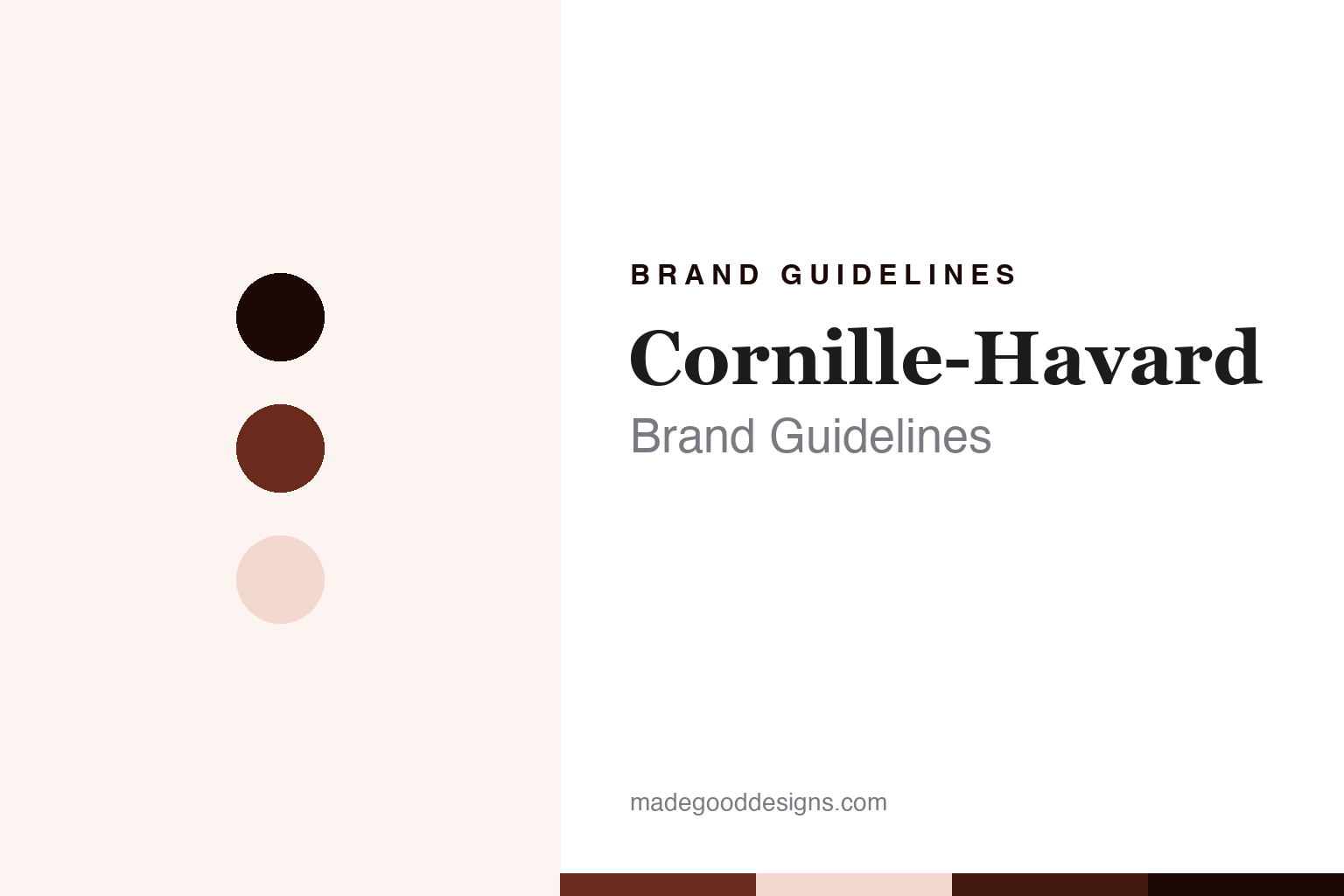
Cornille-Havard Brand Guidelines
Notre-Dame’s Normandy foundry.
Aa
Two constants: a Cornille-Havard copper and blush palette and a Norman serif register. Abstract homage — not a Cornille-Havard product or mark; no instrument, logo or nameplate is reproduced.
Notre-Dame’s Normandy foundry
Bell founders in Villedieu since the end of the Middle Ages.
Fonderie Cornille-Havard casts bells in Villedieu-les-Poêles, in the Manche department, a Normandy town long known for its metalworkers. The foundry says bells have been made there “since the end of the Middle Ages.” Its own published history is rather more precise: in 1836 Paul Havard took over from his brother-in-law, César Béatrix, and in 1865 Adolphe Havard, an engineer trained at the École polytechnique, built the fixed workshop that is “still in operation.” The French Wikipedia dates the foundry to 1865.
The double name came by marriage, as so often in this trade. Léon Cornille, a son-in-law, joined in 1903 and ran the firm from 1904; Marguerite Cornille restarted it in 1946, after the war. On 1 June 1981 it was sold to Françoise and Luigi Bergamo, and their son Paul Bergamo joined in 2000, became president in 2009 and took full ownership in 2012. The French Wikipedia lists it as a small company with ten to nineteen employees in 2022.
It is also a well-known tourist attraction, which is unusual for a working foundry, and its visitor numbers are as much a part of its identity as its bells. The foundry says it receives “more than 55,000 visitors annually”; the French Wikipedia records about 56,750 paying visitors in 2005, the eighth most visited site in the whole Manche department that year.
Colour
Eight bells for Notre-Dame — twice.
Cornille-Havard’s best-known work is in Paris. For the 850th anniversary of Notre-Dame, it cast eight new bronze bells for the cathedral’s north tower, delivered in January 2013 — Gabriel, the largest at about four tonnes, with Anne-Geneviève, Denis, Marcel, Étienne, Benoît-Joseph, Maurice and Jean-Marie. They were blessed on 2 February 2013 and first rang together on 23 March. The foundry’s own site speaks of “nine new bells”; the ninth, the six-tonne bourdon Marie, was cast by Royal Eijsbouts in the Netherlands, because, the French Wikipedia says, it exceeded the Normandy foundry’s capacity.
Then came the fire of April 2019. The public body rebuilding the cathedral says the bells “ont subi la chaleur de l’incendie” — were exposed to its heat — and had to be checked. They were taken down in July 2023 and sent back to “une fonderie située à Villedieu-les-Poêles,” where they had been cast; two of them, the most exposed, were restored by heat treatment in Austria. “Le 12 septembre 2024, les huit cloches ont fait leur retour dans la cathédrale.” They were restored, not recast — and they came back to the foundry that made them, which is the strongest kind of endorsement a bell maker can have.
The foundry also cast brand-new bells for the reopening, in the same 1865 workshop. The Paris diocese says that “En octobre 2024, deux nouvelles cloches ont vu le jour à la fonderie Cornille Havard” — Chiara and Carlo — and they joined a bell given by the Paris 2024 organisers; the three were installed in November 2024 and first rang at Mass on 8 December 2024. In 2024 it also cast a bell for the Belem, the ship that carried the Olympic flame to France. Few foundries have had a year like it: new bells for Notre-Dame and a bell for the Olympic flame’s ship, within months of each other.
Typography
Copper, tin and the bell cemeteries.
Bell metal is a bronze of roughly four parts copper to one of tin — “approximately 78% copper and 22% tin,” according to the Guild of Carillonneurs in North America. Tin is the costly part: the US Geological Survey says the average New York price of refined tin rose 13 per cent in 2025, to 1,600 cents a pound.
Bells have also been treated as raw metal in wartime. A 1947 photograph in Germany’s federal archives shows the “Glockenfriedhof” — bell cemetery — in Hamburg’s free port, captioned: “Diese Glocken wurden von den Nazis während des II. Weltkrieges beschlagnahmt um sie einzuschmelzen” — these bells were confiscated by the Nazis during the Second World War to be melted down. German sources estimate that about 45,000 bells were destroyed in Germany and some 35,000 more from occupied territories; the figures vary, so we attribute them. The same German sources say some 65,000 bells were melted down in the First World War, and that after 1945 more than 13,000 surviving bells were identified and returned from Hamburg.
Bells are recognised as culture too. In 2014 UNESCO selected Belgium’s programme for “Safeguarding the carillon culture” for its Register of Good Safeguarding Practices, and in 2022 it inscribed manual bell ringing in Spain — extended to Italy in 2024 — on its Representative List, calling it “a form of communication that is tied to the classification, acoustics and shapes of bells, bell towers and belfries.”
Bell metal is a bronze of roughly four parts copper to one of tin — “approximately 78% copper and 22% tin,” according to the Guild of Carillonneurs in North America. Tin is the costly part: the US Geological Survey says the average New York price of refined tin rose 13 per cent in 2025, to 1,600 cents a pound.
Aa
A Norman serif — two family names over a town of coppersmiths. (Specimen set in Fraunces, a serif STAND-IN; NOT the Cornille-Havard logo.)
Cornille-Havard
Two family names over a town of coppersmiths.
Cornille-Havard’s name joins two families — the Havards who built the workshop and the Cornilles who married into it — and its brand rests on one building, still working since 1865. The Bergamo family, owners since 1981, kept the older names rather than replacing them with their own — a choice that preserved more than a century of reputation on every bell.
For a design guide, Cornille-Havard shows the value of a single great commission. Notre-Dame gave a small Normandy foundry a story told around the world: cast in 2013, survived the fire, restored, returned in 2024. Compare Rincker in Hesse, another small family foundry, and Paccard, France’s other famous bell house.
Its visitors see what most bell buyers never do: moulds, molten bronze and finished bells in one workshop. The tourism and the commissions feed each other.
For this guide we use a copper red and a blush with a serif, an unofficial interpretation. No bell, foundry building or mark is reproduced.
Explore & save
Keep Cornille-Havard’s identity on hand — save it to a board in the Made Good inspiration library.
Cornille-Havard identity set
Pin the Cornille-Havard copper and blush palette and the Norman serif register to your own board.