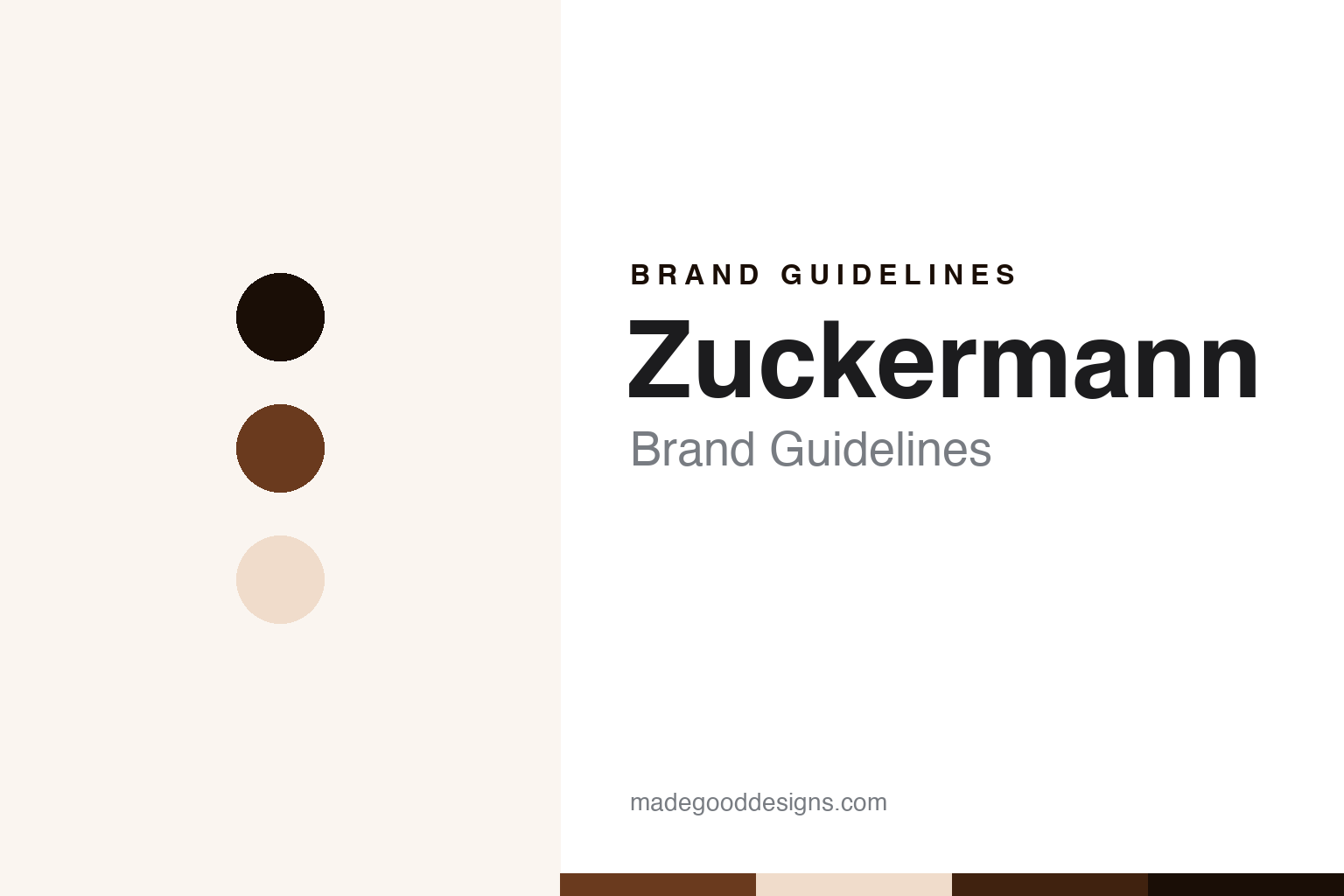
Zuckermann Harpsichords Brand Guidelines
The harpsichord in a box.
Aa
Two constants: a Zuckermann spruce and walnut palette and a Kit sans register. Abstract homage — not a Zuckermann product or mark; no instrument, logo or nameplate is reproduced.
The harpsichord in a box
Wolfgang Zuckermann and the Z-Box.
Zuckermann Harpsichords began with a man who wanted more people to own a harpsichord. Wolfgang Zuckermann, born in Berlin in 1922, built his first instrument in 1955 in Manhattan and began selling kits around 1960, according to Wikipedia and the New York Times. The company’s own account places an early shop in Hoboken, New Jersey, in the early 1950s; the Times puts his workshop on West 14th Street in Manhattan. We give both.
The kit made his name. The Times described the “Z-Box” as “a 35-pound box containing a keyboard, strings, plectrums (or pluckers), jacks (plectrum-holders) and tuning pins, but not the wood for the cabinet. Customers had to visit a lumber yard for that.” “Thousands of people around the world” bought one, the paper said. Wikipedia, citing the historian Edward Kottick, gives higher estimates; we keep to “thousands.”
His reasoning was in his 1969 book, The Modern Harpsichord, published by October House, a company owned by David Jacques Way, who wrote its appendix for kit builders: “Realizing that most people approach a harpsichord with caution, the way they do a vicious dog, I decided that the only way they might lose their fear of harpsichord maintenance was to go through the process of building the instrument for themselves.” The business survived an early setback: in 1958, the Times said, an electrical fire at the West 14th Street workshop destroyed all five of his finished harpsichords.
Colour
Way, Ducornet and Auber.
Zuckermann himself did not keep the company for long. He sold it to David Jacques Way — in the late 1960s, the Times says; in 1970, says the company — and Way moved it from New York to Stonington, Connecticut. In the 1970s Stonington was the prototype and custom shop, while kits were, Wikipedia says, “mass-produced by a facility in Philadelphia.” In 1982 Way went into partnership with the French maker Marc Ducornet, whose Paris workshop made kits; many instruments from the late 1980s were signed “D. Jacques Way & Marc Ducornet.” Ducornet was a partner and co-signer, not an owner.
Way died of a heart attack in his workshop on 4 February 1994, and Richard Auber, who had apprenticed in Ducornet’s Paris shop in 1983, took over; the Times says the company “was sold to Richard Auber.” Zuckermann himself left the trade, ran a bookshop in Avignon and died there in October 2018, aged 96.
The company still trades as Zuckermann Harpsichords International, at Cutler Street in Stonington, with a workshop “OPEN BY APPOINTMENT ONLY.” It describes itself as “The craftsmen you can trust to build and restore your instruments,” and says: “For more than 60 years, we have been producing, servicing, and restoring harpsichords.” Its online shop now lists clavichord kits, with harpsichord kits available on request. The Times noted in 2018 that “little of his former company’s thriving business is connected to the kits.”
Typography
A revival, then a kit.
The modern harpsichord was reinvented twice. First in Paris: the Cité de la musique says Wanda Landowska’s name “reste indissolublement lié au clavecin Pleyel (16 pieds), modèle conçu à partir de ses suggestions, inauguré en 1912” — remains inseparably linked to the Pleyel 16-foot harpsichord, built to her suggestions and launched in 1912, to which she stayed faithful throughout her career. Instruments in that style are now called “revival” harpsichords.
Then in Boston. Harvard Magazine records that Frank Hubbard and William Dowd “independently pursued apprenticeships with disciples of Dolmetsch, then founded a harpsichord company in 1949,” and that their serial number one was “modeled on a design by the Flemish Ruckers family.” Wikipedia sums up the difference: they built “on historical principles, rather than the 20th-century modern (now known as ‘revival’) style practised by virtually all professional makers.” Zuckermann’s kit followed both — and, by the account of the historian Edward Kottick quoted on Wikipedia, “Some of today’s finest builders got their start with a Zuckermann slantside kit.”
A museum now holds one of the trade’s great collections. Nuremberg’s Germanisches Nationalmuseum says that in 1969, with help from the Volkswagen Foundation, it acquired “Die Klavierhistorische Sammlung des Bamberger Klavierherstellers J.C. Neupert,” which “enthält über 300 Objekte, die meisten davon Tasteninstrumente” — more than 300 objects, most of them keyboard instruments.
Frank Hubbard set out the historical approach at book length in Three Centuries of Harpsichord Making, published by Harvard University Press in 1965; the harpsichordist Ralph Kirkpatrick wrote that Hubbard “unquestionably knows more about the history and construction of harpsichords than anyone alive today.” Hubbard’s former partner William Dowd, who closed his Massachusetts workshop in 1988, built, according to the Boston Globe, “more than 800 instruments that are now played in 26 countries.”
Germany’s oldest name in the field, J.C. Neupert, founded in 1868, built harpsichords from the 1900s and still works near Bamberg; its historical collection passed to Nuremberg’s Germanisches Nationalmuseum in the late 1960s. The same museum had acquired the Rück collection, of about 1,500 pieces, in 1962, making Nuremberg one of the great places to study historical keyboards.
In Germany the scale was different. Kurt Wittmayer’s firm in Bavaria made about 440 instruments a year in the 1960s, according to the German Wikipedia, and some 8,430 modern instruments in all before closing in 1995. Zuckermann’s kit, by contrast, put the work in the buyer’s hands.
Aa
A kit sans — a maker’s name on a box of parts. (Specimen set in Inter Tight, a sans STAND-IN; NOT the Zuckermann logo.)
Zuckermann
A maker’s name on a box of parts.
Zuckermann’s brand was, quite literally, the box itself: an instrument reduced to parts, a surname printed on the outside, and an invitation to build. Ducornet later told the Times: “Wolfgang Zuckermann was for the harpsichord a little like Charles Lindbergh was for aviation.”
For a design guide, Zuckermann shows a founder’s name outliving his involvement by more than fifty years, carried by owners who kept the kit story while moving the business toward finished instruments. Compare Hubbard, whose own kit followed in 1963, and Neupert, the German maker of revival instruments.
Its home today is a Connecticut coastal town.
For this guide we use a walnut and a spruce with a sans serif, an unofficial interpretation. No instrument, kit or logo is reproduced.
Explore & save
Keep Zuckermann Harpsichords’s identity on hand — save it to a board in the Made Good inspiration library.
Zuckermann identity set
Pin the Zuckermann spruce and walnut palette and the Kit sans register to your own board.