William Dowd Harpsichords Brand Guidelines
Boston and Paris, 1949–1988.
Aa
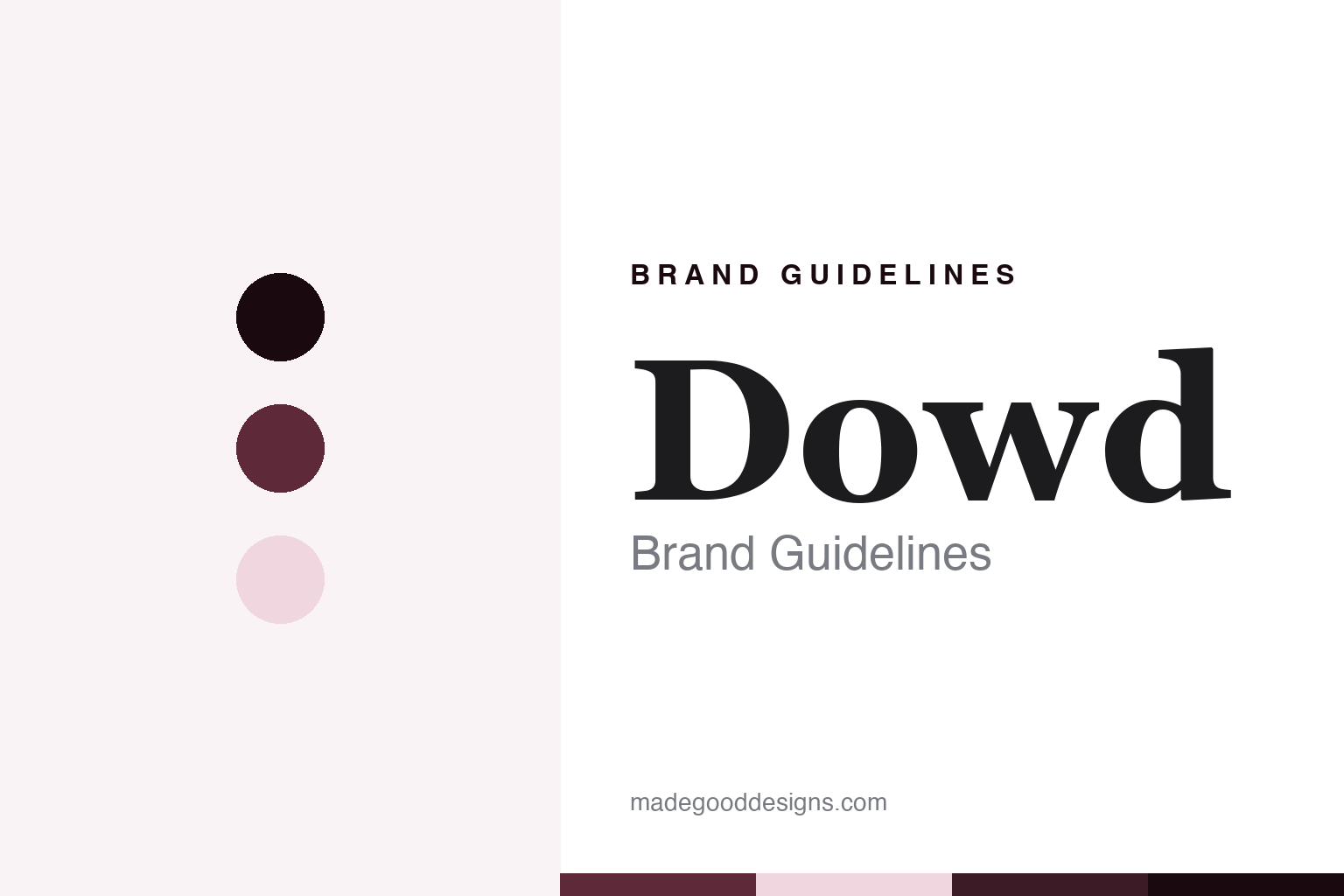
Two constants: a Dowd claret and rose palette and a French-double serif register. Abstract homage — not a Dowd product or mark; no instrument, logo or nameplate is reproduced.
Boston and Paris
William Dowd built French doubles for four decades.
William Richmond Dowd (1922–2008) was born in Newark, New Jersey. In 1949 he founded Hubbard & Dowd in Boston with Frank Hubbard; Harvard Magazine says the two had “independently pursued apprenticeships with disciples of Dolmetsch,” and their first instrument was modelled on the Flemish Ruckers family’s designs. The partnership ended in 1958, and Dowd set up his own workshop in Cambridge, Massachusetts.
There, Wikipedia says, he made “around twenty instruments a year until 1988.” His favoured models were two-manual French harpsichords after the eighteenth-century Parisian makers Blanchet and Taskin, and the players who used his instruments, Wikipedia records, included Gustav Leonhardt, Isolde Ahlgrimm, Ralph Kirkpatrick, Igor Kipnis and Bob van Asperen.
He also worked in France, running a workshop in Paris for well over a decade. With Reinhard von Nagel he ran a Paris branch from about 1971 — sources give 1971 and 1972 — until 1985. We did not establish what happened to that workshop afterwards, so we make no claim about a successor.
Colour
Closed in 1988.
Dowd closed his Massachusetts workshop on 1 September 1988, after nearly four decades of building harpsichords, first with Hubbard and then on his own. The Boston Globe, in its 2008 obituary, said he had made “more than 800 instruments that are now played in 26 countries.” He died in Reston, Virginia, on 25 November 2008.
Under our rule for defunct businesses we say it plainly: William Dowd Harpsichords no longer exists, and we found no company continuing the name. What remains are the instruments and an archive: the Smithsonian’s National Museum of American History holds a Dowd Harpsichord Collection.
The name still means something to players. A Dowd harpsichord is identified by its maker, its model and, often, its owner; the brand lives in the instruments rather than in any trading company.
Typography
The Boston school.
The modern harpsichord was reinvented twice. First in Paris: the Cité de la musique says Wanda Landowska’s name “reste indissolublement lié au clavecin Pleyel (16 pieds), modèle conçu à partir de ses suggestions, inauguré en 1912” — remains inseparably linked to the Pleyel 16-foot harpsichord, built to her suggestions and launched in 1912, to which she stayed faithful throughout her career. Instruments in that style are now called “revival” harpsichords.
Then in Boston. Harvard Magazine records that Frank Hubbard and William Dowd “independently pursued apprenticeships with disciples of Dolmetsch, then founded a harpsichord company in 1949,” and that their serial number one was “modeled on a design by the Flemish Ruckers family.” Wikipedia sums up the difference: they built “on historical principles, rather than the 20th-century modern (now known as ‘revival’) style practised by virtually all professional makers.”
And then came the kit. The New York Times, in its 2018 obituary of Wolfgang Zuckermann, described his “Z-Box” as “a 35-pound box containing a keyboard, strings, plectrums (or pluckers), jacks (plectrum-holders) and tuning pins, but not the wood for the cabinet,” and said “Thousands of people around the world” bought one. Where Zuckermann sold parts, Dowd sold finished instruments to professionals; the two approaches widened the harpsichord’s audience from opposite ends.
Frank Hubbard set out the historical approach at book length in Three Centuries of Harpsichord Making, published by Harvard University Press in 1965; the harpsichordist Ralph Kirkpatrick wrote that Hubbard “unquestionably knows more about the history and construction of harpsichords than anyone alive today.” The Smithsonian’s National Museum of American History holds the records of both Boston pioneers — the Hubbard Harpsichord Records and the Dowd Harpsichord Collection — so the American revival is documented in a national archive.
Wolfgang Zuckermann explained his kit in his 1969 book The Modern Harpsichord: “Realizing that most people approach a harpsichord with caution, the way they do a vicious dog, I decided that the only way they might lose their fear of harpsichord maintenance was to go through the process of building the instrument for themselves.”
Germany’s oldest name in the field, J.C. Neupert, founded in 1868, built harpsichords from the 1900s and still works near Bamberg; its historical collection passed to Nuremberg’s Germanisches Nationalmuseum in the late 1960s. The same museum had acquired the Rück collection, of about 1,500 pieces, in 1962, making Nuremberg one of the great places to study historical keyboards.
In Germany the scale was different. Kurt Wittmayer’s firm in Bavaria made about 440 instruments a year in the 1960s, according to the German Wikipedia, and some 8,430 modern instruments in all before closing in 1995. Across the inner German border, the Ammer workshops in Eisenberg, founded in 1927, built harpsichords with the Leipzig instrument museum from the 1930s, were nationalised in 1972, and continued in family hands, later in the West, until 2017.
The Cité de la musique traces Landowska’s influence forward “aux temps des débuts américains dans la facture de clavecin selon des principes historiques” — to the beginnings of American harpsichord making on historical principles. Harvard, Harvard Magazine reports, owns the partners’ serial number one, the Ruckers-style instrument with which the Boston revival began.
Across the inner German border, the Ammer workshops in Eisenberg, founded in 1927, built harpsichords with the Leipzig instrument museum from the 1930s, were nationalised in 1972, and continued in family hands, later in the West, until 2017. The harpsichord revival, in other words, was international, and Dowd’s Paris branch made him part of its European side as well as its American one.
Aa
A French-double serif — a maker’s name on two manuals. (Specimen set in Fraunces, a serif STAND-IN; NOT the Dowd logo.)
Dowd
A maker’s name on two manuals.
Dowd’s identity was, above all, the instrument itself: a two-manual French double, built to historical models, with his name on the nameplate. He did not need a slogan; the names of his players carried the brand.
For a design guide, Dowd shows a maker’s reputation outliving the business by decades. Compare Hubbard, his former partner, whose firm passed to others, and Wittmayer, a German maker of the same era that also closed.
His clients’ names — Leonhardt, Kirkpatrick, Kipnis — are the closest thing his brand had to an advertising campaign.
For this guide we use a claret and a rose with a serif, an unofficial interpretation. No instrument or mark is reproduced.
Explore & save
Keep William Dowd Harpsichords’s identity on hand — save it to a board in the Made Good inspiration library.
Dowd identity set
Pin the Dowd claret and rose palette and the French-double serif register to your own board.