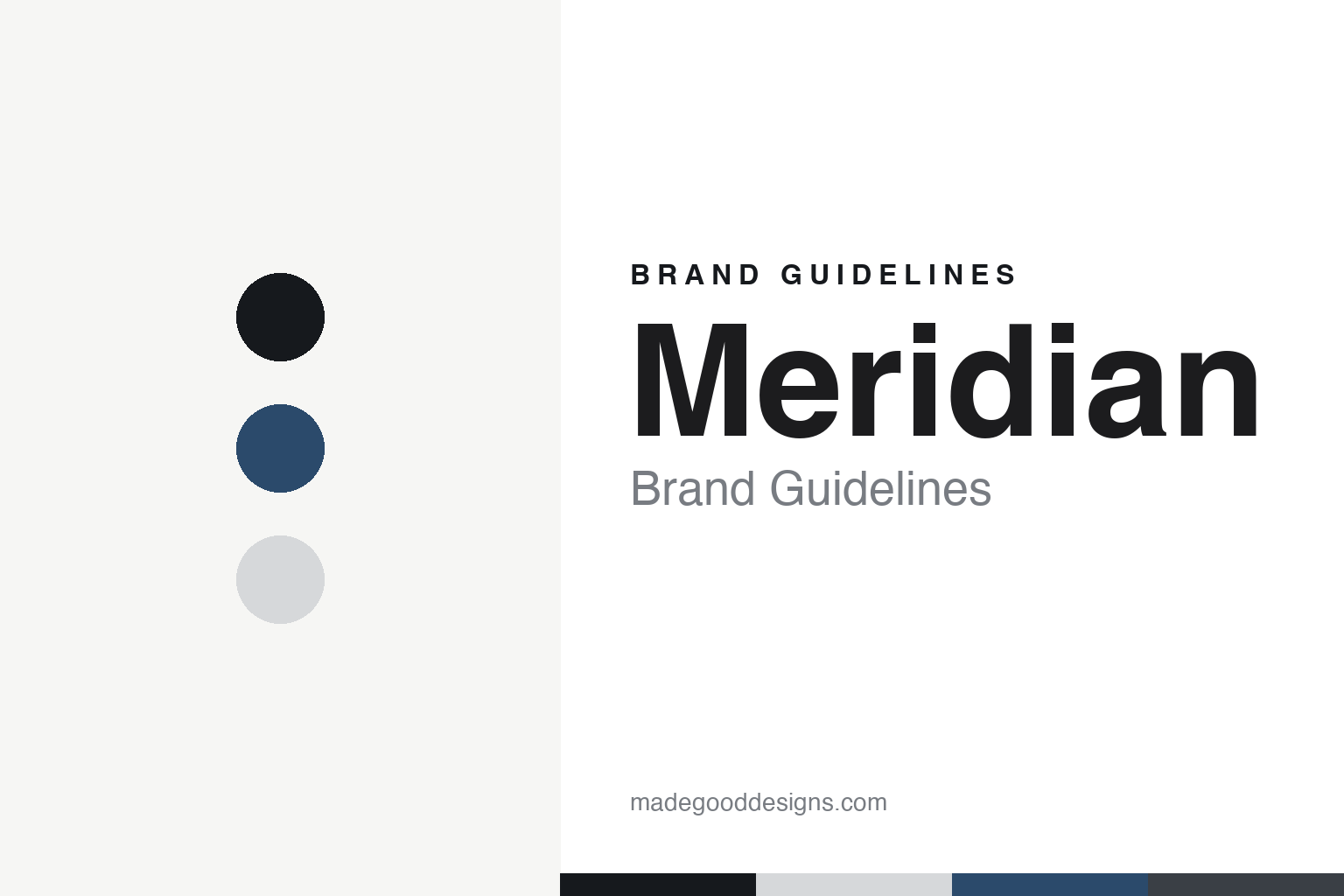
Meridian Brand Guidelines
The Huntingdon maker that put the amplifier inside the loudspeaker.
Aa
Two constants: a Meridian graphite, silver and blue palette and an engineered sans register. Abstract homage — not a Meridian product or mark; no loudspeaker, logo or nameplate is reproduced.
Boothroyd Stuart
An engineer and a designer from Lecson.
Meridian began in 1977 as a partnership between an electronics engineer, Bob Stuart, and an industrial designer, Allen Boothroyd. English Wikipedia says the business first traded as Boothroyd-Stuart and adopted the Meridian name in 1985; the company dates its history to 1977, and its website says it has been “inspiring the future of sound since 1977.” It is based in Huntingdon, Cambridgeshire, where Companies House lists the registered office of Meridian Audio Limited on Latham Road. That legal entity is younger than the brand: it was incorporated in April 1992 under the shelf name Begintarget Limited and took the Meridian Audio name that June.
The founders met earlier, at Lecson. Stuart told StereoNET in 2020 that his first hi-fi job was at Lecson in 1972, where he met Boothroyd; English Wikipedia says the pair designed the Lecson AC1 pre-amplifier and AP1 power amplifier, produced in 1974, which won a British Design Council Award and are now held by the Victoria and Albert Museum and the Museum of Modern Art. Around 1976, Stuart recalled, he put it to Boothroyd: “Rather than consult for all these flaky companies, let’s start a flaky company of our own!”
Boothroyd, who studied industrial design at the Royal College of Art, worked well beyond hi-fi. English Wikipedia credits him with the case design of the BBC Micro computer in 1981, and says that in 1991 he set up his own consultancy, Cambridge Product Design, whose work included loudspeakers for KEF, Celestion and Pioneer and products for Aga. He died in February 2020; Meridian’s website carries a notice headed “In memory of Allen Boothroyd 1943–2020.”
Colour
Active speakers, CD and lossless audio.
Meridian’s first product, by its own account, was the M1 of 1977, which it calls the “world’s first active loudspeaker for the home” — a claim we report rather than test. Stuart described it to StereoNET as “an active three-way.” The 100 Series of modular electronics followed in 1978, the company says; English Wikipedia says the 100 Series brought the founders their second Design Council Award, in 1982, and that a third followed in 1988, making them the first design team to win the award three times.
The company moved early into digital audio. Its MCD CD player is dated 1983 on Meridian’s timeline and 1985 by English Wikipedia, which calls it the first audiophile CD player; Stuart told StereoNET it shipped “just six months after the Philips original,” with a modified oscillator and a new analogue stage. Meridian then took its active loudspeakers into digital processing: it dates the D600, which it calls the first digital active loudspeaker for the home, to 1989, the D6000 to 1991 and its flagship DSP8000 to 2000. The DSP8000 entered the CEDIA Hall of Fame in 2023, the company says.
Its best-known technical legacy is in data. Meridian Lossless Packing, developed under Stuart, became the lossless format for DVD-Audio in 2000 and was later used for Blu-ray through Dolby, hi-fi+ reported in 2020, when the Royal Academy of Engineering gave Stuart its Prince Philip Medal — the first audio engineer to receive it, the magazine said. In 2014 Meridian launched MQA, a format for high-resolution streaming, and Stuart went on to lead MQA Ltd as chairman and chief technology officer. English Wikipedia says MQA Ltd went into administration on 3 April 2023 and that Lenbrook bought its assets on 19 September 2023.
Meridian’s second business is licensing its sound to other companies. Its timeline lists McLaren Automotive from 2007, Land Rover from 2010 and Jaguar from 2011, followed by Kia, Rivian, the Chinese electric-car brands HiPhi and Avatr, Togg of Turkey, LG Electronics, British Airways and United Airlines. Companies House lists “leasing of intellectual property” alongside the manufacture of consumer electronics as the company’s business.
Typography
Design and documentation.
Much of Britain’s hi-fi electronics trade clusters in Cambridgeshire. Quad, founded in London by Peter Walker in 1936, moved to Huntingdon in 1941 after being bombed out during the war, English Wikipedia says. Meridian, founded in 1977 by Bob Stuart and Allen Boothroyd, is based in the town, and Cyrus says its research team has worked from its Huntingdon head office since 1984.
Several old British names now belong to one group. International Audio Group (IAG), a Chinese company based in Shenzhen, says it set up its UK arm in Huntingdon in September 1997 after acquiring Wharfedale, Quad, Leak, Ekco and Castle, then added Audiolab in 2004 and Mission in June 2005. It says its manufacturing is centralised at its own factory in Ji’an, in Jiangxi province.
Scotland’s Linn, founded in Glasgow by Ivor Tiefenbrun — in 1973, by the company’s timeline and the company register, though the opening line of English Wikipedia gives 1972 — says each system is built by hand at its factory at Waterfoot, outside the city.
Today, by their own accounts and the records we checked, Audiolab, Leak and Mission give IAG’s address on Glebe Road in Huntingdon; Cyrus, still based in Huntingdon, says it moved its manufacturing to SMS Electronics in Nottingham in 2019; Meridian, on Latham Road in Huntingdon, says its research, design and engineering have been led from Britain since 1977; and Roksan, founded in 1985, has belonged since November 2016 to Monitor Audio, of Rayleigh in Essex.
This guide sets out what can be checked about each brand — who founded it, who owns it, and what it says about where its products are made — and marks clearly what rests only on the company’s own word.
Aa
An engineered sans — the register of a maker led by an engineer and a designer. (Specimen set in Inter Tight, a sans STAND-IN; NOT the Meridian logo.)
Meridian
Who owns Meridian, and what it says about where it builds.
Ownership is documented mainly through Companies House. Its register shows the Luxembourg investment company Reinet Investments S.C.A. as a person with “significant influence or control” over Meridian Audio Limited from April 2016, when the register began, until 18 December 2023. Since May 2018 it has listed a director, Donald Buchanan, as holding more than half, but less than three-quarters, of the shares and voting rights. We could not find a dated public announcement of either change, and we do not repeat unsourced accounts of earlier sales. Stuart stepped down as a director in September 2017 and Boothroyd in March 2020, according to English Wikipedia; hi-fi+ gives Stuart’s time as chief technology officer as 1977 to 2015.
On manufacturing, the company’s wording is careful. Its “Made in Britain” page says that since 1977 its “research, design and engineering have been led from” Britain, describes the “handcrafted construction” of its architectural loudspeakers “in our Cambridgeshire factory,” and shows an engineering lab at its Cambridgeshire headquarters; it does not say that every product is built there, so neither do we. The current range runs from DSP loudspeakers such as the DSP320.2 up to the DSP8000 XE and DSP9, through the Ellipse wireless speaker of 2024, to custom-installation electronics such as the 218 and 210. Meridian says it has won more than 350 awards, including three Design Council awards, and that its products are held by the V&A and MoMA; English Wikipedia attributes those museum holdings to the founders’ Lecson amplifiers. The company says the DSP9 won a Red Dot award, and in 2026 it exhibited at the HIGH END show in Vienna. The name is a common one, so buyers should make sure they are dealing with Meridian Audio of Huntingdon, at meridian-audio.com.
For a design guide, Meridian shows how an engineer and a designer working as equals can shape a brand for decades, from a sculpted active loudspeaker to sound licensed into cars. Compare Naim, another British maker known for its own electronics, and Linn. For this guide we use graphite, silver and a signal blue with a sans, an unofficial interpretation; no product or logo is reproduced.
Explore & save
Keep Meridian’s identity on hand — save it to a board in the Made Good inspiration library.
Meridian identity set
Pin the Meridian graphite, silver and blue palette and the engineered sans register to your own board.