Roksan Brand Guidelines
The London turntable maker that stood its platter on two plinths.
Aa
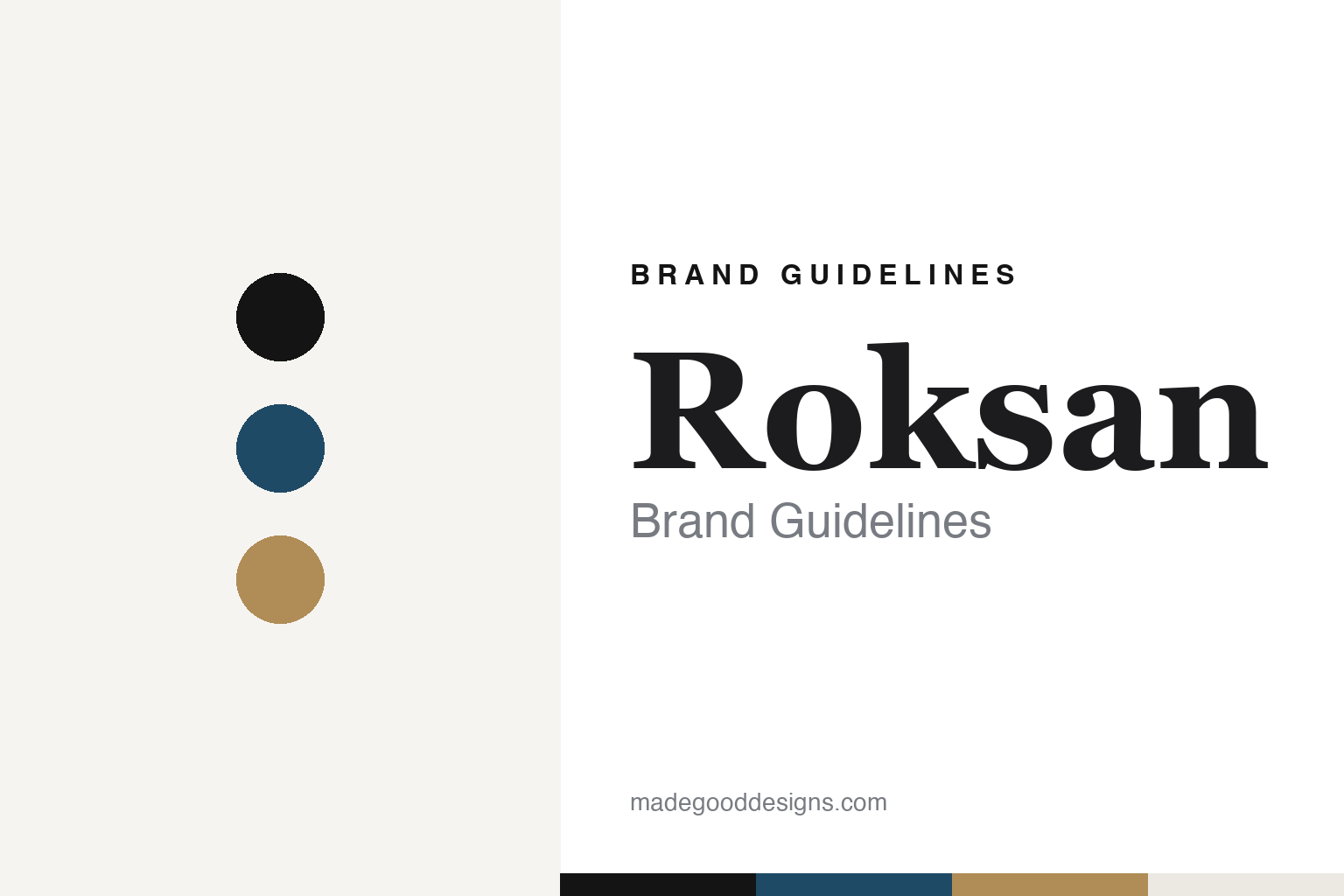
Two constants: a Roksan black, blue and brass palette and a serif register. Abstract homage — not a Roksan product or mark; no turntable, logo or nameplate is reproduced.
Roksan
Two London graduates and a turntable.
Roksan was founded in London in 1985 by Tufan Hashemi and Touraj Moghaddam. Hashemi’s first name appears as “Toufan” in much of the trade press and as “Tufan” at Companies House. English Wikipedia says both men were graduates of the University of London, from Imperial College and Queen Mary College. The company’s first and best-known product, the Xerxes turntable, came in its first year: Roksan says it “was launched the same year the company was founded,” and English Wikipedia says it was unveiled at a hi-fi show alongside a concept for the Darius loudspeaker.
The original company appears at Companies House as Roksan Engineering PLC, incorporated on 18 July 1985 with a registered office on Chalk Farm Road in Camden, north London, and with Moghaddam and Hashemi among its directors. It is listed as in liquidation, with its last accounts filed for the year to March 1991. English Wikipedia gives Roksan’s founding date as 9 August 1985; that day and month match the incorporation, ten years later, of the company that traded as Roksan Audio Limited, so we give the year alone.
Moghaddam designed the Xerxes. Rather than hang the platter and arm on a sprung sub-chassis, as many turntables of the time did, he built it as two plinths separated by small rubber “Blobs,” English Wikipedia says; the name is that of the Persian king Xerxes I. The design was revised as the Xerxes.X for Roksan’s tenth anniversary in 1995, as the Xerxes.20 in 2005 and later as the Xerxes.20plus. English Wikipedia quotes Stereophile’s Art Dudley writing that “the first Roksan Xerxes was so good, and so superior to the pre-Lingo LP12” — the LP12 being the turntable made by Linn. SoundStage! Simplifi reported in 2025 that the Xerxes line had been discontinued.
Colour
Verity, a buy-back and the founders’ parting.
Roksan widened from turntables into electronics and loudspeakers. English Wikipedia lists tonearms such as the Artemiz, Nima and Tabriz, the Shiraz cartridge, the Darius and Ojan loudspeakers, and amplifier ranges including Caspian, Kandy, K2 and K3, Oxygene and blak, and it credits the industrial designer John Cornock, who joined in 1990, with work on the Radius turntable, the K3 range and blak, among others. The first Caspian appeared in 1998, with updates in 2004 and 2010, SoundStage! Simplifi reported. Several model names — Xerxes, Darius, Caspian, Shiraz, Tabriz — echo Persian history and geography.
The company changed hands twice in the 1990s. In 1996 it was bought by Verity plc, the hi-fi group that then owned Mission, Quad and Wharfedale, according to English Wikipedia and hi-fi+. Companies House shows a new board at Roksan Audio Limited from February 1996, and Hashemi and Moghaddam returning as directors in August 1998, when, English Wikipedia says, they bought the company back after Verity demerged. hi-fi+ described the business as “quickly bought back by co-founders.”
The founders later parted. Companies House records Moghaddam’s resignation as a director of Roksan Audio Limited on 15 July 2011; he went on to run Vertere Acoustics, a turntable and cable maker of his own, and What Hi-Fi? has described him as “the man behind Roksan and Vertere.” Hashemi stayed on, and from April 2016 Companies House listed him as holding more than three-quarters of the company’s shares. The blak amplifier, hi-fi+ wrote in 2017, was the last product developed under his direction.
Typography
Design and documentation.
Much of Britain’s hi-fi electronics trade clusters in Cambridgeshire. Quad, founded in London by Peter Walker in 1936, moved to Huntingdon in 1941 after being bombed out during the war, English Wikipedia says. Meridian, founded in 1977 by Bob Stuart and Allen Boothroyd, is based in the town, and Cyrus says its research team has worked from its Huntingdon head office since 1984.
Several old British names now belong to one group. International Audio Group (IAG), a Chinese company based in Shenzhen, says it set up its UK arm in Huntingdon in September 1997 after acquiring Wharfedale, Quad, Leak, Ekco and Castle, then added Audiolab in 2004 and Mission in June 2005. It says its manufacturing is centralised at its own factory in Ji’an, in Jiangxi province.
Scotland’s Linn, founded in Glasgow by Ivor Tiefenbrun — in 1973, by the company’s timeline and the company register, though the opening line of English Wikipedia gives 1972 — says each system is built by hand at its factory at Waterfoot, outside the city.
Today, by their own accounts and the records we checked, Audiolab, Leak and Mission give IAG’s address on Glebe Road in Huntingdon; Cyrus, still based in Huntingdon, says it moved its manufacturing to SMS Electronics in Nottingham in 2019; Meridian, on Latham Road in Huntingdon, says its research, design and engineering have been led from Britain since 1977; and Roksan, founded in 1985, has belonged since November 2016 to Monitor Audio, of Rayleigh in Essex.
This guide sets out what can be checked about each brand — who founded it, who owns it, and what it says about where its products are made — and marks clearly what rests only on the company’s own word.
Aa
A serif register for a maker that named its products after kings, a sea and Persian cities. (Specimen set in Fraunces, a serif STAND-IN; NOT the Roksan logo.)
Roksan
Under Monitor Audio since 2016.
In November 2016 Roksan was sold to Monitor Audio, the loudspeaker maker based in Rayleigh, Essex. Roksan’s own announcement is dated 28 November 2016. The UK trade site AV2Day reported that Hashemi was retiring, that Roksan’s 17 employees were joining Monitor Audio, and that Monitor Audio’s managing director, Andrew Flatt, said: “Roksan had been up for sale for a couple of years, and I indicated two years ago what I was willing to pay for it.” Terms were not disclosed. hi-fi+ wrote in 2017 that it was the first time in 32 years the company had run without its founders. Companies House shows a new Roksan Audio Limited, incorporated in December 2016 at Monitor Audio’s Rayleigh address and owned 75 per cent or more by Monitor Audio Limited; the older company was renamed in January 2017 and dissolved in 2018.
Where Roksan builds has moved with its owner. In 2017 hi-fi+ reported that the range would continue to be built in London. Today Roksan’s website places the brand at “Monitor Audio Group headquarters in Rayleigh, Essex,” and a company post from May 2025 says the Caspian Series 4G amplifiers are “proudly designed and manufactured in Britain, with all operations based at” that site. The company does not say the same of its other current range, the Attessa, so we make no claim for it. The Caspian 4G streaming amplifier, priced at US$5,000, uses the BluOS streaming platform from Lenbrook of Canada, SoundStage! Simplifi noted. The group’s chief executive, Robert Barford, is quoted on the site: “We’re proud to be a fully independent British Audio Group.” The name is easy to confuse — Companies House lists several unrelated businesses called Roksana — and the brand’s own site is roksan.com.
For a design guide, Roksan shows how a founder-led name can carry on inside a larger group, with its Persian model names and its turntable history intact. Compare Monitor Audio, its owner since 2016, and Rega, another British turntable maker. For this guide we use black, a deep Caspian blue and brass with a serif, an unofficial interpretation; no product or logo is reproduced.
Explore & save
Keep Roksan’s identity on hand — save it to a board in the Made Good inspiration library.
Roksan identity set
Pin the Roksan black, blue and brass palette and the serif register to your own board.